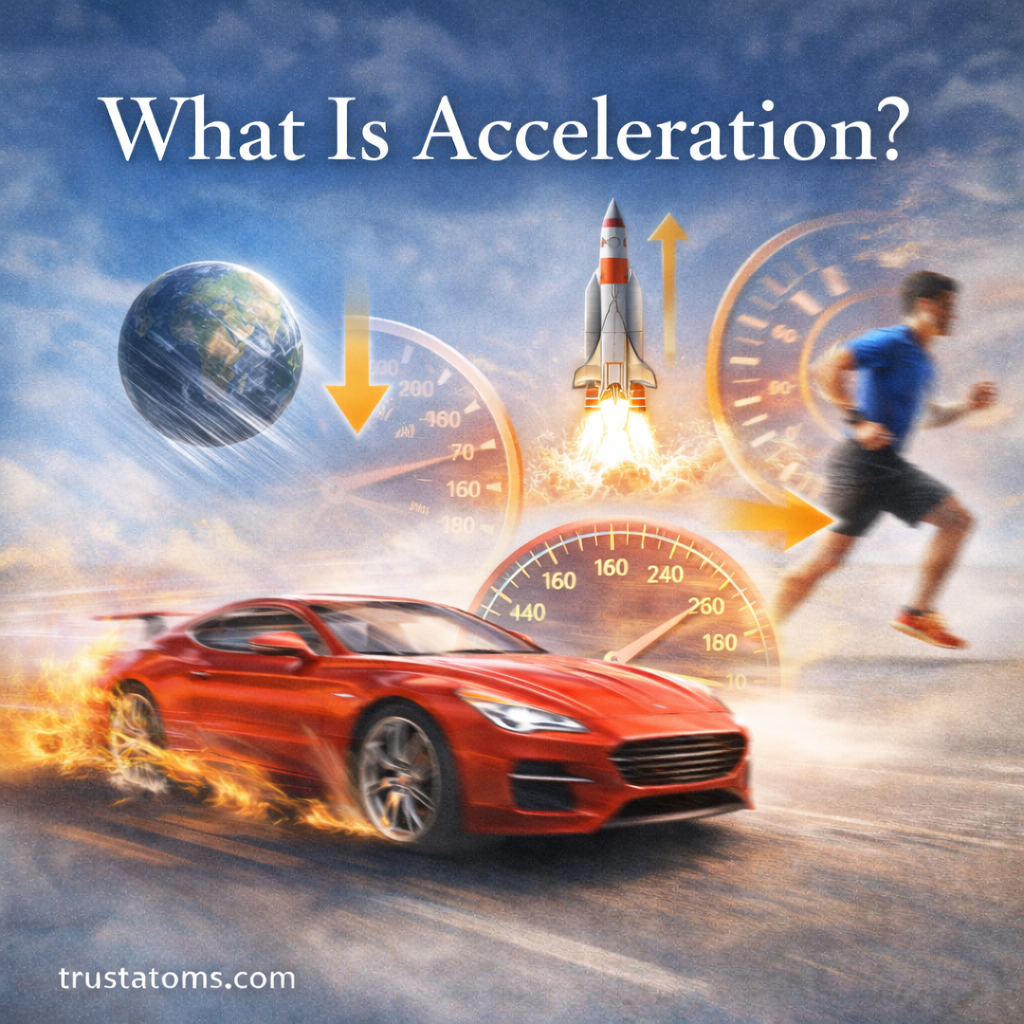
Acceleration is one of the most important concepts in physics. It explains how motion changes over time — whether something speeds up, slows down, or changes direction.
Many people think acceleration only means “speeding up.” In physics, it has a broader and more precise meaning.
In this guide, you’ll learn what acceleration is, how it’s calculated, and how it applies to everyday motion and advanced physics.
Definition of Acceleration
Acceleration is the rate at which velocity changes over time.
Velocity includes:
- Speed
- Direction
If either speed or direction changes, acceleration occurs.
This means acceleration happens when an object:
- Speeds up
- Slows down
- Turns
Acceleration is a vector quantity, meaning it has both magnitude and direction.
The Formula for Acceleration
Acceleration is calculated using the formula:
a = (vf − vi) / t
Where:
- a = acceleration
- vf = final velocity
- vi = initial velocity
- t = time
This formula measures how quickly velocity changes.
Units of Acceleration
In the International System (SI), acceleration is measured in:
meters per second squared (m/s²)
This unit means:
The velocity changes by a certain number of meters per second, every second.
For example:
If acceleration is 5 m/s², the object’s speed increases by 5 meters per second each second.
Types of Acceleration
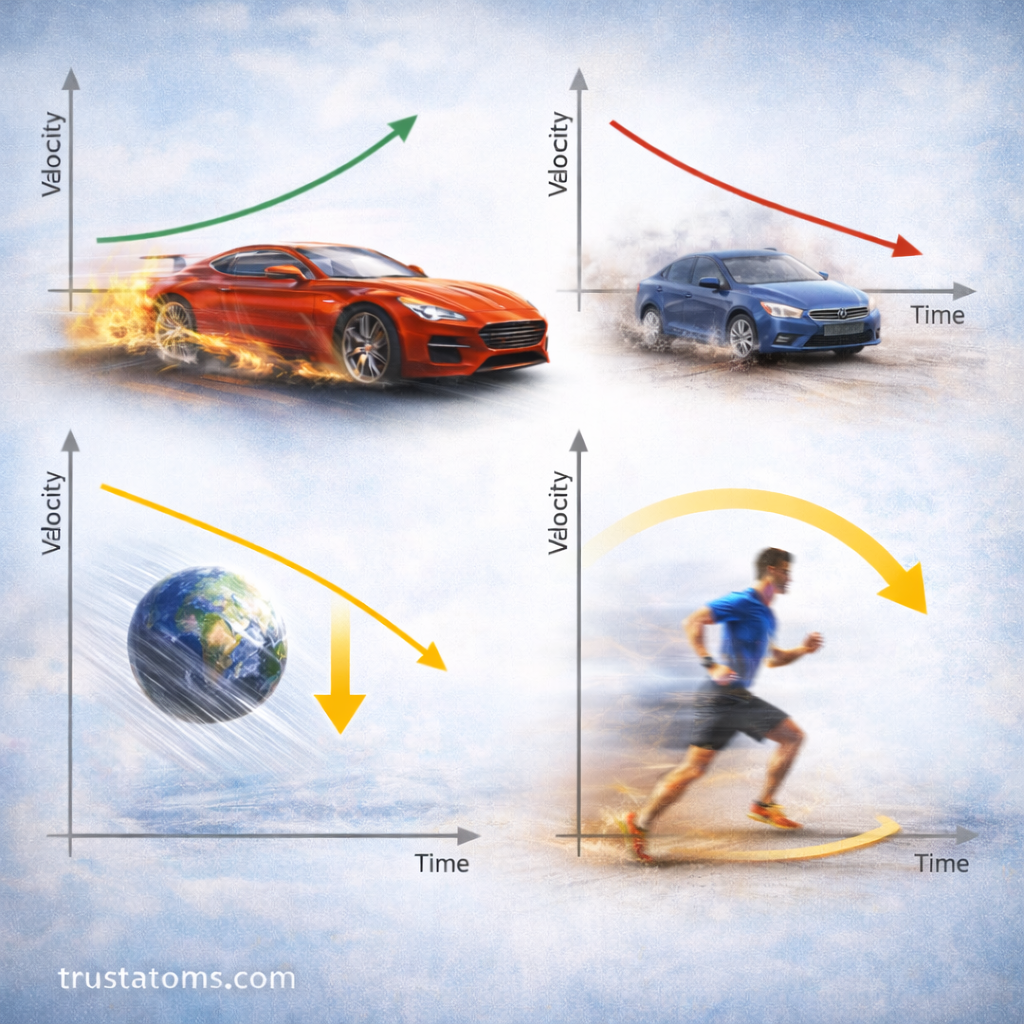
Acceleration can occur in different ways.
Positive Acceleration
Occurs when an object speeds up in its direction of motion.
Example:
- A car pressing the gas pedal
- A runner sprinting
Negative Acceleration (Deceleration)
Occurs when an object slows down.
Example:
- A car braking
- A ball rolling to a stop
Even though we call it “deceleration,” it is still acceleration in physics.
Acceleration Due to Direction Change
An object can accelerate even if its speed stays constant.
Example:
- A car turning a corner
- A satellite orbiting Earth
- A ball moving in a circle
Changing direction changes velocity, which means acceleration is present.
Acceleration and Newton’s Second Law
Acceleration is directly related to force through Newton’s Second Law:
F = ma
Rewriting the formula:
a = F / m
This tells us:
- More force → more acceleration
- More mass → less acceleration
Acceleration depends on the net force acting on an object.
Everyday Examples of Acceleration
Acceleration is happening constantly around you.
1. Driving a Car
- Pressing the gas → acceleration forward
- Pressing the brake → acceleration backward
- Turning the steering wheel → acceleration sideways
2. Falling Objects
Objects accelerate downward due to gravity.
Near Earth’s surface, gravitational acceleration is approximately:
9.8 m/s²
This means velocity increases by 9.8 meters per second every second during free fall (ignoring air resistance).
3. Sports Movements
Athletes constantly accelerate:
- A baseball speeding toward home plate
- A basketball changing direction
- A sprinter launching from starting blocks
4. Roller Coasters
Roller coasters accelerate when:
- Dropping down steep hills
- Climbing upward
- Turning sharply
The feeling of being pushed into your seat is caused by acceleration.
Acceleration vs. Speed
Speed measures how fast something moves.
Acceleration measures how quickly speed (or direction) changes.
An object can:
- Move fast without accelerating (constant speed in a straight line)
- Accelerate even if moving slowly
- Accelerate while slowing down
Speed and acceleration are related but not the same.
Constant vs. Changing Acceleration
Constant Acceleration
Occurs when acceleration remains the same over time.
Example:
- Free fall near Earth (ignoring air resistance)
Changing Acceleration
Occurs when acceleration varies.
Example:
- A car accelerating unevenly
- A rocket burning fuel
- Turbulence in an airplane
Most real-world motion involves changing acceleration.
Why Acceleration Matters
Understanding acceleration helps explain:
- Vehicle safety systems
- Rocket launches
- Engineering design
- Sports mechanics
- Orbital motion
- Structural stress
Acceleration determines how forces affect motion.
Without acceleration, motion would never change.
Common Misconceptions
“Acceleration Means Speeding Up”
Not always.
Slowing down or turning also counts as acceleration.
“If Speed Is Constant, There Is No Acceleration”
Not true.
Changing direction produces acceleration even if speed stays constant.
“Heavier Objects Accelerate Faster”
Not necessarily.
Acceleration depends on the ratio of force to mass (F/m).
Final Thoughts
Acceleration is the rate of change of velocity over time.
It occurs whenever speed or direction changes.
Measured in meters per second squared, acceleration connects force and motion through Newton’s laws.
From driving a car to launching a rocket, acceleration shapes how objects move through space.
Understanding it gives you a clearer view of how the physical world behaves.