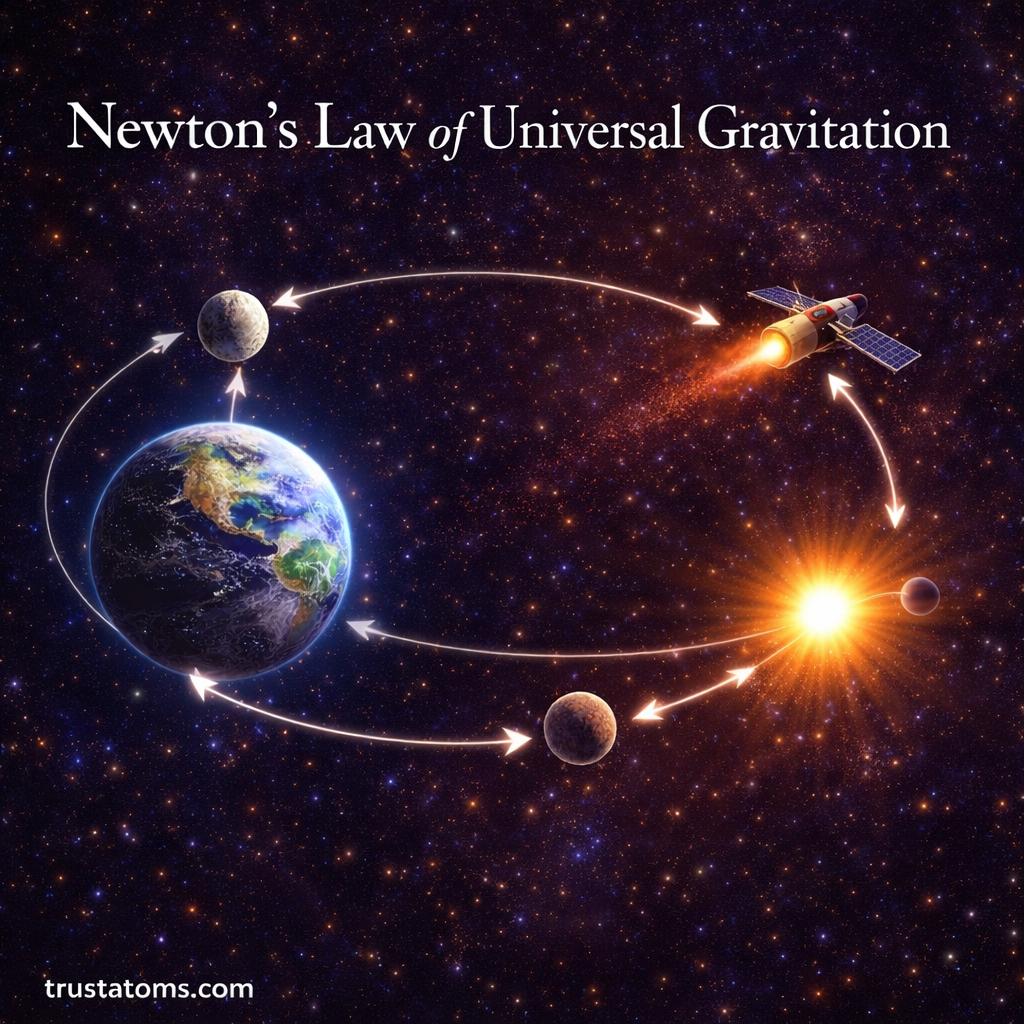
Newton’s Law of Universal Gravitation is one of the most important principles in physics and space science. It explains how every object in the universe attracts every other object through the force of gravity.
From apples falling on Earth to planets orbiting the Sun, this law provides a unified explanation for motion both on Earth and in space.
What Is Newton’s Law of Universal Gravitation?
Proposed by Sir Isaac Newton in the 17th century, this law states that every mass exerts an attractive force on every other mass.
Key idea
- All objects with mass attract each other
- The strength of this force depends on mass and distance
In simple terms, larger objects have stronger gravitational pull, and objects closer together experience stronger attraction.
How Gravity Works Between Objects
Gravity acts instantly over distance and affects everything with mass.
Two main factors influence gravitational force
- Mass
- Greater mass = stronger gravitational pull
- Example: Earth pulls objects more strongly than the Moon
- Distance
- Greater distance = weaker gravitational force
- Gravity decreases rapidly as objects move farther apart
Understanding the Relationship
Newton discovered that gravitational force follows a predictable pattern:
- It increases as mass increases
- It decreases as distance increases
This relationship allows scientists to calculate gravitational interactions between planets, stars, and other celestial bodies.
Why the Law Is Called “Universal”
Newton’s law is considered universal because it applies everywhere:
- On Earth
- In the solar system
- Across galaxies
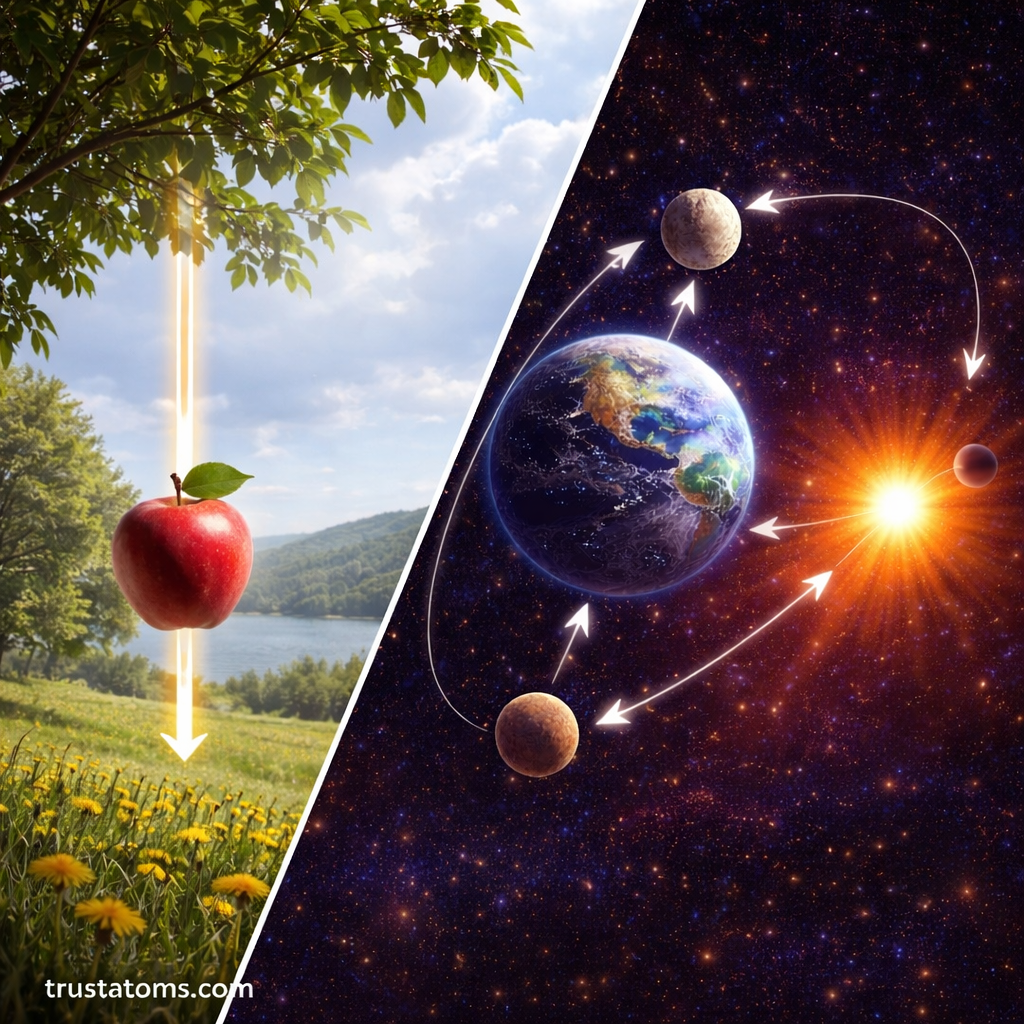
The same principle that causes an apple to fall also keeps the Moon in orbit around Earth and planets orbiting the Sun.
Gravity and Orbital Motion
Newton’s law explains why objects stay in orbit instead of flying off into space.
How it works
- Gravity pulls objects inward
- Forward motion keeps them moving
- The combination creates an orbit
Without gravity, planets and satellites would travel in straight lines instead of curved paths.
Real-World Examples
Newton’s Law of Universal Gravitation can be observed in many everyday and cosmic situations.
Examples on Earth
- Objects falling to the ground
- Ocean tides caused by the Moon’s gravity
- Weight of objects depending on gravitational pull
Examples in space
- Planets orbiting the Sun
- Moons orbiting planets
- Satellites staying in orbit around Earth
Applications in Science and Technology
This law is essential for many modern technologies and scientific advancements.
Key applications
- Calculating satellite orbits
- Planning space missions
- Predicting planetary motion
- Understanding black holes and galaxies
- Modeling gravitational interactions in the universe
Limitations of Newton’s Law
While extremely accurate in many situations, Newton’s law has limitations.
Where it falls short
- At extremely high speeds
- In very strong gravitational fields
- At very small (quantum) scales
In these cases, Einstein’s theory of relativity provides a more accurate description of gravity.
Newton vs. Modern Physics
Newton’s law remains widely used because of its simplicity and accuracy in most situations. However, modern physics has expanded on his ideas.
Key differences
- Newton: Gravity as a force between masses
- Einstein: Gravity as the curvature of space-time
Both models are useful, depending on the level of precision needed.
Why This Law Matters
Newton’s Law of Universal Gravitation changed how we understand the universe. It connected motion on Earth with motion in space, showing that the same physical laws apply everywhere.
What we gain from this law
- Predictable models of motion
- Better understanding of planetary systems
- Ability to explore and navigate space
Final Thoughts
Newton’s Law of Universal Gravitation remains a cornerstone of science. It explains how objects interact through gravity and provides the foundation for understanding motion across the universe.
Even centuries later, this law continues to guide scientific discovery, engineering, and space exploration.