What is everything made of?
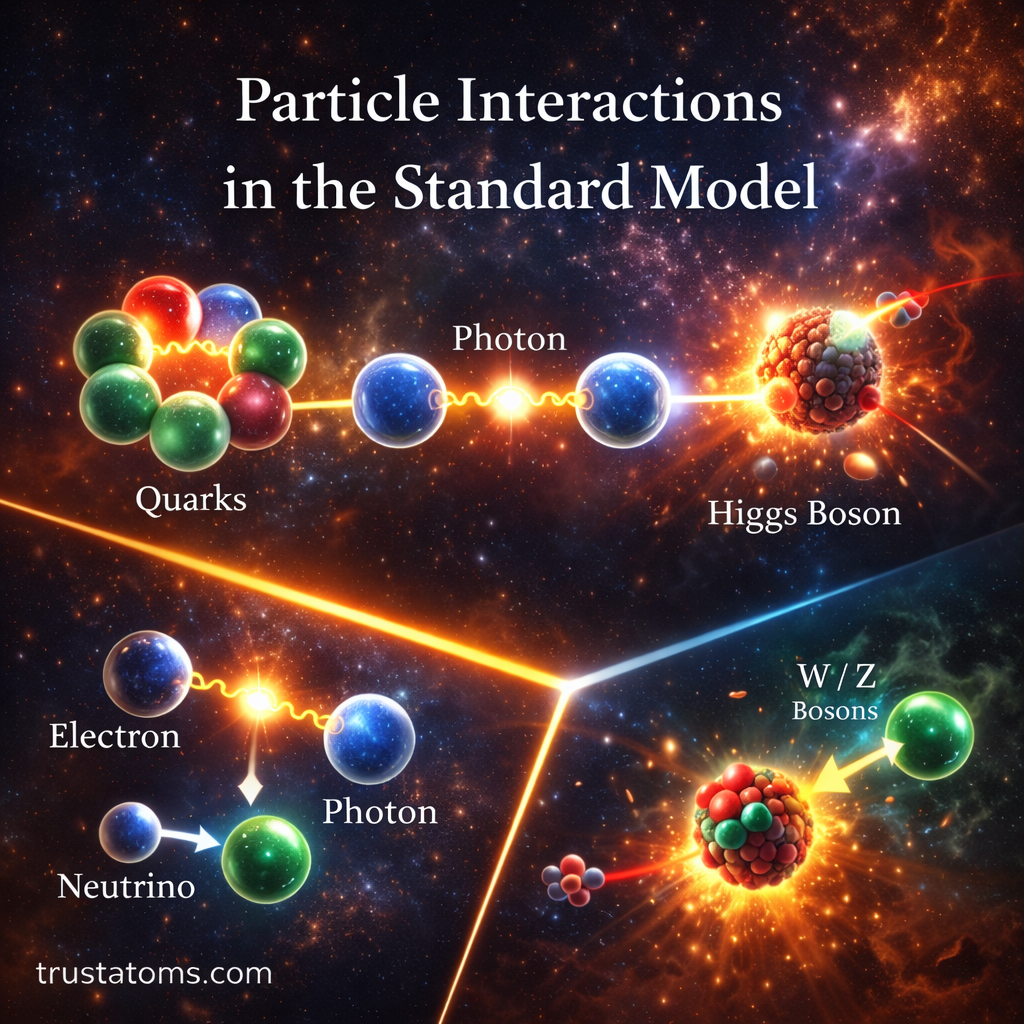
Modern physics answers this question through the Standard Model — the most successful theory ever developed to describe fundamental particles and their interactions.
The Standard Model explains:
- What matter is made of
- How particles interact
- Which forces govern the universe at small scales
In this guide, we’ll explore particle interactions in the Standard Model, how forces are transmitted, and why this framework remains central to modern physics.
What Is the Standard Model?
The Standard Model is a theoretical framework that describes:
- Elementary particles
- Three of the four fundamental forces
- How those particles interact
It includes:
- Matter particles (fermions)
- Force-carrying particles (bosons)
- The Higgs boson
It does not include gravity, which remains outside the Standard Model.
The Building Blocks of Matter: Fermions
Fermions are the particles that make up matter.
They are divided into two categories:
1. Quarks
Quarks combine to form:
- Protons
- Neutrons
- Other hadrons
There are six types (flavors):
- Up
- Down
- Charm
- Strange
- Top
- Bottom
Protons and neutrons are made of up and down quarks.
2. Leptons
Leptons include:
- Electron
- Muon
- Tau
- Three types of neutrinos
Electrons orbit atomic nuclei and enable chemistry.
Neutrinos barely interact with matter but are incredibly abundant in the universe.
Force-Carrying Particles: Gauge Bosons
Interactions between particles occur through force carriers called gauge bosons.
The Standard Model includes three fundamental forces:
1. Electromagnetic Force
Carrier: Photon
Responsible for:
- Electricity
- Magnetism
- Light
- Chemical bonding
The photon mediates interactions between charged particles.
2. Strong Nuclear Force
Carrier: Gluon
Responsible for:
- Holding quarks together
- Binding protons and neutrons inside nuclei
The strong force is extremely powerful but acts only at very short distances.
It explains why atomic nuclei remain stable despite proton repulsion.
3. Weak Nuclear Force
Carriers: W and Z bosons
Responsible for:
- Radioactive decay
- Neutrino interactions
- Processes inside the Sun
The weak force changes one type of particle into another, enabling nuclear reactions that power stars.
The Higgs Boson and Mass
The Higgs boson is associated with the Higgs field.
The Higgs field:
- Fills all of space
- Interacts with certain particles
- Gives them mass
Without the Higgs mechanism:
- Fundamental particles would be massless
- Atoms could not form
- Matter as we know it would not exist
The Higgs boson was discovered in 2012 at CERN, confirming a key prediction of the Standard Model.
How Particle Interactions Work
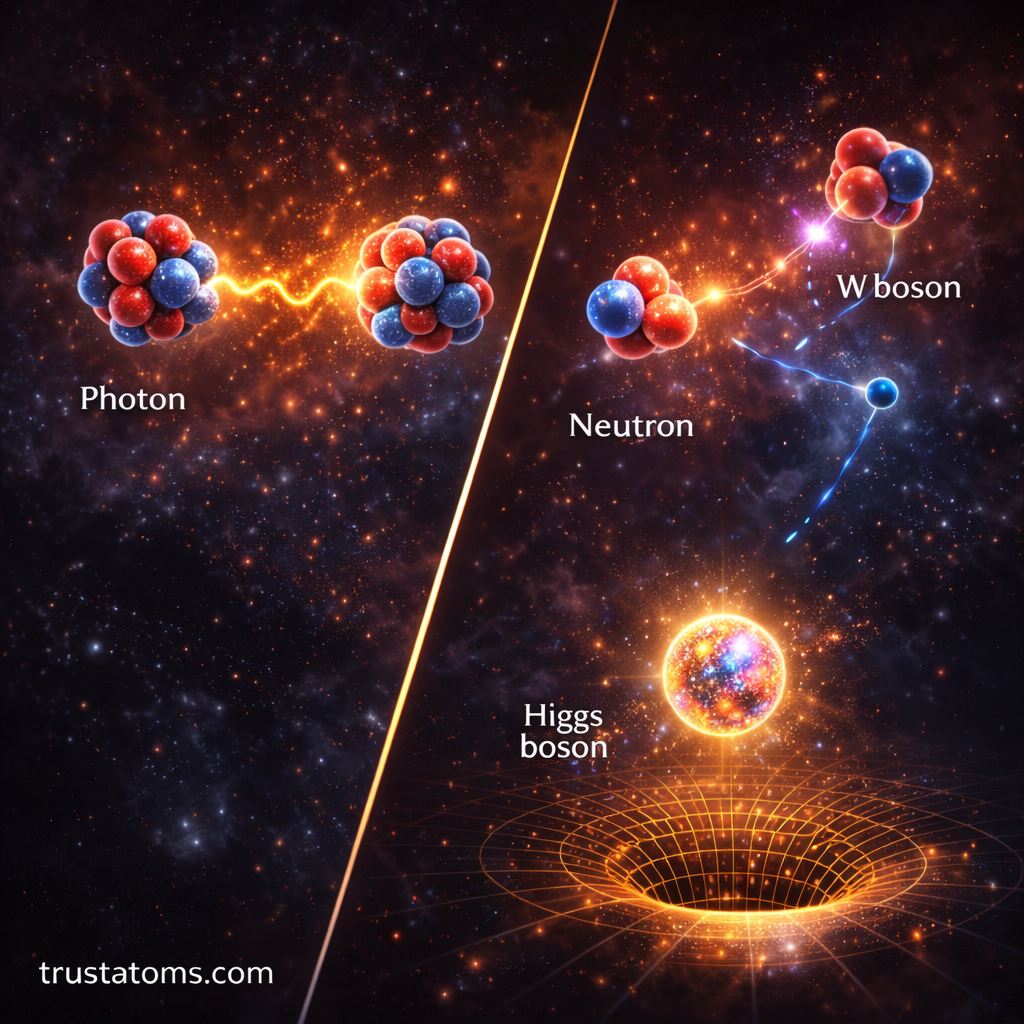
Particle interactions are described through quantum field theory.
Instead of particles physically “touching,” interactions occur when:
- One particle emits a force carrier.
- Another particle absorbs it.
- Momentum and energy are transferred.
For example:
- Two electrons repel each other by exchanging photons.
- Quarks exchange gluons to remain bound.
- A neutron decays when it emits a W boson.
These exchanges are represented using Feynman diagrams, which visualize particle interactions.
Conservation Laws in Interactions
Every interaction must obey strict conservation rules:
- Conservation of energy
- Conservation of momentum
- Conservation of electric charge
- Conservation of lepton and baryon numbers
These conservation laws ensure consistency in particle processes.
No interaction violates these fundamental principles.
The Role of Symmetry
The Standard Model is built on mathematical symmetry principles.
Symmetry determines:
- Which forces exist
- How particles interact
- Why certain particles behave similarly
These symmetries are called gauge symmetries.
They are the mathematical foundation of the three forces described in the model.
What the Standard Model Does Not Explain
Despite its success, the Standard Model is incomplete.
It does not include:
- Gravity
- Dark matter
- Dark energy
- The matter–antimatter imbalance of the universe
Physicists are searching for new physics beyond the Standard Model to answer these open questions.
Experimental Confirmation
The Standard Model has been tested repeatedly in high-energy experiments.
Particle accelerators:
- Smash particles together
- Create short-lived particles
- Confirm predicted interaction patterns
Precision measurements consistently match theoretical predictions with extraordinary accuracy.
This is why the Standard Model remains one of the most validated theories in science.
Why Particle Interactions Matter
Understanding particle interactions explains:
- Why atoms form
- Why nuclei remain stable
- How stars produce energy
- How radioactive decay works
- How matter behaves at the smallest scales
Without these interactions:
- No chemistry
- No biology
- No structure in the universe
Everything we observe depends on particle interactions governed by these fundamental forces.
Final Takeaways
- The Standard Model describes fundamental particles and three fundamental forces.
- Fermions make up matter.
- Gauge bosons transmit forces.
- The Higgs field gives particles mass.
- Particle interactions occur through force carrier exchange.
- Conservation laws govern all interactions.
The Standard Model represents humanity’s deepest understanding of the microscopic universe — a framework explaining how the smallest building blocks interact to create everything around us.