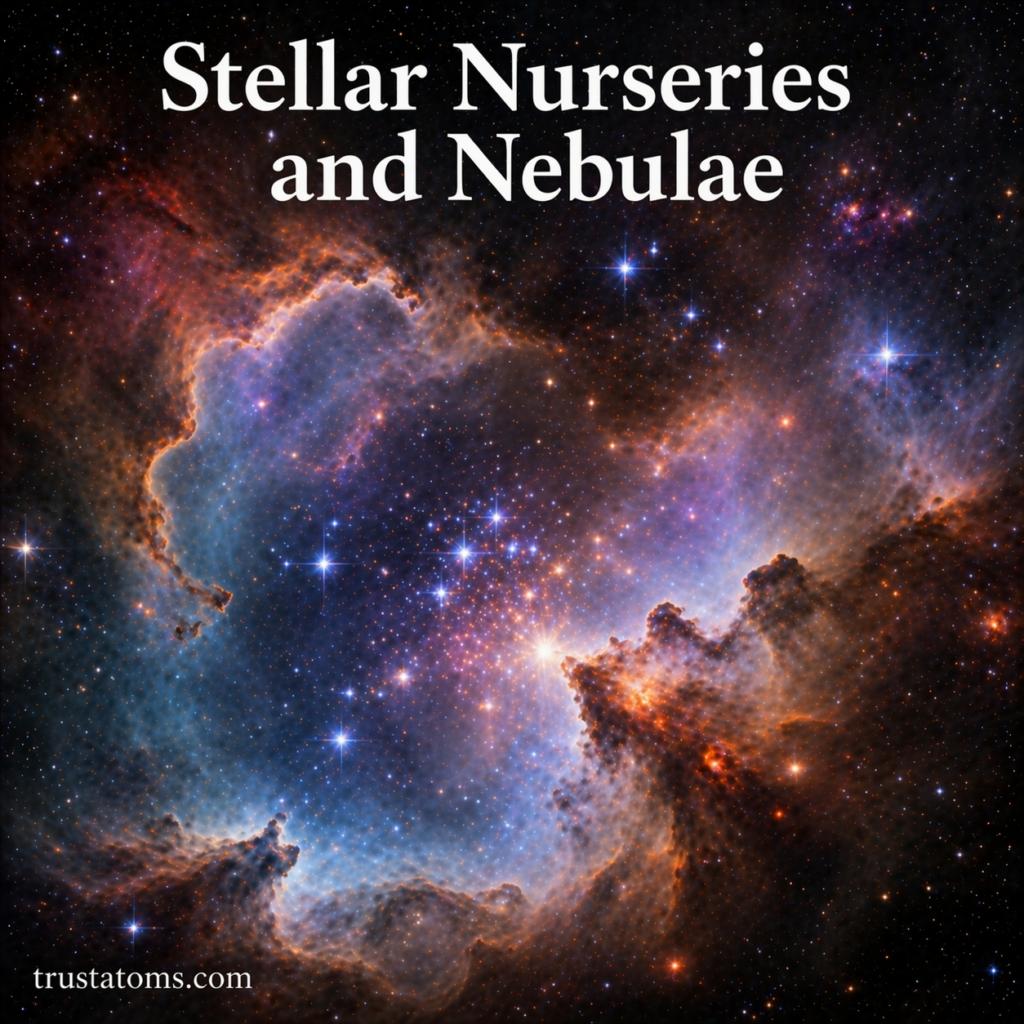
Stellar nurseries and nebulae are some of the most beautiful and important regions in the universe. These vast clouds of gas and dust are where stars are born, making them essential to understanding how galaxies evolve over time.
From glowing clouds illuminated by nearby stars to dense regions where new stars are forming, nebulae are the starting point of the stellar life cycle.
What Is a Nebula?
A nebula is a large cloud of gas and dust in space. The word “nebula” comes from the Latin word for “cloud,” which accurately describes their appearance.
Key characteristics
- Composed mainly of hydrogen and helium
- Can span hundreds of light-years
- Visible due to light emission or reflection
- Found throughout galaxies
Nebulae can appear in a variety of colors depending on their composition and how they interact with light.
What Is a Stellar Nursery?
A stellar nursery is a type of nebula where new stars are actively forming.
What makes it different
- Contains dense regions of gas and dust
- Gravity causes material to collapse
- New stars (protostars) begin to form
These regions are often hidden by dust, making them difficult to observe in visible light. Scientists use infrared and radio telescopes to study them.
How Stars Form in Nebulae
Star formation is a gradual process that takes place within stellar nurseries.
Step-by-step process
- A region of gas and dust becomes dense
- Gravity pulls material inward
- The region collapses and heats up
- A protostar forms
- Nuclear fusion begins → a new star is born
This process can take millions of years.
Types of Nebulae
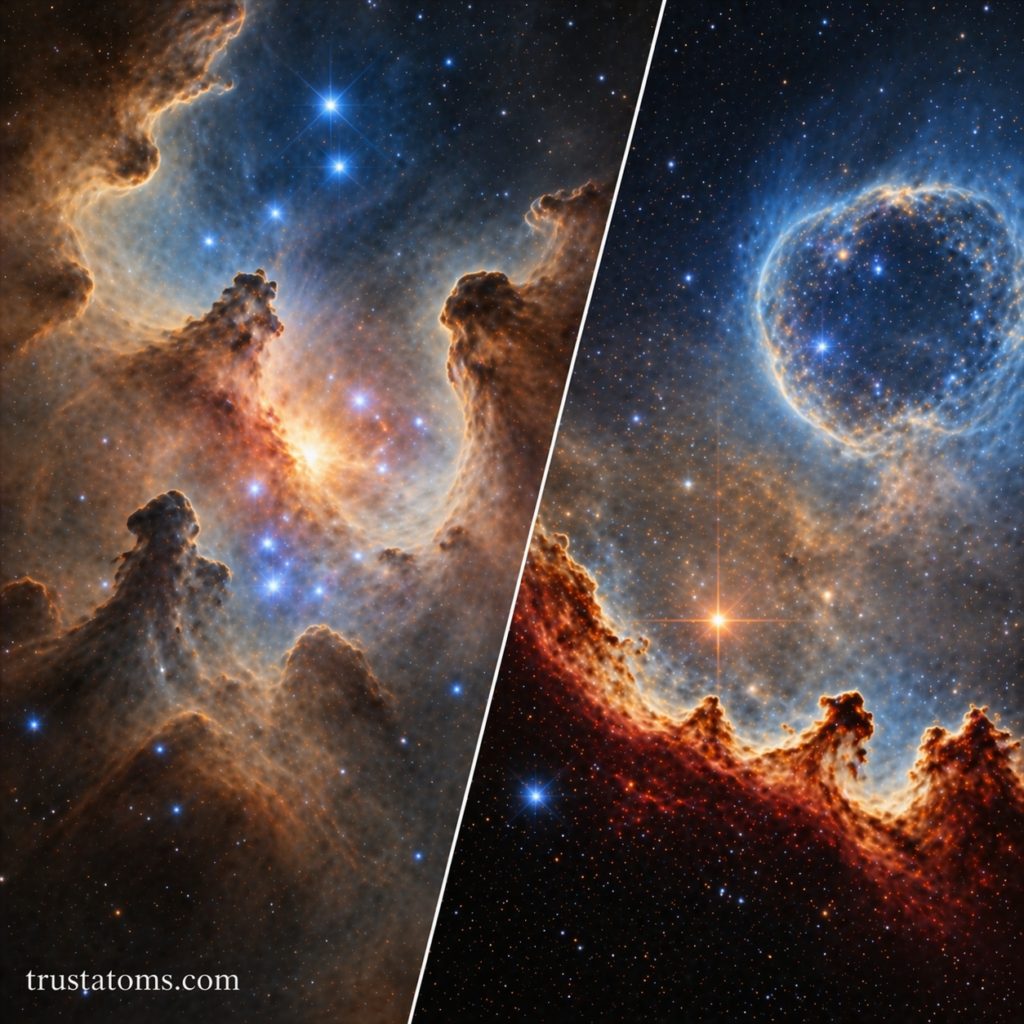
Not all nebulae form stars. There are several different types, each with unique characteristics.
Emission Nebulae
- Glow brightly due to ionized gas
- Energized by nearby hot stars
- Often appear red or pink
Reflection Nebulae
- Do not emit their own light
- Reflect light from nearby stars
- Often appear blue
Dark Nebulae
- Dense clouds that block light
- Appear as dark patches against bright backgrounds
- Often contain star-forming regions
Planetary Nebulae
- Formed when dying stars shed outer layers
- Create glowing shells of gas
- Not involved in star formation
Famous Stellar Nurseries
Some nebulae are well-known for their active star formation.
Examples
- Orion Nebula
- Eagle Nebula (Pillars of Creation)
- Carina Nebula
These regions provide astronomers with valuable insight into how stars are born.
Why Nebulae Are Important
Nebulae play a key role in the life cycle of stars and galaxies.
Their importance
- Birthplaces of new stars
- Supply material for planetary systems
- Help recycle matter in the universe
- Influence the structure of galaxies
Without nebulae, new stars—and the systems around them—would not exist.
The Cycle of Matter in the Universe
Nebulae are part of a continuous cosmic cycle.
The cycle
- Stars form in nebulae
- Stars evolve and eventually die
- Material is expelled into space
- New nebulae form
- The cycle repeats
This process ensures that elements are reused and redistributed throughout the universe.
Key Takeaways
- Nebulae are massive clouds of gas and dust in space
- Stellar nurseries are nebulae where stars are forming
- Gravity drives the formation of new stars
- Different types of nebulae serve different roles
- They are essential to the ongoing cycle of matter in the universe
Final Thoughts
Stellar nurseries and nebulae are where the story of stars begins. These vast, dynamic regions not only create new stars but also connect different stages of the cosmic life cycle.
By studying nebulae, astronomers can better understand how stars, planets, and even galaxies come into existence—offering a deeper view into the origins of the universe itself.