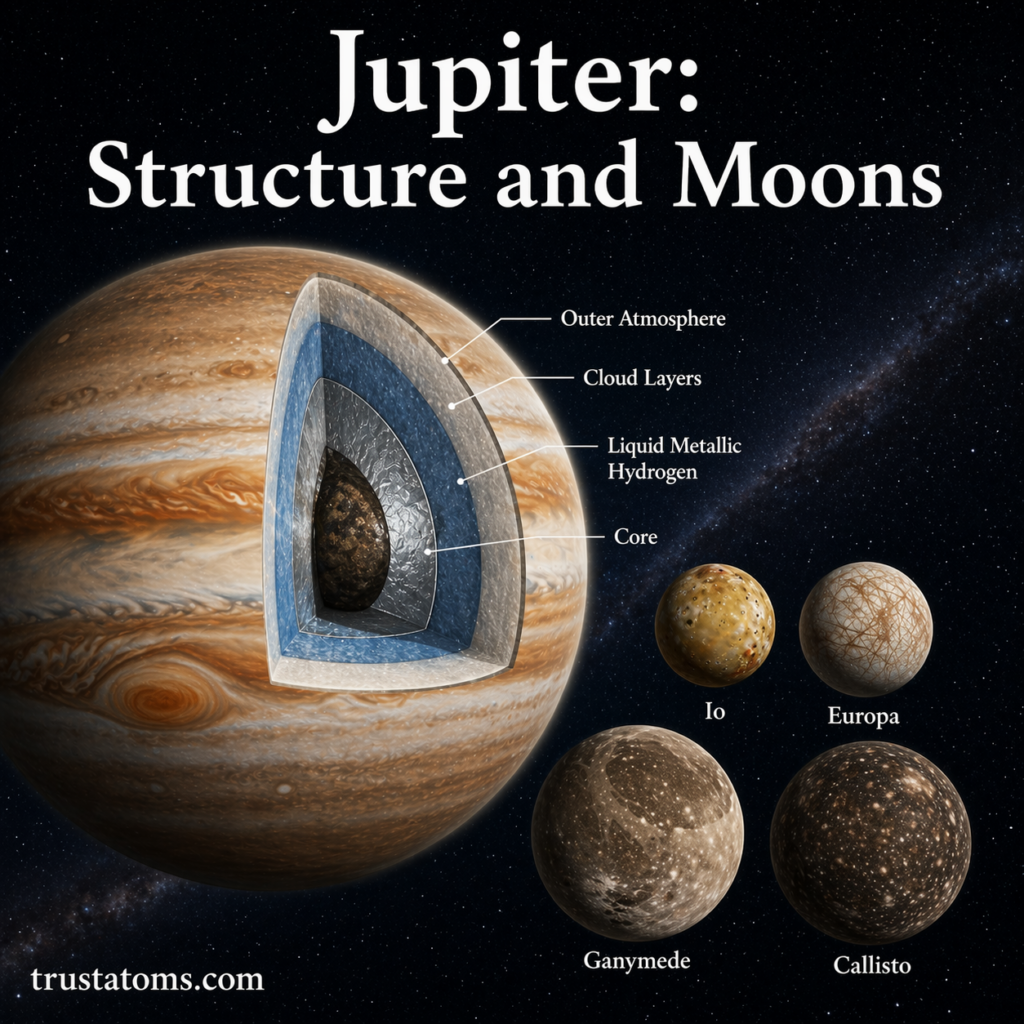
Jupiter is the largest planet in our Solar System and a fascinating world of swirling storms, powerful gravity, and dozens of moons. Known as a gas giant, Jupiter plays a major role in shaping the Solar System’s structure and protecting inner planets like Earth from cosmic debris.
This guide explores Jupiter’s internal structure and its diverse system of moons, offering a clear understanding of why this planet is so unique.
Overview of Jupiter
Jupiter is the fifth planet from the Sun and is more massive than all other planets combined.
Key facts about Jupiter:
- Diameter: About 11 times wider than Earth
- Composition: Mostly hydrogen and helium
- Day length: About 10 hours (very fast rotation)
- Year length: About 12 Earth years
Its immense size and gravity make it a dominant force in the Solar System.
Jupiter’s Structure
Unlike Earth, Jupiter does not have a solid surface. Instead, it is made up of layers of gas and liquid that become denser toward the center.
1. Outer Atmosphere
Jupiter’s atmosphere is the most visible feature, known for its colorful bands and massive storms.
- Composed mainly of hydrogen and helium
- Features alternating light and dark cloud bands
- Contains powerful jet streams and winds exceeding 300 mph
The Great Red Spot
One of Jupiter’s most famous features is the Great Red Spot.
- A विशाल storm larger than Earth
- Has been active for over 300 years
- Rotates counterclockwise
2. Cloud Layers
Beneath the visible atmosphere are multiple cloud layers made of different compounds:
- Ammonia ice clouds (upper layer)
- Ammonium hydrosulfide clouds (middle layer)
- Water clouds (deeper layer)
These layers contribute to Jupiter’s banded appearance.
3. Liquid Metallic Hydrogen Layer
Deeper inside Jupiter, extreme pressure transforms hydrogen gas into a liquid metallic state.
- Conducts electricity
- Generates Jupiter’s powerful magnetic field
- Plays a key role in the planet’s internal dynamics
4. Core
At the center of Jupiter is a dense core, though its exact composition is still debated.
- Likely made of rock and metal
- Extremely hot and under immense pressure
- May be partially dissolved into surrounding layers
Jupiter’s Magnetic Field
Jupiter has the strongest magnetic field of any planet in the Solar System.
Why it matters:
- Traps charged particles, creating intense radiation belts
- Extends millions of kilometers into space
- Influences nearby moons and space environment
This magnetic field is generated by the movement of liquid metallic hydrogen inside the planet.
Jupiter’s Ring System
Although less visible than Saturn’s, Jupiter also has a faint ring system.
- Made mostly of dust particles
- Likely formed from debris ejected by small moons
- Difficult to see without specialized instruments
Jupiter’s Moons
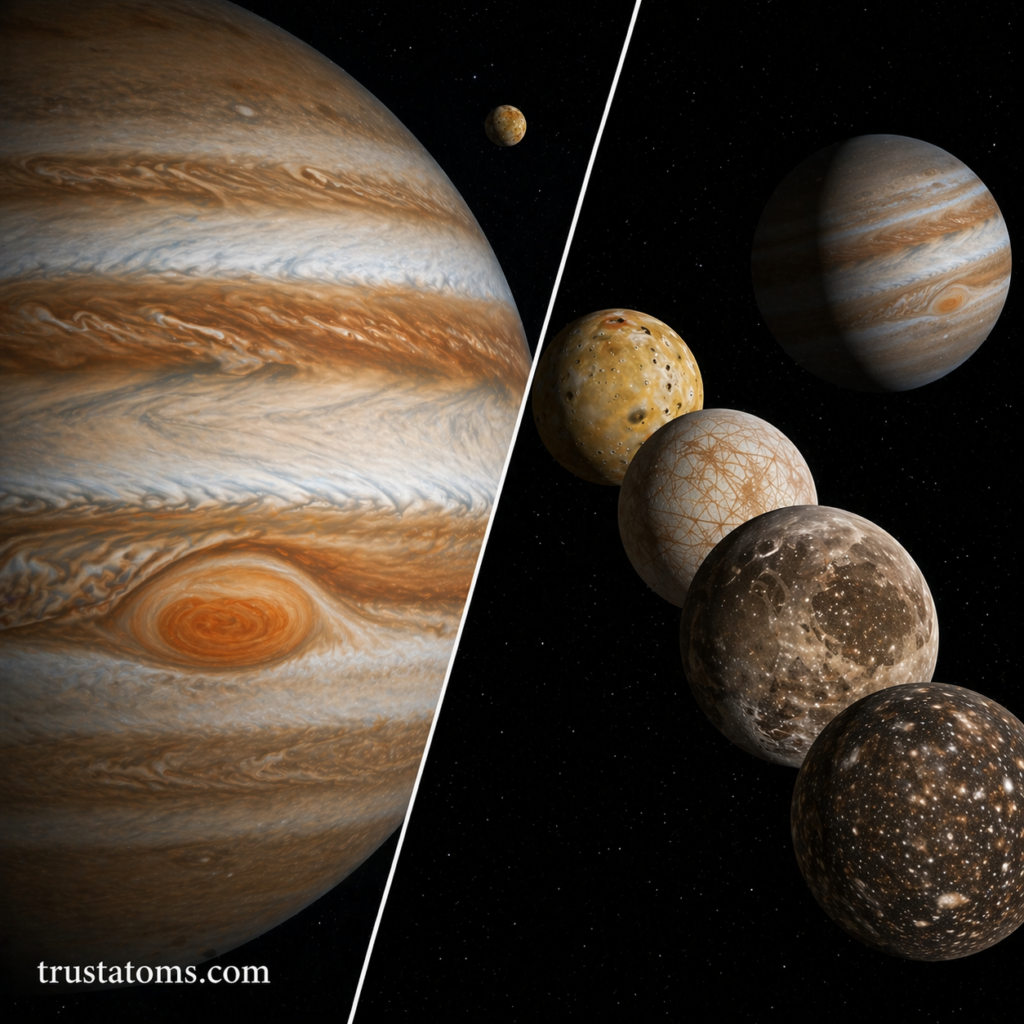
Jupiter has over 90 known moons, making it a miniature planetary system.
The Galilean Moons
The four largest moons were discovered by Galileo Galilei in 1610 and are known as the Galilean moons.
1. Io
Io is the most volcanically active body in the Solar System.
- Covered in active volcanoes
- Surface constantly reshaped by eruptions
- Heated by gravitational interactions with Jupiter
2. Europa
Europa is one of the most promising places to search for life beyond Earth.
- Covered by a thick layer of ice
- Likely has a subsurface ocean
- Smooth surface with cracks and ridges
3. Ganymede
Ganymede is the largest moon in the Solar System.
- Bigger than the planet Mercury
- Has its own magnetic field
- Features a mix of icy and rocky terrain
4. Callisto
Callisto is heavily cratered and one of the oldest surfaces in the Solar System.
- Covered in impact craters
- Minimal geological activity
- May have a subsurface ocean
Other Moons
Beyond the Galilean moons, Jupiter has many smaller moons with diverse characteristics.
- Some are irregularly shaped
- Many have eccentric orbits
- Likely captured asteroids or fragments from collisions
Why Jupiter Matters
Jupiter’s influence extends far beyond its own system.
Key roles in the Solar System:
- Acts as a gravitational shield, deflecting comets and asteroids
- Helps stabilize planetary orbits
- Provides insight into gas giant formation
Studying Jupiter helps scientists understand both our Solar System and distant planetary systems.
Final Thoughts
Jupiter is more than just the largest planet—it is a dynamic and complex world with a powerful structure and a fascinating collection of moons.
From its turbulent atmosphere to its potentially life-supporting moons, Jupiter continues to be a major focus of scientific exploration. As research advances, this giant planet may hold answers to some of the biggest questions about planetary formation and life beyond Earth.