When we look at the night sky, some stars appear brighter than others. But what we see from Earth doesn’t always reflect a star’s true power. To understand how bright stars really are, astronomers use two key concepts: luminosity and stellar magnitude.
These measurements help scientists compare stars, determine distances, and better understand how stars evolve over time.
What Is Luminosity?
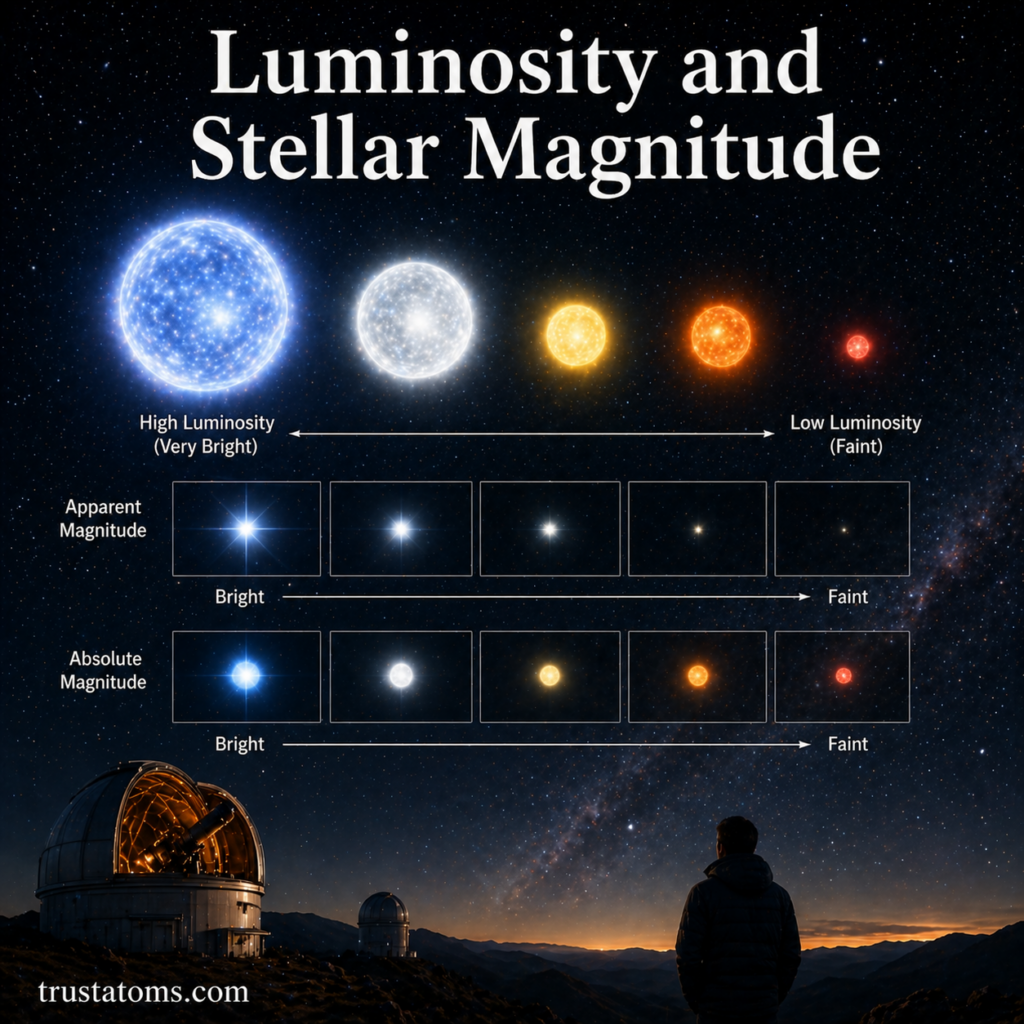
Luminosity is the total amount of energy a star emits per second. It represents the star’s true brightness, independent of how far away it is.
Key Points About Luminosity
- It measures intrinsic brightness
- It depends on a star’s size and temperature
- It is often compared to the Sun’s luminosity
For example:
- A star with 10 times the Sun’s luminosity emits 10 times more energy
- Larger and hotter stars tend to be more luminous
Luminosity gives us a clear picture of how powerful a star actually is.
What Is Stellar Magnitude?
Stellar magnitude describes how bright a star appears from Earth.
There are two main types:
Apparent Magnitude
- Measures how bright a star looks from Earth
- Affected by distance and interstellar dust
- Lower numbers mean brighter objects
Examples:
- Very bright stars: negative or low values
- Fainter stars: higher positive values
Absolute Magnitude
- Measures a star’s brightness at a standard distance of 10 parsecs (about 32.6 light-years)
- Allows direct comparison between stars
- Reflects true brightness, similar to luminosity
The Magnitude Scale Explained
The magnitude scale can seem counterintuitive at first.
How It Works
- A difference of 1 magnitude equals about 2.5 times difference in brightness
- A difference of 5 magnitudes equals exactly 100 times difference
This means:
- A star with magnitude 1 is much brighter than a star with magnitude 6
- Lower (or negative) values indicate greater brightness
This logarithmic scale helps astronomers handle the wide range of brightness in the universe.
Luminosity vs. Magnitude
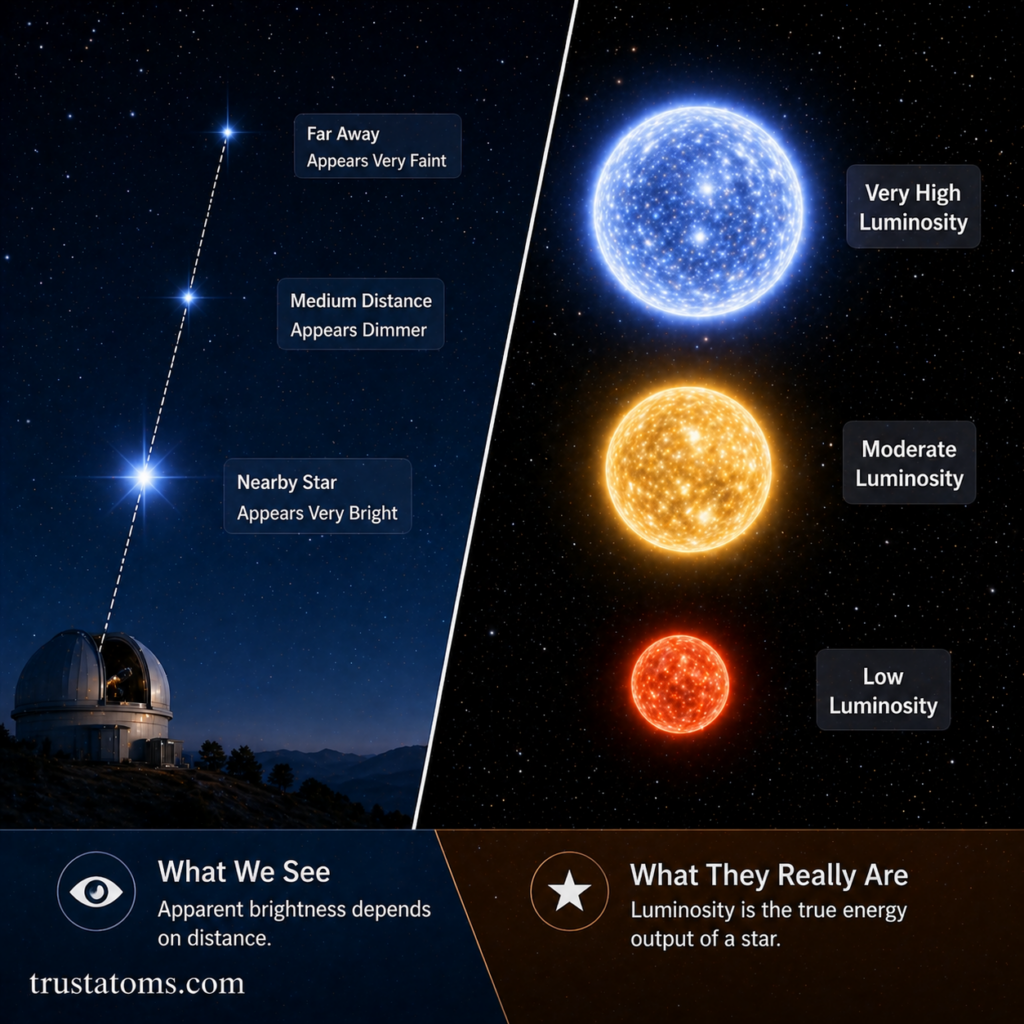
While both terms describe brightness, they are not the same.
Key Differences
- Luminosity: True energy output of a star
- Apparent Magnitude: How bright it appears from Earth
- Absolute Magnitude: True brightness at a fixed distance
Why This Matters
A star might appear dim simply because it is far away—even if it is extremely luminous. Conversely, a nearby star might appear bright but actually have low luminosity.
Understanding the distinction helps avoid misleading conclusions about stars.
Factors That Affect Brightness
Several factors influence how bright a star appears.
Distance
- The farther away a star is, the dimmer it appears
- Brightness decreases with distance
Temperature
- Hotter stars emit more energy
- Blue stars are typically brighter than red stars
Size
- Larger stars have more surface area to emit light
- Giant stars are often more luminous
Interstellar Dust
- Dust and gas can block or scatter light
- Makes stars appear dimmer than they actually are
How Astronomers Measure Luminosity
Astronomers calculate luminosity using observations and known physical relationships.
Common Methods
- Measure the star’s apparent brightness
- Determine its distance (using parallax or other methods)
- Calculate true brightness based on distance
This process allows scientists to convert observed light into actual energy output.
The Inverse Square Law
One of the key principles behind brightness is the inverse square law.
What It Means
- Brightness decreases as distance increases
- Specifically, brightness is inversely proportional to the square of the distance
For example:
- If a star is twice as far away, it appears four times dimmer
- If it is three times farther, it appears nine times dimmer
This law is essential for understanding why distant stars appear faint.
Why Luminosity and Magnitude Matter
These concepts are fundamental to modern astronomy.
Key Uses
- Comparing different types of stars
- Determining distances in space
- Studying stellar evolution
- Identifying unusual or extreme stars
- Mapping galaxies and cosmic structures
Without these measurements, it would be difficult to interpret what we see in the night sky.
Luminosity Classes and Stellar Types
Stars are also categorized based on their luminosity.
Common Luminosity Classes
- Main Sequence Stars – Stable stars like the Sun
- Giants – Larger and more luminous stars
- Supergiants – Extremely bright and massive stars
- White Dwarfs – Small but very dense remnants
These classifications help astronomers place stars on the Hertzsprung-Russell diagram, a key tool for studying stellar evolution.
Final Thoughts
Luminosity and stellar magnitude give us two different ways to understand stellar brightness—one based on true energy output and the other based on how stars appear from Earth.
By combining these concepts, astronomers can unlock important information about distance, size, temperature, and the life cycles of stars. What may look like a simple point of light in the sky is actually a complex and measurable object with a story to tell.