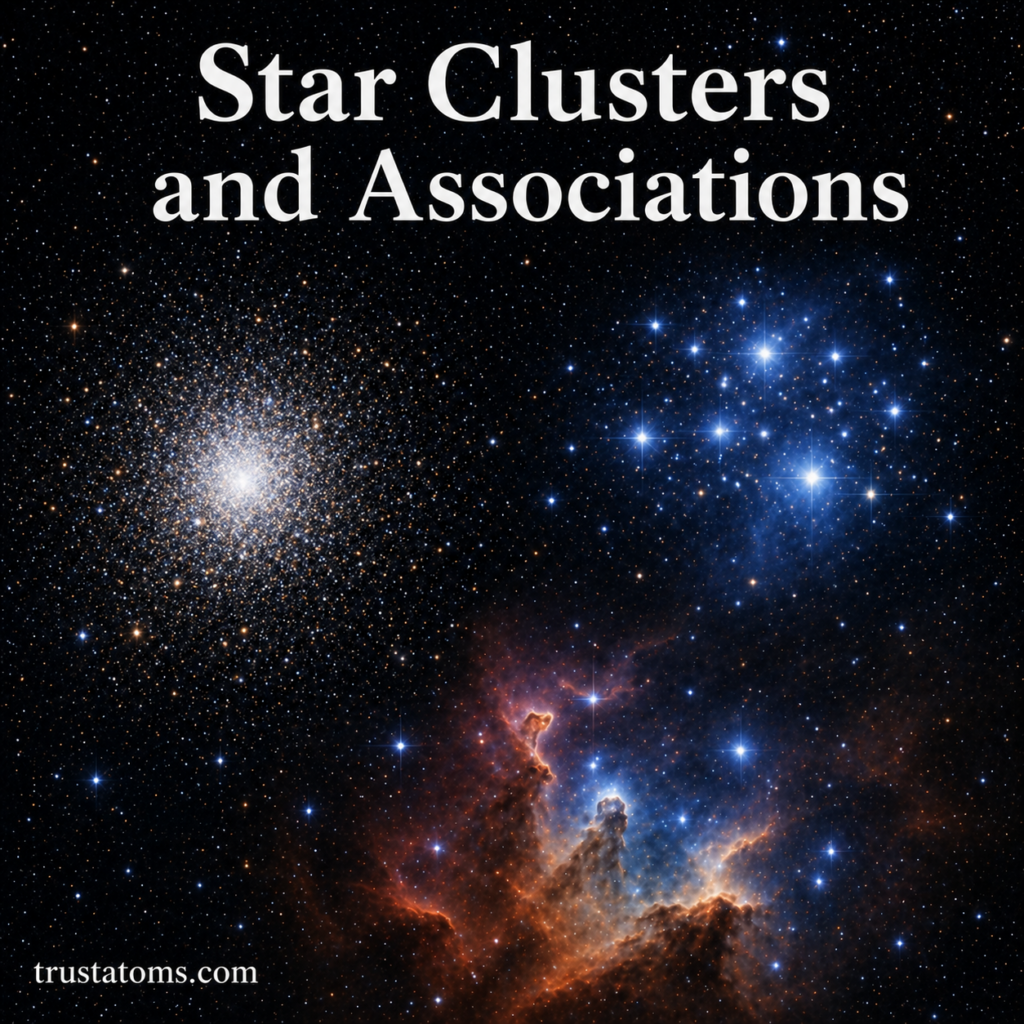
Stars are rarely born in isolation. Instead, they often form in groups within vast clouds of gas and dust. These groups are known as star clusters and stellar associations, and they provide valuable insight into how stars evolve over time.
By studying these groupings, astronomers can better understand stellar lifecycles, galactic structure, and the history of the universe.
What Are Star Clusters?
A star cluster is a group of stars that are gravitationally bound and formed from the same molecular cloud.
Because they share a common origin, stars in a cluster:
- Have similar ages
- Contain similar chemical compositions
- Are located relatively close together in space
Star clusters are important because they act like natural laboratories, allowing scientists to compare stars at different stages of evolution under similar conditions.
Types of Star Clusters
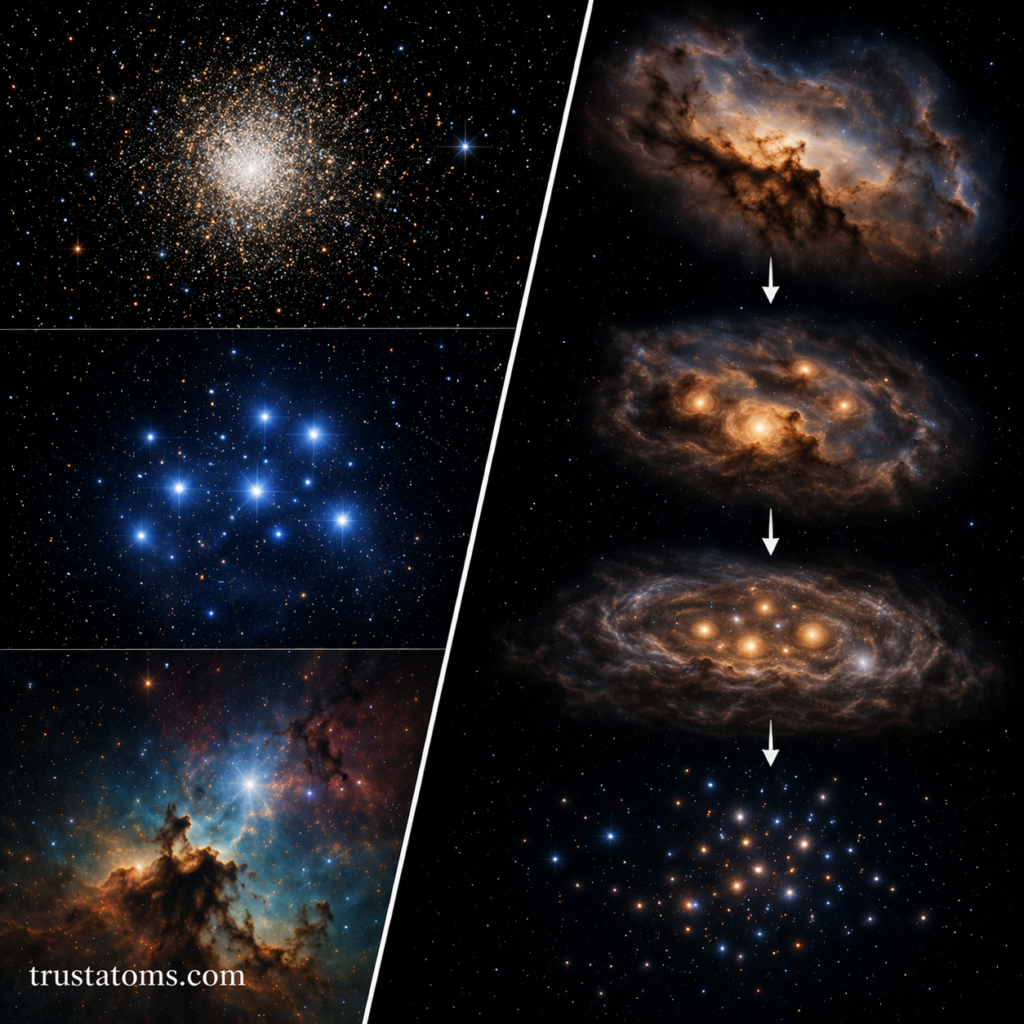
There are two main types of star clusters: open clusters and globular clusters.
Open Clusters
Open clusters are loosely bound groups of stars found primarily in the disk of a galaxy.
Key features include:
- Typically contain a few dozen to a few thousand stars
- Relatively young (millions to a few billion years old)
- Irregular shapes
- Located in spiral arms of galaxies
Examples of well-known open clusters include:
- The Pleiades (Seven Sisters)
- The Hyades
These clusters often disperse over time as gravitational interactions weaken their structure.
Globular Clusters
Globular clusters are tightly packed, spherical collections of stars.
Key characteristics:
- Contain hundreds of thousands to millions of stars
- Very old (often over 10 billion years)
- Highly symmetrical and densely packed
- Found in the halo of galaxies
Globular clusters are among the oldest known objects in the universe and provide clues about the early stages of galaxy formation.
What Are Stellar Associations?
Unlike star clusters, stellar associations are loosely grouped stars that are not strongly bound by gravity.
Characteristics of stellar associations:
- Spread over large regions of space
- Weak gravitational binding
- Stars share a common origin
- Tend to disperse relatively quickly
Because they are less stable than clusters, associations eventually break apart and their stars become part of the general stellar population of the galaxy.
Types of Stellar Associations
Stellar associations are often categorized based on the types of stars they contain.
OB Associations
These associations consist of massive, hot, and bright stars.
- Dominated by O-type and B-type stars
- Very young (a few million years old)
- Strong ultraviolet radiation
- Short lifespans due to massive stars
T Associations
These are groups of very young stars still in early stages of development.
- Contain T Tauri stars (young, forming stars)
- Associated with star-forming regions
- Often surrounded by gas and dust
R Associations
These associations are linked with reflection nebulae.
- Stars illuminate nearby dust clouds
- Produce visible glowing regions
- Help astronomers identify star-forming environments
How Star Clusters and Associations Form
Both clusters and associations originate from giant molecular clouds.
Formation Process
- Cloud Collapse
A region within a molecular cloud begins to collapse under gravity. - Fragmentation
The cloud breaks into smaller regions, each forming individual stars. - Star Formation
Protostars develop and begin to shine. - Grouping Outcome
- Dense regions form clusters
- Less dense regions form associations
The density and initial conditions of the cloud determine whether the stars remain bound or drift apart.
Evolution Over Time
Star clusters and associations evolve differently based on their structure and environment.
Open Clusters
- Gradually lose stars due to gravitational interactions
- Disperse over hundreds of millions of years
- Eventually become part of the galaxy’s field stars
Globular Clusters
- Remain stable for billions of years
- Experience slow internal changes
- Continue orbiting the galaxy’s core
Stellar Associations
- Disperse relatively quickly
- Lose structure within a few million years
- Blend into the surrounding stellar population
Why Star Clusters Matter in Astronomy
Star clusters are essential tools for understanding the universe.
Key Benefits for Scientists
- Studying stellar evolution in a controlled environment
- Determining ages of stars using cluster comparisons
- Measuring distances in space
- Understanding galactic structure and formation
- Testing models of stellar physics
Because all stars in a cluster formed at roughly the same time, differences between them are mainly due to mass, making comparisons more accurate.
Star Clusters in the Milky Way
Our galaxy contains thousands of star clusters and associations.
- Open clusters are found in the galactic disk
- Globular clusters orbit in the galactic halo
- Associations are common in active star-forming regions
These structures help map the Milky Way and reveal its evolutionary history.
Final Thoughts
Star clusters and associations show that stars are born together, even if they don’t always stay together. From tightly bound globular clusters to loosely scattered associations, these groupings provide a deeper understanding of how stars form, evolve, and interact within galaxies.
By studying them, astronomers gain valuable insights into both the past and future of the universe.