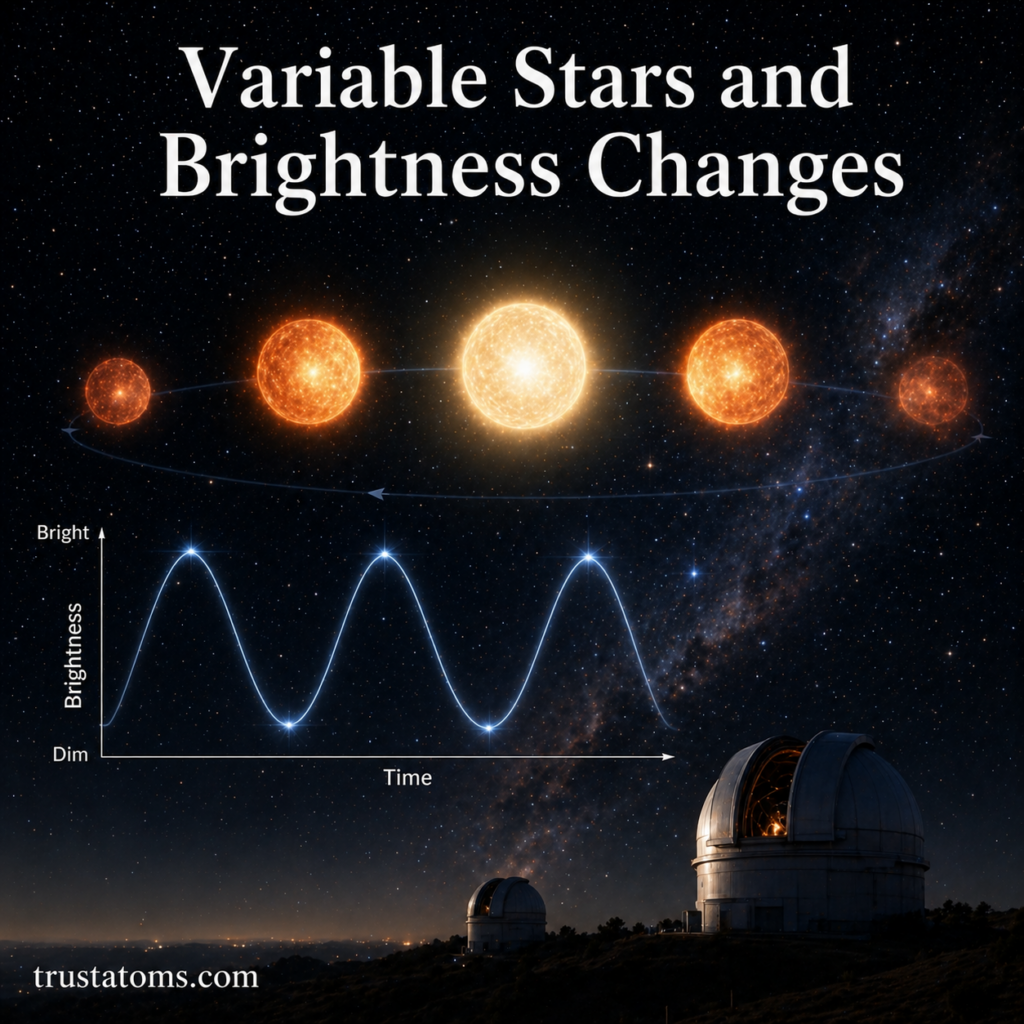
Not all stars shine with a constant brightness. Some stars vary in how much light they emit over time—these are known as variable stars. Their brightness can change due to internal processes or external factors, making them incredibly valuable tools for astronomers.
By studying variable stars, scientists can measure distances, understand stellar evolution, and even map the structure of galaxies.
What Are Variable Stars?
A variable star is a star whose brightness, as seen from Earth, changes over time.
These changes can occur over:
- Seconds or minutes
- Days or weeks
- Months or even years
The variation may be regular and predictable or irregular and chaotic, depending on the type of star.
Why Do Stars Change Brightness?
Brightness changes in stars happen for two main reasons:
1. Intrinsic Variability
The star itself physically changes.
- Expansion and contraction of the star’s outer layers
- Temperature fluctuations
- Internal energy changes
2. Extrinsic Variability
The brightness changes due to external factors.
- One object blocking another (eclipsing systems)
- Rotation revealing brighter or darker regions
- Dust or material passing in front of the star
Understanding the cause helps astronomers classify and study each variable star more effectively.
Types of Variable Stars
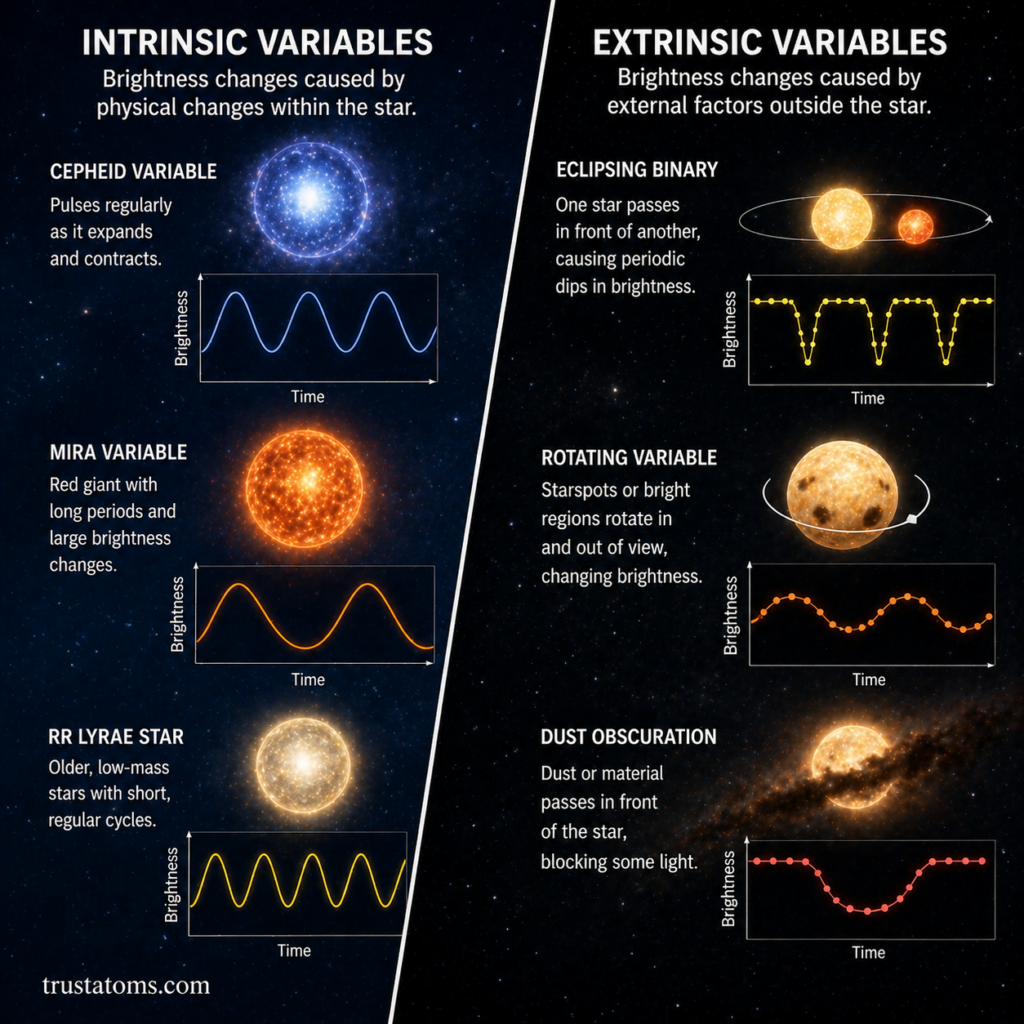
Variable stars are broadly categorized into intrinsic and extrinsic types.
Intrinsic Variable Stars
These stars vary in brightness due to changes within the star itself.
Pulsating Variables
These stars expand and contract rhythmically.
- Cepheid Variables
- Highly regular brightness cycles
- Used as “standard candles” to measure distances
- RR Lyrae Stars
- Older, low-mass stars
- Short, predictable periods
- Mira Variables
- Red giant stars
- Long periods and large brightness changes
Eruptive Variables
These stars experience sudden outbursts or flares.
- Caused by instability or energy release
- Can dramatically increase brightness
- Often unpredictable
Extrinsic Variable Stars
These stars vary in brightness due to external influences.
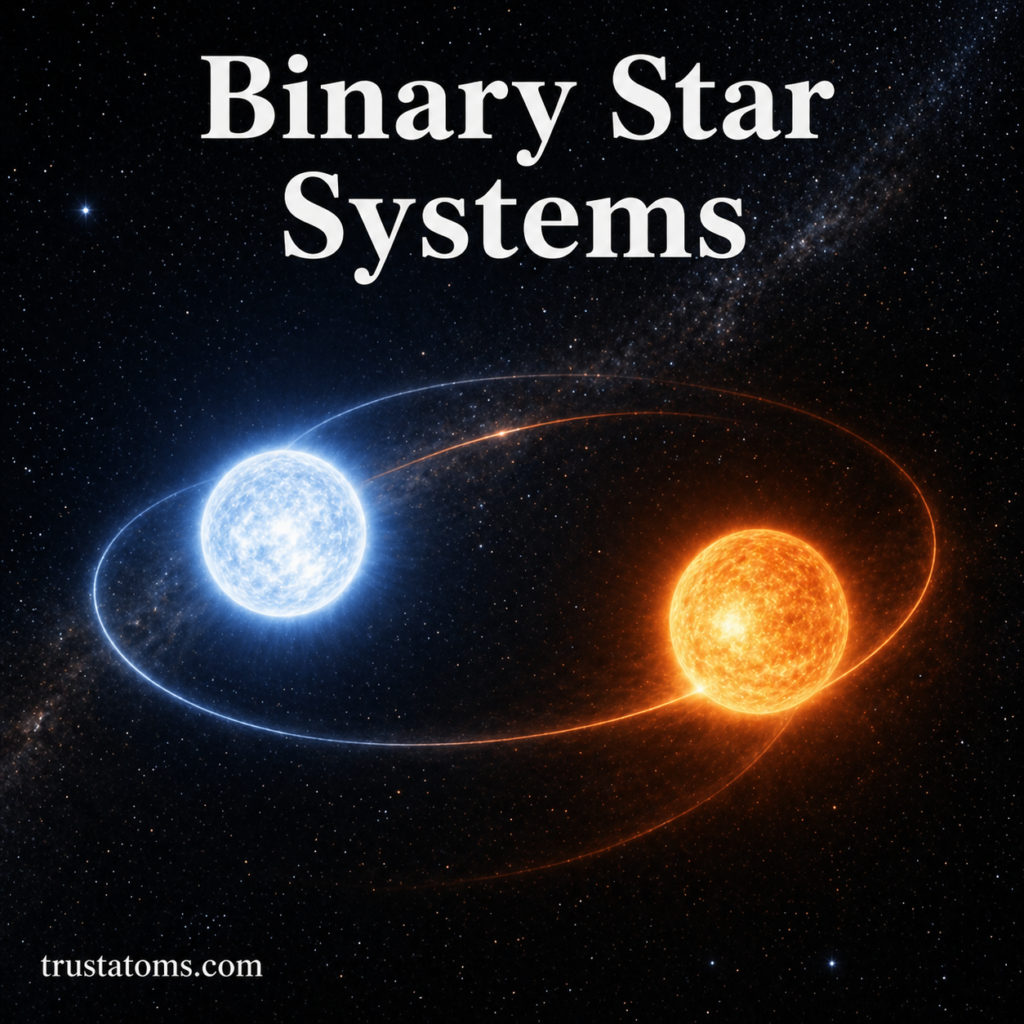
Eclipsing Binaries
- Two stars orbit each other
- One passes in front of the other
- Causes periodic dips in brightness
Rotating Variables
- Stars with uneven surfaces (e.g., starspots)
- Rotation changes the visible brightness
- Produces repeating light patterns
Light Curves: Tracking Brightness Changes
Astronomers use light curves to study variable stars.
A light curve is a graph that shows a star’s brightness over time.
What Light Curves Reveal
- Period of brightness changes
- Magnitude of variation
- Type of variability
- Physical properties of the star
Different types of variable stars produce distinct light curve shapes, making them easier to identify.
Cepheid Variables and Measuring Distance
One of the most important uses of variable stars is measuring distances in space.
Cepheid variables have a direct relationship between their brightness and pulsation period.
Why This Matters
- The longer the period, the brighter the star
- By measuring the period, astronomers can determine true brightness
- Comparing true brightness to observed brightness reveals distance
This method has been crucial in determining the scale of the universe.
Timescales of Brightness Changes
Variable stars change brightness over different timescales depending on their type.
- Rapid variables: seconds to hours
- Moderate variables: days to weeks
- Long-period variables: months to years
These timescales provide clues about the physical processes occurring within or around the star.
Why Variable Stars Are Important
Variable stars play a major role in modern astronomy.
Key Contributions
- Measuring distances to faraway galaxies
- Understanding stellar structure and evolution
- Identifying binary systems
- Studying extreme astrophysical events
- Mapping the size and expansion of the universe
Without variable stars, many astronomical measurements would be far less precise.
Observing Variable Stars
Variable stars can be observed using both professional and amateur equipment.
How They Are Studied
- Telescopes measure brightness over time
- Photometers detect light intensity
- Space telescopes provide precise long-term data
- Amateur astronomers contribute valuable observations
Because many variable stars are visible from Earth, they are popular targets for observation.
Final Thoughts
Variable stars remind us that the universe is not static. Stars can pulse, flare, dim, and brighten in fascinating ways, revealing the dynamic processes happening deep within them or in their surroundings.
From helping measure cosmic distances to uncovering the physics of stellar interiors, variable stars are among the most useful and intriguing objects in astronomy.