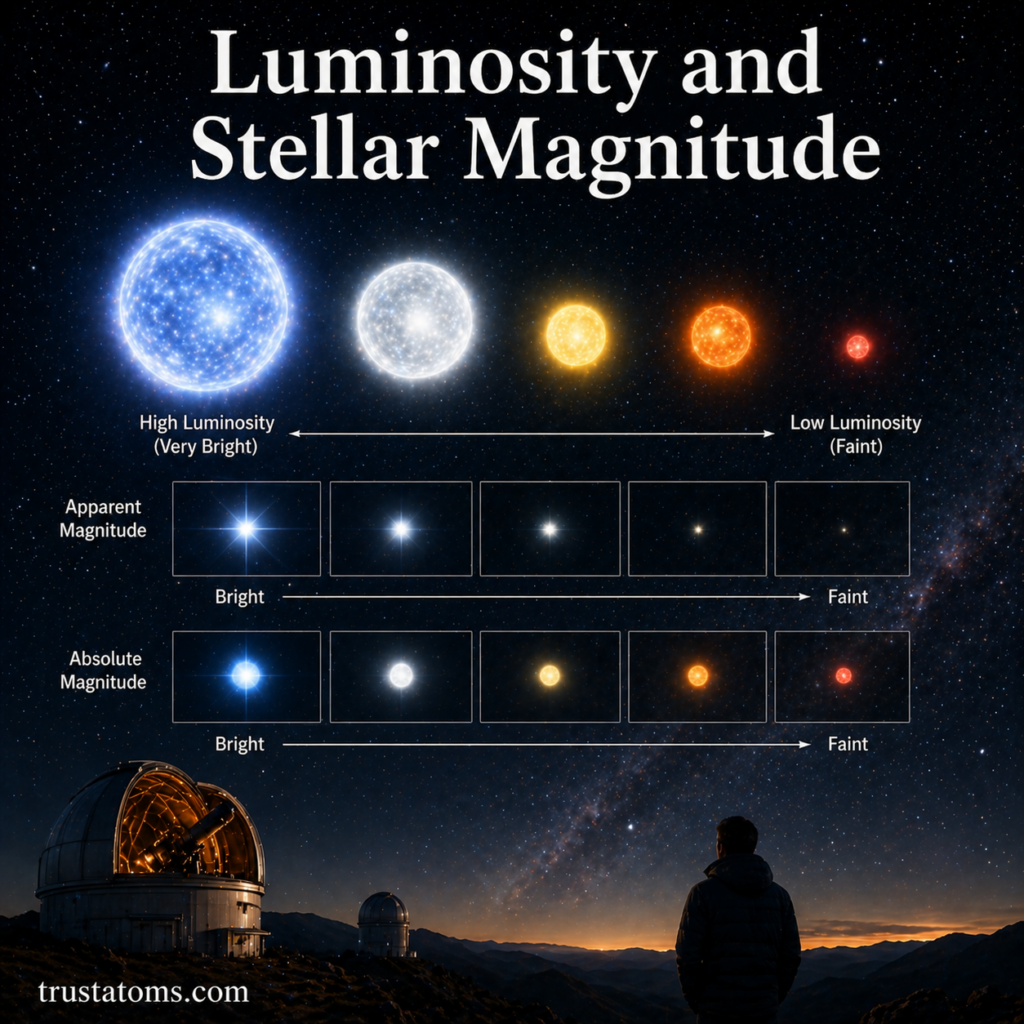
Luminosity measures the total energy a star emits per second, while stellar magnitude describes its brightness on a numerical scale. Astronomers distinguish between apparent magnitude, which describes how bright a star looks from Earth, and absolute magnitude, which allows stars to be compared at the same distance.
A star that appears faint in the night sky may actually release far more energy than a brighter-looking neighbor. Understanding this difference is an essential part of the study of astronomy, helping scientists investigate stellar temperatures, sizes, distances, and physical properties.
By combining luminosity and magnitude measurements, astronomers can determine whether a star appears bright because it is nearby or because it produces an enormous amount of energy.
What Is Stellar Luminosity?
Luminosity is the total amount of energy a star radiates into space every second. It represents the star’s intrinsic energy output rather than its appearance from a particular viewing distance.
Scientists measure luminosity in watts, although they frequently express stellar luminosities relative to the Sun. The Sun produces approximately 3.83 × 10²⁶ watts of radiant power, a quantity called one solar luminosity.
A star with 10 solar luminosities emits approximately ten times as much energy per second as the Sun, regardless of how far away that star is.
Two major physical properties influence stellar luminosity:
- Surface temperature: Hotter stellar surfaces radiate more energy per unit area.
- Radius: Larger stars have more surface area from which energy can escape.
For an approximately spherical star behaving like a thermal radiator, luminosity increases with the square of its radius and the fourth power of its effective surface temperature. This explains why a very large, relatively cool star can still be extremely luminous.
Astronomers use the Hertzsprung–Russell Diagram to compare stellar luminosity with temperature and identify patterns among different types of stars.
Accurate distance measurements are also necessary when calculating luminosity from observed brightness. Measuring Distance in the Universe explains how astronomers determine the distances needed for these calculations.
What Is Stellar Magnitude?
Stellar magnitude is a numerical system used to describe brightness. Unlike a straightforward scale where larger numbers mean greater brightness, the magnitude system assigns smaller numbers to brighter objects.
A star with magnitude 1 appears brighter than a star with magnitude 3. Exceptionally bright objects can even have negative magnitude values.
Astronomers distinguish between two main measurements: apparent magnitude and absolute magnitude.
Apparent Magnitude: Brightness Seen From Earth
Apparent magnitude measures how bright a celestial object appears to an observer. It depends on the amount of light reaching the observer rather than solely on the object’s actual energy output.
For example, Sirius has an apparent visual magnitude of approximately −1.46, making it the brightest star in Earth’s nighttime sky apart from the Sun.
A star can have a relatively low luminosity yet appear bright because it is nearby. Conversely, a distant star may appear faint despite producing enormous amounts of energy.
Absolute Magnitude: Brightness at a Standard Distance
Absolute magnitude describes how bright a star would appear if observed from a standard distance of 10 parsecs, approximately 32.6 light-years, without dimming from intervening material.
Placing stars at the same hypothetical distance removes the effect of their different distances from Earth. This allows astronomers to compare their intrinsic brightness more meaningfully.
The Sun has an absolute visual magnitude of approximately +4.83. Its apparent magnitude is about −26.74 because Earth is exceptionally close to it compared with other stars.
How the Stellar Magnitude Scale Works
The modern magnitude scale is logarithmic, meaning equal numerical differences correspond to equal brightness ratios rather than equal changes in measured light.
A difference of five magnitudes corresponds to a brightness ratio of exactly 100. Each one-magnitude difference therefore represents a factor of approximately 2.512.
| Magnitude Difference | Brightness Ratio |
|---|---|
| 1 magnitude | About 2.51 times |
| 2 magnitudes | About 6.31 times |
| 3 magnitudes | About 15.85 times |
| 5 magnitudes | Exactly 100 times |
| 10 magnitudes | Exactly 10,000 times |
For example, a magnitude 1 star appears 100 times brighter than a magnitude 6 star when measured in the same wavelength band.
This system allows astronomers to describe enormous differences in brightness using relatively small numerical values.
Luminosity vs. Stellar Magnitude
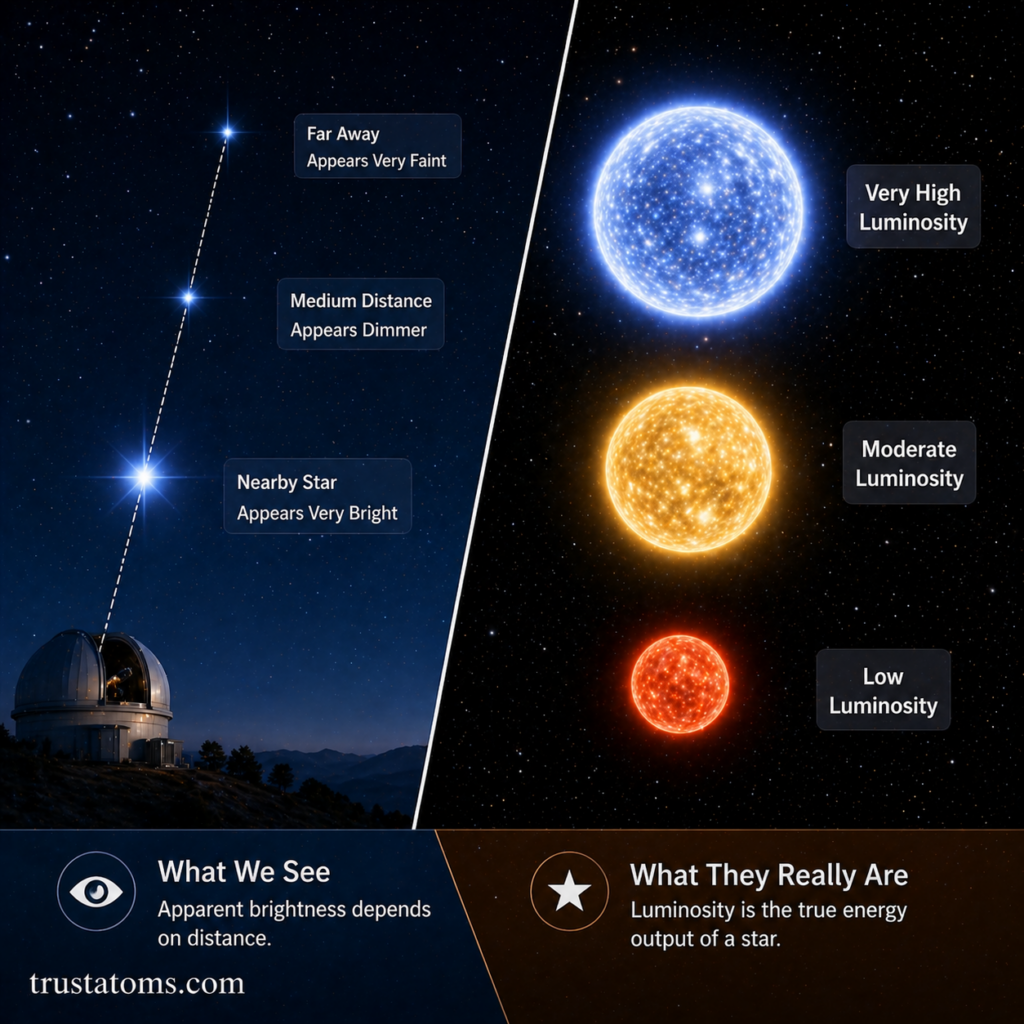
Although luminosity and magnitude both describe stellar brightness, they represent different physical measurements.
| Measurement | What It Describes | Depends on Distance? |
|---|---|---|
| Luminosity | Total energy emitted per second | No |
| Apparent magnitude | Observed brightness | Yes |
| Absolute magnitude | Brightness at a standard distance | No |
Absolute magnitude is related to luminosity, but the two are not identical. Magnitudes may describe brightness within a particular wavelength band, while bolometric luminosity includes the star’s total radiation across all wavelengths.
How Distance Changes a Star’s Apparent Brightness
Light spreads outward as it travels from a star. As the distance increases, the same amount of emitted energy is distributed across a larger area.
This relationship follows the inverse square law: observed brightness decreases in proportion to the square of the distance.
Consider a star observed from two different distances:
- At 10 light-years, the star has a particular observed brightness.
- At 20 light-years, it would appear four times dimmer.
- At 30 light-years, it would appear nine times dimmer.
The star’s luminosity remains unchanged in this example. Only the amount of light reaching the observer decreases, assuming no additional absorption or scattering.
Factors That Affect Stellar Brightness
Several physical and observational factors influence how bright a star appears.
- Distance: More distant stars generally appear fainter when their luminosities are equal.
- Temperature: Hotter stellar surfaces emit more energy per unit area and produce different distributions of wavelengths.
- Size: Larger stellar surfaces can produce greater total luminosity.
- Interstellar dust: Dust absorbs and scatters some starlight, reducing observed brightness.
- Intrinsic variability: Some stars change brightness because of pulsations, eruptions, or other physical processes.
Not every brightness change indicates a change in distance. Variable Stars and Brightness Changes examines stars whose observed light varies over time, including pulsating and eclipsing systems.
How Astronomers Calculate Stellar Luminosity
Astronomers can estimate a star’s luminosity by combining its observed energy flux with an independently measured distance.
The basic process involves three steps:
- Measure the star’s apparent brightness using calibrated observations.
- Determine its distance (using parallax or other methods).
- Calculate its intrinsic luminosity using the inverse square relationship between observed flux and distance.
For total energy output, astronomers must also account for radiation outside the observed wavelength bands and correct for absorption by intervening dust when necessary.
How Luminosity Helps Classify Different Stars
Luminosity measurements help astronomers distinguish stars with different physical properties and evolutionary stages.
- Main Sequence Stars – Stable stars like the Sun that generate energy primarily through hydrogen fusion in their cores.
- Giants – Expanded stars that can be highly luminous despite relatively cool surfaces.
- Supergiants – Very large, luminous stars occupying regions of high luminosity on stellar classification diagrams.
- White Dwarfs – Compact stellar remnants that are often relatively faint because of their small surface areas.
These groups illustrate why temperature alone cannot determine luminosity. A cool giant can emit more total energy than a much hotter but smaller star.
Combining luminosity with temperature and spectral information allows astronomers to investigate stellar structure, estimate physical properties, and compare stars at different evolutionary stages.
Frequently Asked Questions
Is luminosity the same as brightness?
Not exactly. Luminosity describes the total energy a star emits each second, while apparent brightness describes how much of that radiation reaches an observer. A distant luminous star can appear fainter than a nearby star with lower luminosity.
Why do brighter stars have lower magnitude numbers?
The magnitude scale developed from an early system that classified prominent stars as first magnitude and faint visible stars as sixth magnitude. Modern astronomy preserves this reversed numerical ordering while using a precisely defined logarithmic scale.
Can two stars have the same luminosity but different apparent magnitudes?
Yes. Two stars with identical luminosities can appear to have different brightness levels if they are at different distances. Interstellar dust can also make one appear fainter, even when both emit the same amount of energy.
Luminosity reveals how much energy a star produces, while apparent and absolute magnitude provide complementary ways to describe its brightness. By combining these measurements with distance and temperature, astronomers can distinguish nearby faint stars from distant luminous ones and better understand the physical differences among stellar populations.
Sources: OpenStax, Astronomy 2e; European Space Agency (ESA), Gaia mission; Encyclopaedia Britannica, Stellar magnitude.