Light doesn’t always travel in perfectly straight lines.
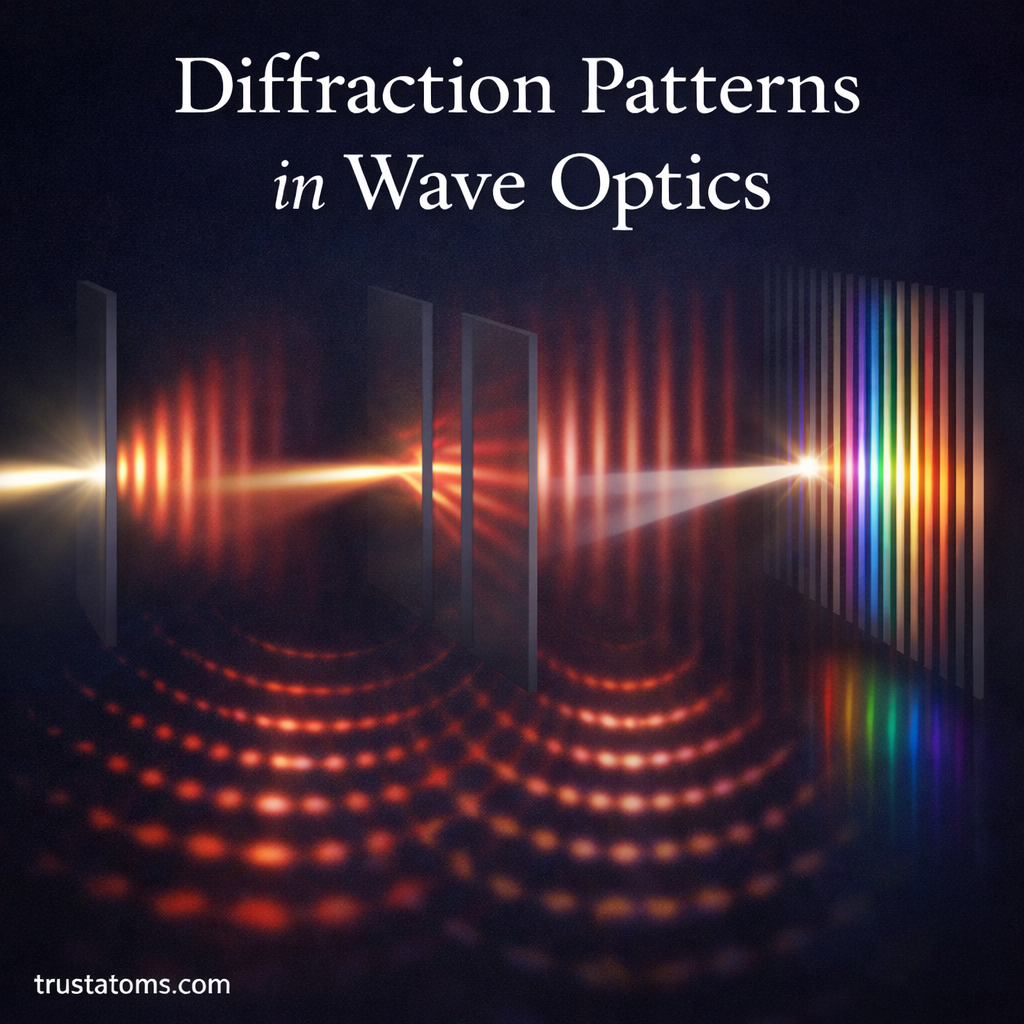
When it encounters a narrow opening or passes by an edge, it spreads out. This spreading behavior is called diffraction, and the patterns it creates are known as diffraction patterns.
Diffraction is one of the clearest demonstrations that light behaves as a wave. It plays a central role in wave optics and helps explain phenomena seen in laboratories, telescopes, microscopes, and even everyday life.
In this guide, we’ll explore what diffraction patterns are, why they form, the types of diffraction, and how they’re used in science and technology.
What Is Diffraction?
Diffraction occurs when a wave bends or spreads as it passes through a narrow opening or around an obstacle.
It happens with all types of waves:
- Water waves
- Sound waves
- Light waves
- X-rays
- Radio waves
In wave optics, diffraction refers specifically to the bending and spreading of light waves.
The effect becomes most noticeable when:
- The opening is about the same size as the wavelength of light
- The obstacle is very small
- Light passes through very narrow slits
What Is a Diffraction Pattern?
A diffraction pattern is the series of bright and dark regions formed when waves interfere after passing through an opening or around an object.
Instead of forming a simple shadow, light creates:
- A bright central maximum
- Alternating dark and bright fringes
- Symmetrical intensity patterns
This pattern results from interference, where light waves combine constructively and destructively.
Why Diffraction Happens
Light behaves like a wave.
When waves pass through a small opening:
- Each point in the opening acts as a source of secondary waves.
- These waves spread outward.
- The waves overlap.
- Interference creates bright and dark regions.
This explanation is based on the Huygens–Fresnel principle, which describes how wavefronts propagate.
Single-Slit Diffraction
One of the simplest diffraction setups uses a single narrow slit.
What You Observe
- A wide, bright central band
- Dimmer bright fringes on either side
- Dark regions between them
The central maximum is much brighter and wider than the others.
Key Insight
The narrower the slit:
- The wider the diffraction pattern spreads
This shows that light does not simply pass straight through — it spreads significantly when confined.
Double-Slit Diffraction and Interference
When light passes through two closely spaced slits, something remarkable happens.
Instead of two bright bands, you see:
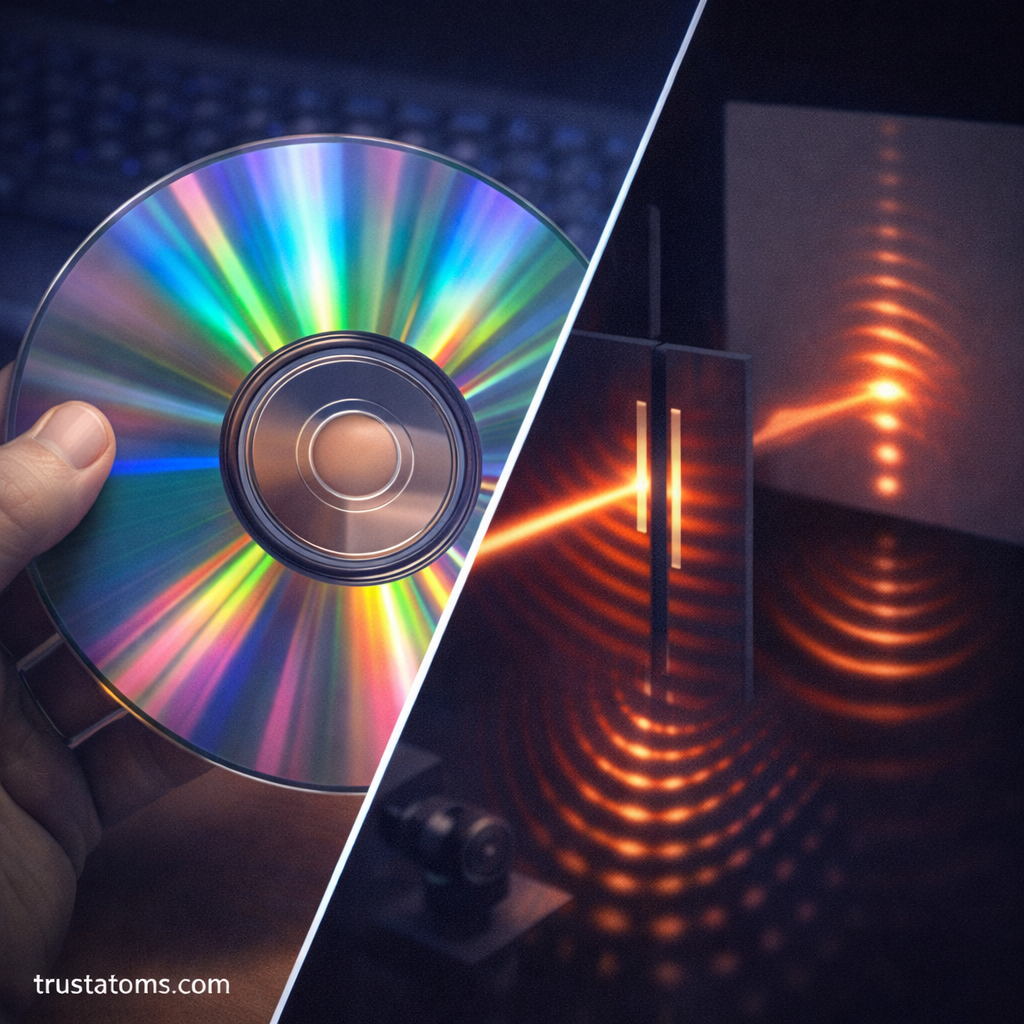
- Multiple evenly spaced bright and dark fringes
- A clear interference pattern
This experiment demonstrates the wave nature of light.
What It Reveals
- Light waves overlap and interfere
- Bright fringes occur where waves reinforce each other
- Dark fringes occur where waves cancel each other
This phenomenon was famously demonstrated in the early 1800s and remains one of the strongest proofs of wave behavior.
Diffraction Gratings
A diffraction grating contains many closely spaced slits.
When light passes through:
- It spreads into sharp, bright lines
- Colors separate clearly
- Spectral patterns appear
Diffraction gratings are used to analyze light by separating it into its component wavelengths.
Applications include:
- Spectroscopy
- Astronomy
- Chemical analysis
- Laser measurements
Factors That Affect Diffraction Patterns
Several variables influence how diffraction patterns appear.
Wavelength
- Longer wavelengths spread more
- Shorter wavelengths spread less
This is why radio waves diffract easily around buildings, while visible light does not bend as dramatically.
Slit Width
- Narrower slits increase spreading
- Wider slits reduce spreading
Distance to the Screen
- Greater distance spreads the pattern wider
- Closer screens compress the pattern
Diffraction vs Interference
Diffraction and interference are closely related but not identical.
Diffraction:
- Caused by wave spreading from a single opening or edge
- Produces a central maximum and side fringes
Interference:
- Occurs when waves from multiple sources overlap
- Produces evenly spaced bright and dark fringes
In reality, most diffraction patterns include interference effects.
Real-World Examples of Diffraction
Diffraction is not just a laboratory phenomenon.
Seeing Colors on a CD
The closely spaced tracks on a compact disc act like a diffraction grating, separating white light into rainbow colors.
Sound Around Corners
Low-frequency sound waves bend around obstacles, allowing you to hear someone even if you can’t see them.
X-Ray Crystallography
Scientists use diffraction patterns to determine atomic structures of crystals, including DNA and proteins.
Astronomical Observations
Telescopes must account for diffraction limits when resolving distant stars.
The Diffraction Limit
Diffraction imposes a fundamental limit on resolution.
Even perfect optical systems cannot resolve details smaller than a certain size due to wave spreading.
This limit affects:
- Microscopes
- Telescopes
- Cameras
- Laser systems
Engineers design instruments carefully to minimize unwanted diffraction effects.
Why Diffraction Patterns Matter in Physics
Diffraction patterns provide strong evidence that light behaves as a wave.
They help physicists:
- Measure wavelengths
- Determine material properties
- Study crystal structures
- Understand wave behavior
Diffraction bridges classical wave theory and quantum mechanics, playing a role in experiments involving electrons and even atoms.
It shows that wave behavior is not limited to water or sound — it is a fundamental property of nature.
Common Misconceptions
“Diffraction only happens with light.”
All waves diffract, including sound and water waves.
“Diffraction means reflection.”
Diffraction involves bending and spreading — not bouncing.
“Diffraction is rare.”
It happens constantly, but often at scales too small to notice without special equipment.
Final Thoughts
Diffraction patterns reveal something profound:
Light does not behave like a simple stream of particles moving in straight lines.
Instead, it spreads, overlaps, interferes, and forms structured patterns.
From rainbow reflections on a CD to atomic-scale measurements in research labs, diffraction is everywhere.
In wave optics, diffraction patterns aren’t just visual effects — they are evidence of the deep wave nature of reality.