The Solar System didn’t appear overnight—it formed over billions of years through a complex process involving gravity, dust, gas, and time. Understanding how our Solar System formed helps scientists explain everything from planet composition to the origins of life on Earth.
In this guide, we’ll break down the key stages of Solar System formation in a clear, step-by-step way.
What Is the Solar System?
The Solar System consists of the Sun and everything bound to it by gravity, including:
- Eight planets
- Dwarf planets like Pluto
- Moons
- Asteroids
- Comets
- Dust and gas
At the center is the Sun, which contains more than 99% of the system’s total mass.
The Nebular Hypothesis: How It All Began
The most widely accepted explanation for the formation of the Solar System is the nebular hypothesis.
What Is a Solar Nebula?
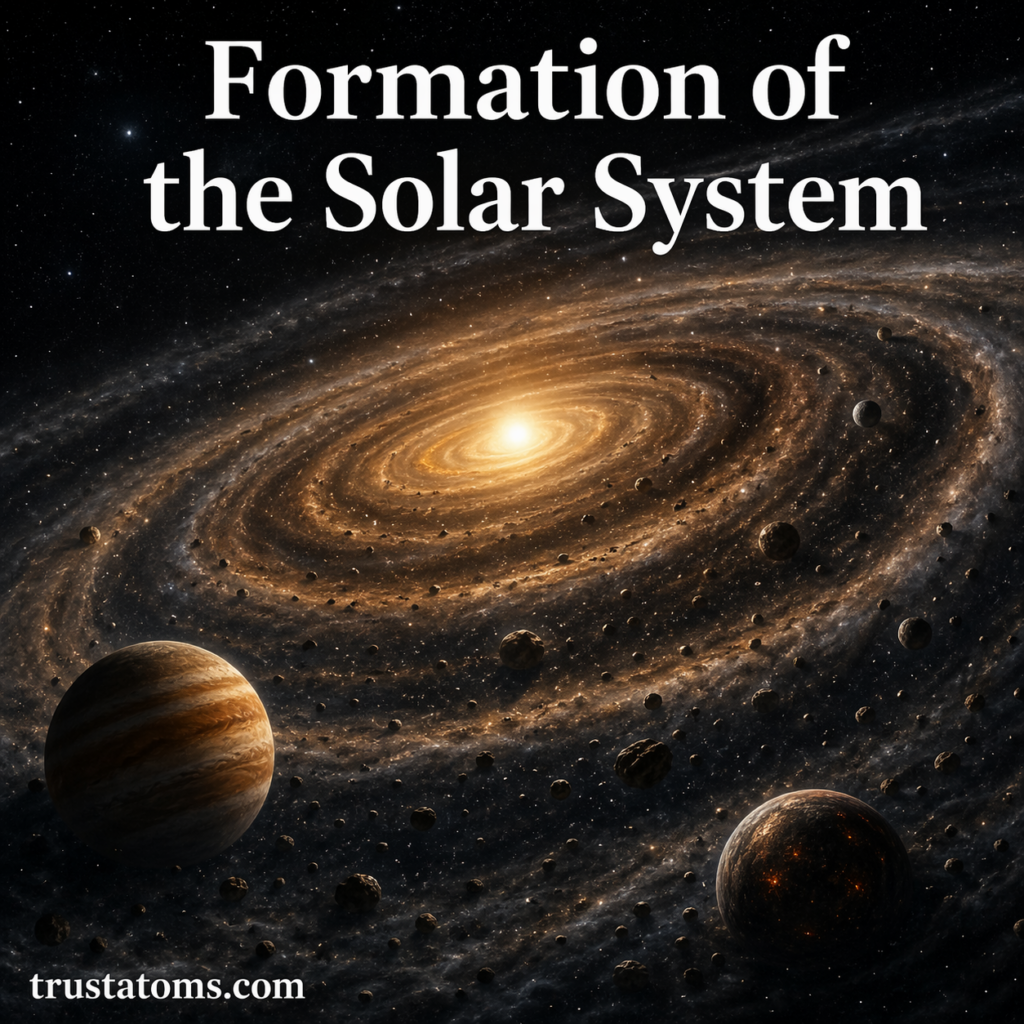
A solar nebula is a massive cloud of gas and dust in space. Around 4.6 billion years ago, a region within such a cloud began to collapse under its own gravity.
Possible triggers for this collapse include:
- Shockwaves from a nearby supernova
- Gravitational disturbances
- Density variations within the cloud
As the nebula collapsed, it began to spin faster and flatten into a disk shape.
Stage 1: Formation of the Protosun
At the center of the collapsing nebula, material began to concentrate, forming a protosun—the early version of our Sun.
Key Characteristics of the Protosun Stage
- Increasing temperature and pressure
- Continuous accumulation of gas and dust
- No nuclear fusion yet
Eventually, the core became hot and dense enough to ignite nuclear fusion, officially forming the Sun.
Stage 2: Formation of the Protoplanetary Disk
As the protosun formed, the remaining material spread out into a rotating protoplanetary disk.
Why a Disk Shape?
- Conservation of angular momentum caused flattening
- Faster rotation led to a thin, spinning disk
This disk is where planets, moons, and other bodies would eventually form.
Stage 3: Accretion and Planet Formation
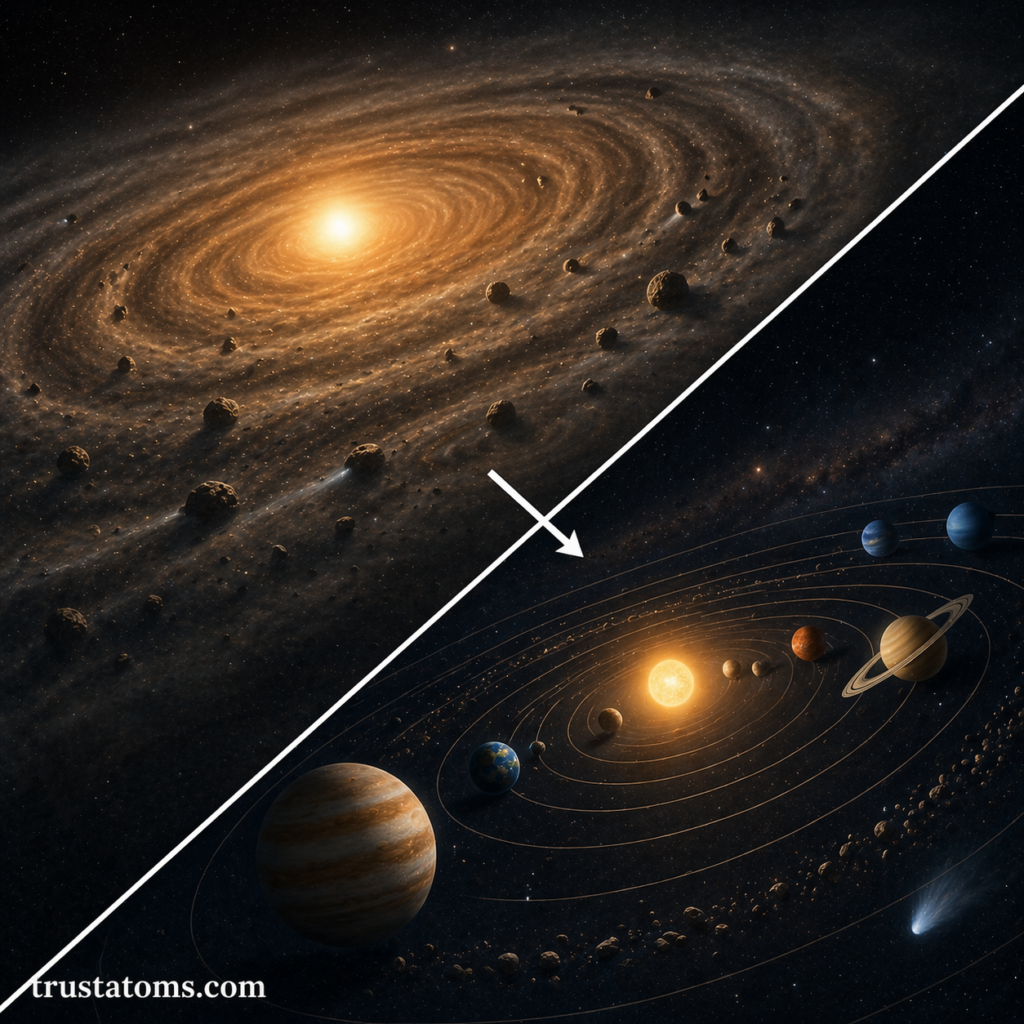
Within the protoplanetary disk, particles began sticking together through a process called accretion.
How Accretion Works
- Tiny dust grains collide and stick together
- They form larger clumps called planetesimals
- Planetesimals collide and merge into protoplanets
Over millions of years, these protoplanets grew into full-sized planets.
Inner vs Outer Planets: Why They’re Different
One of the most important outcomes of Solar System formation is the clear difference between inner and outer planets.
Inner Planets (Terrestrial)
- Mercury, Venus, Earth, Mars
- Made mostly of rock and metal
- Smaller and denser
- Formed in hotter regions near the Sun
Outer Planets (Gas and Ice Giants)
- Jupiter, Saturn, Uranus, Neptune
- Composed largely of gas and ices
- Much larger in size
- Formed in cooler outer regions
This difference is largely due to temperature variations within the protoplanetary disk.
Stage 4: Clearing the Solar System
After the Sun ignited, it emitted strong solar winds—streams of charged particles that swept away remaining gas and dust.
Effects of Solar Winds
- Cleared leftover material from inner regions
- Prevented further planet formation near the Sun
- Shaped the final structure of the Solar System
What remained became asteroids, comets, and other small bodies.
Formation of Moons and Smaller Bodies
Not everything became a planet. Many smaller structures formed as well.
Moons
Moons formed in different ways:
- From leftover material orbiting planets
- Through massive collisions (e.g., Earth’s Moon)
- By gravitational capture
Asteroids and Comets
- Asteroids: Rocky remnants, mostly in the asteroid belt
- Comets: Ice-rich objects from outer regions like the Kuiper Belt
These objects are considered leftovers from the early Solar System.
Evidence Supporting Solar System Formation Theory
Scientists rely on multiple lines of evidence to support the nebular hypothesis.
Key Evidence
- Observations of protoplanetary disks around young stars
- Radiometric dating of meteorites (~4.6 billion years old)
- Computer simulations of planetary formation
- Consistent planetary motion in a flat orbital plane
Together, these confirm that our Solar System formed through a disk-based process.
Why This Matters
Understanding the formation of the Solar System helps scientists:
- Study how planets form around other stars
- Predict where life might exist elsewhere
- Understand Earth’s unique conditions
- Explore the origins of water and organic molecules
It also provides context for ongoing space missions and astronomical discoveries.
Final Thoughts
The formation of the Solar System is a story of gravity, motion, and time. From a simple cloud of gas and dust, a structured system of planets, moons, and other objects emerged.
While the process took millions of years, the result is a stable and dynamic system that continues to evolve even today.
As technology advances, scientists are uncovering more details about this process—helping us better understand not just where we are, but how we got here.