The Sun may look like a steady, glowing sphere, but it is constantly changing. One of the most visible signs of solar activity is the appearance of sunspots—dark patches on the Sun’s surface that reveal powerful magnetic forces at work.
These sunspots are closely tied to the solar cycle, a repeating pattern of activity that affects everything from space weather to satellite communications on Earth.
What Are Sunspots?
Sunspots are temporary dark regions on the Sun’s surface, known as the photosphere.
They appear darker because they are cooler than surrounding areas, although they are still extremely hot.
Key Characteristics of Sunspots
- Temperature: ~3,500–4,500°C (cooler than the surrounding ~5,500°C)
- Caused by intense magnetic activity
- Can last from days to months
- Often appear in pairs or groups
Sunspots are not permanent—they form, evolve, and disappear over time.
What Causes Sunspots?
Sunspots are caused by disturbances in the Sun’s magnetic field.
Magnetic Field Interactions
- The Sun’s magnetic field becomes twisted and tangled
- Strong magnetic pressure reduces heat flow to the surface
- This creates cooler, darker regions (sunspots)
These magnetic disruptions are strongest in areas where sunspots form.
Structure of a Sunspot
Sunspots are not uniform—they have distinct regions.
Main Parts of a Sunspot
- Umbra:
- Dark central region
- Coolest part
- Penumbra:
- Lighter outer area
- Slightly warmer than the umbra
This structure gives sunspots their characteristic appearance.
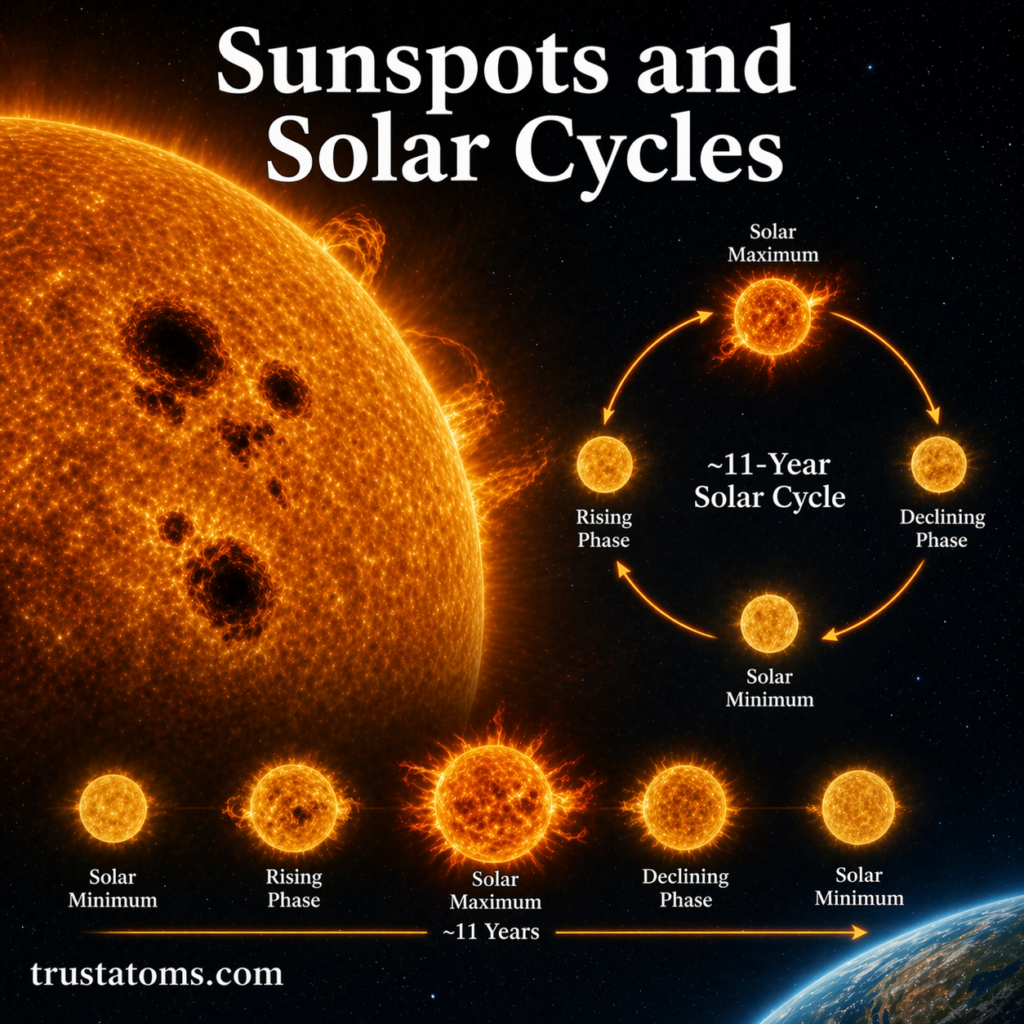
The Solar Cycle Explained
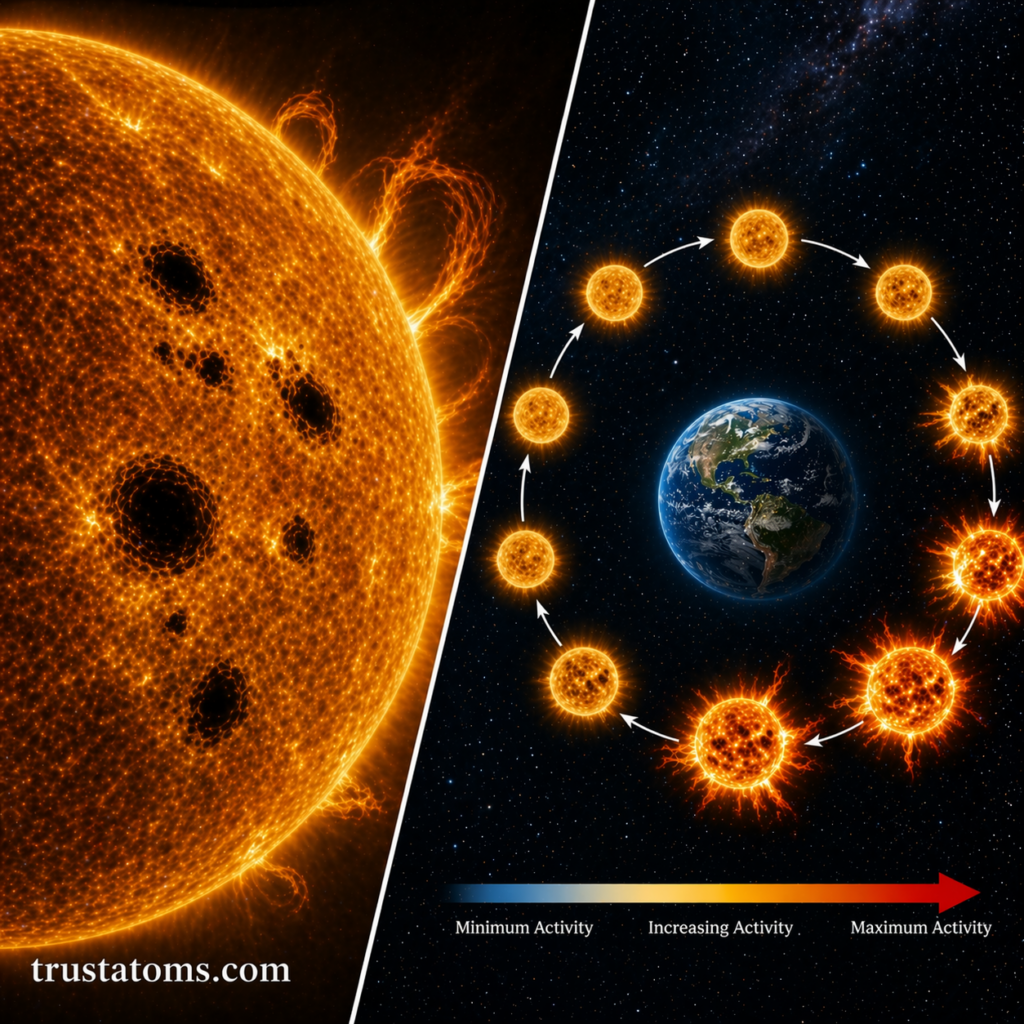
The solar cycle is a repeating pattern of solar activity that lasts about 11 years.
During this cycle, the number of sunspots rises and falls.
Phases of the Solar Cycle
- Solar Minimum
- Few or no sunspots
- Low solar activity
- Rising Phase
- Increasing number of sunspots
- More solar activity
- Solar Maximum
- Peak number of sunspots
- Frequent solar flares and CMEs
- Declining Phase
- Decreasing sunspot count
- Activity gradually reduces
This cycle then repeats.
Why the Solar Cycle Happens
The solar cycle is driven by the Sun’s magnetic field dynamics.
Key Processes Behind the Cycle
- Differential rotation (equator spins faster than poles)
- Magnetic field lines become twisted over time
- Periodic reversal of the Sun’s magnetic poles
At the end of each cycle, the Sun’s magnetic polarity flips, marking the start of a new cycle.
Sunspots and Solar Activity
Sunspots are closely linked to other solar phenomena.
Events Associated with Sunspots
- Solar flares
- Coronal mass ejections (CMEs)
- Increased radiation output
More sunspots generally mean more solar activity.
Effects on Earth
Changes in sunspot activity can influence Earth in several ways.
Space Weather Impacts
- Disruptions to radio communications
- GPS signal interference
- Satellite damage risks
These effects are strongest during solar maximum.
Auroras
Increased solar activity leads to more frequent and intense auroras.
- Caused by charged particles interacting with Earth’s atmosphere
- Visible as Northern and Southern Lights
Climate Influence (Minor but Studied)
While the Sun plays a role in Earth’s climate, the solar cycle has only a small impact compared to other factors.
Scientists continue to study this relationship.
How Scientists Study Sunspots
Sunspots have been observed for centuries and are now studied using advanced technology.
Methods of Observation
- Solar telescopes
- Space-based observatories
- Magnetic field measurements
- Satellite imaging
Tracking sunspots helps scientists predict solar activity and space weather.
Why Sunspots Matter
Sunspots are more than just dark spots—they are indicators of the Sun’s behavior.
Importance of Studying Sunspots
- Helps predict solar storms
- Protects satellites and power systems
- Improves understanding of stellar activity
- Supports space exploration planning
They provide valuable insight into how stars function.
Final Thoughts
Sunspots and solar cycles reveal that the Sun is a dynamic and ever-changing star. From magnetic disturbances to powerful solar storms, these phenomena play a critical role in shaping space weather and influencing Earth’s technological systems.
By studying sunspots and tracking the solar cycle, scientists can better understand our closest star—and prepare for its effects on our modern world.