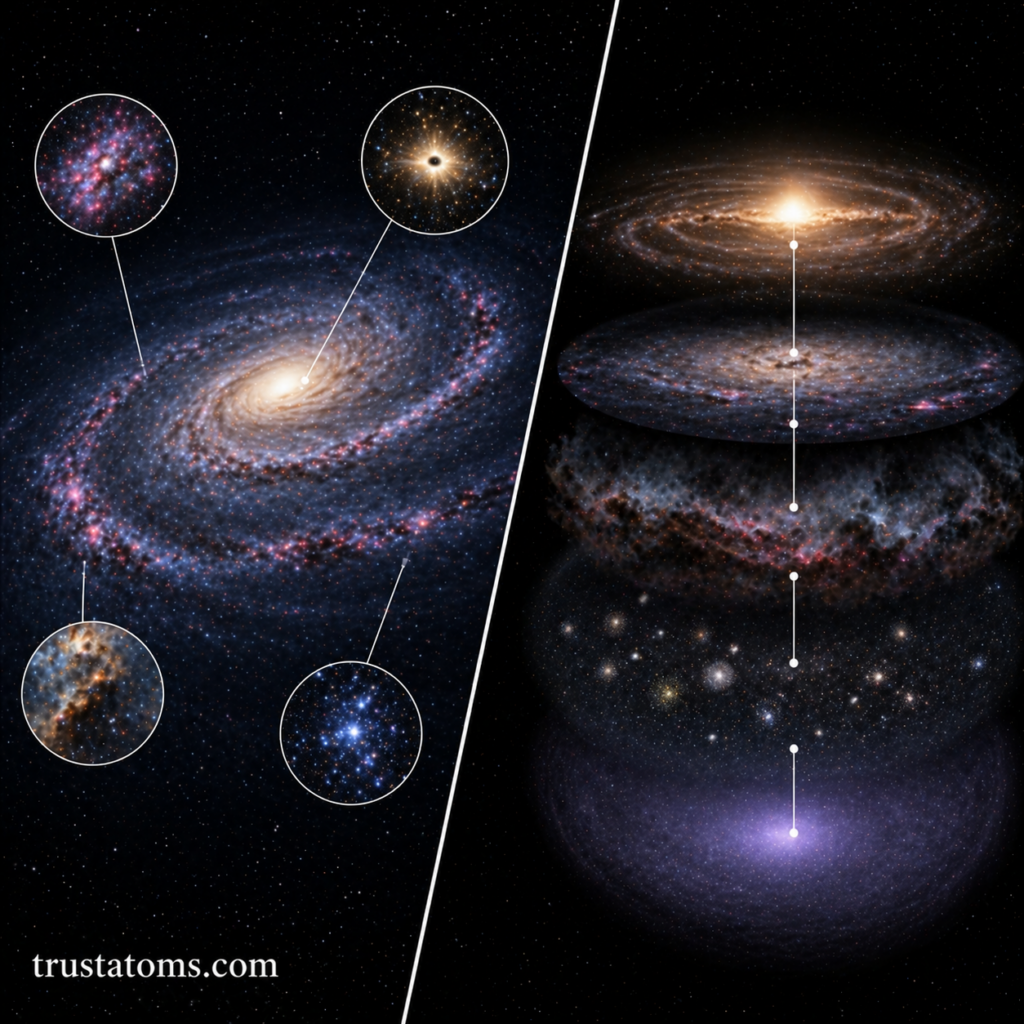
The Milky Way is our home galaxy—a vast spiral system containing hundreds of billions of stars, extensive clouds of gas and dust, and an enormous amount of dark matter. Understanding its structure helps astronomers map our place in the universe and study how galaxies form and evolve.
Overview of the Milky Way
The Milky Way is classified as a barred spiral galaxy, meaning it has a central bar-shaped region with spiral arms extending outward.
Key facts:
- Diameter: about 100,000–120,000 light-years
- Stars: 100–400 billion
- Age: over 13 billion years
- Shape: flattened disk with a central bulge
Our solar system is located in one of the galaxy’s spiral arms, far from the center.
The Galactic Core
At the very center of the Milky Way lies a dense region known as the galactic core.
Features of the core:
- Extremely high star density
- Strong gravitational forces
- Intense radiation and energy
At its center is a supermassive black hole called Sagittarius A*.
Why it matters:
- Influences the motion of nearby stars
- Plays a role in galaxy formation and evolution
- Emits powerful energy when active
The Galactic Bulge
Surrounding the core is the galactic bulge, a spherical or peanut-shaped region of older stars.
Key characteristics:
- Contains mostly old, metal-rich stars
- Dense and tightly packed
- Minimal new star formation
The bulge acts as a transition zone between the core and the disk.
The Galactic Disk
The disk is the most recognizable part of the Milky Way, containing the spiral arms and much of the visible structure.
Features of the disk:
- Flattened, rotating structure
- Rich in gas and dust
- Active star formation regions
What’s found in the disk:
- Young stars
- Open star clusters
- Nebulae (stellar nurseries)
- Planetary systems like our own
Spiral Arms
The Milky Way has several spiral arms extending outward from the central bar.
Major arms include:
- Perseus Arm
- Scutum-Centaurus Arm
- Sagittarius Arm
Our solar system is located in a smaller structure called the Orion Arm (or Orion Spur).
Importance of spiral arms:
- Sites of active star formation
- Contain large amounts of gas and dust
- Help define the galaxy’s shape
The Galactic Halo
Beyond the disk lies the galactic halo, a vast, spherical region surrounding the Milky Way.
Characteristics:
- Contains very old stars
- Sparse distribution
- Includes globular clusters
The halo extends far beyond the visible parts of the galaxy.
Dark Matter Halo
One of the most important components of the Milky Way is its dark matter halo.
Key points:
- Invisible and does not emit light
- Makes up most of the galaxy’s mass
- Extends well beyond the visible galaxy
Without dark matter, the Milky Way would not have enough gravity to hold itself together.
Star Clusters in the Milky Way
The galaxy contains two main types of star clusters.
Open clusters:
- Found in the disk
- Younger stars
- Loosely bound
Globular clusters:
- Found in the halo
- Very old stars
- Densely packed
These clusters help astronomers study stellar evolution and the history of the galaxy.
Gas, Dust, and Star Formation
Interstellar gas and dust play a vital role in the Milky Way’s ongoing evolution.
Their role:
- Form new stars in nebulae
- Absorb and scatter light
- Contribute to the galaxy’s dynamic structure
Regions like emission nebulae and molecular clouds are key sites of star birth.
Motion and Rotation
The Milky Way is constantly rotating.
Key details:
- Stars orbit the center of the galaxy
- The Sun takes about 225–250 million years to complete one orbit
- Different parts rotate at different speeds
This motion helps maintain the structure of the galaxy over time.
Why Understanding the Milky Way Matters
Studying our galaxy provides insights into:
- How galaxies form and evolve
- The distribution of dark matter
- The lifecycle of stars
- The potential for life elsewhere
Organizations like NASA and the European Space Agency use advanced telescopes and missions to map and study the Milky Way in detail.
Final Thoughts
The Milky Way is a complex and dynamic system made up of interconnected components—from its dense core to its vast halo. Each part plays a role in shaping the galaxy and supporting the processes that create stars, planets, and potentially life.
By understanding the structure of the Milky Way, we gain a clearer picture of our place in the cosmos and how galaxies like ours evolve over billions of years.