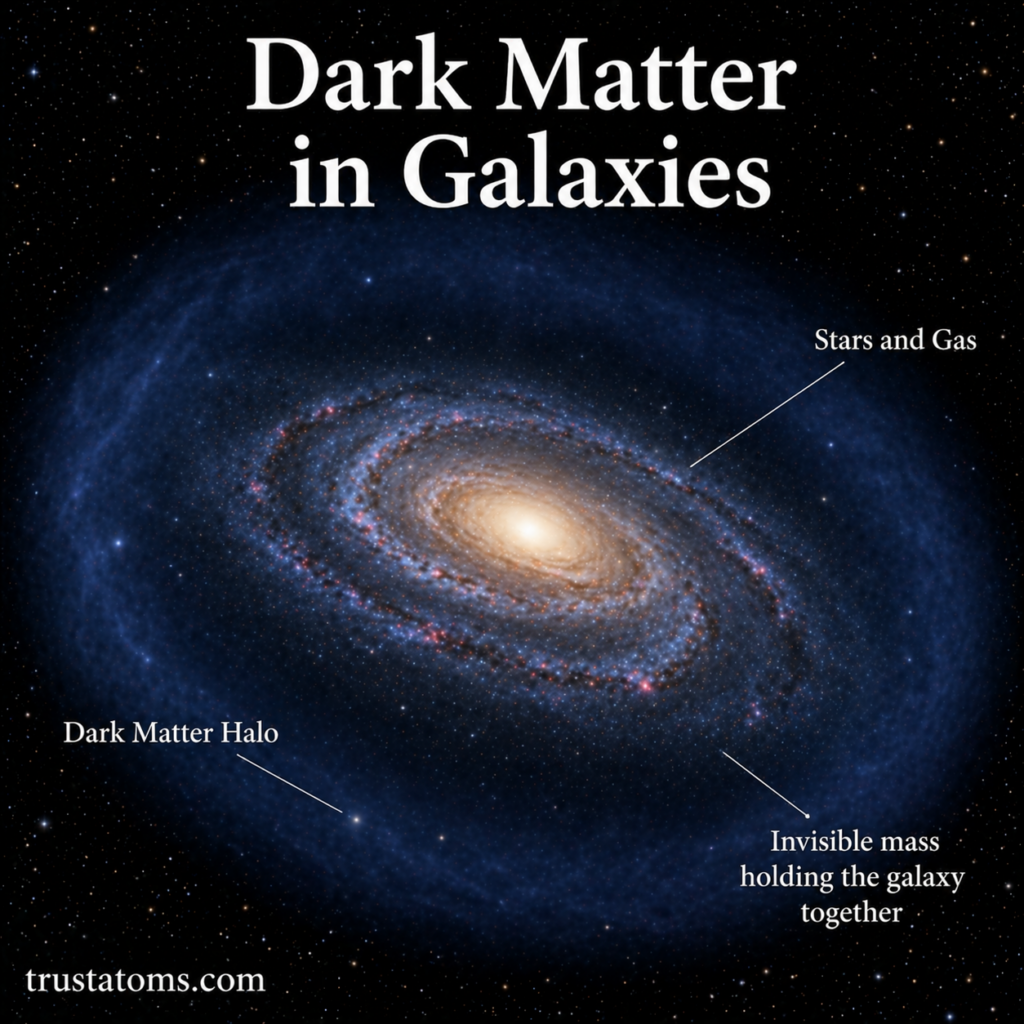
Galaxies are held together by more than what we can see. While stars, gas, and dust make up the visible parts of a galaxy, most of its mass is actually made of something invisible—dark matter.
Dark matter does not emit, absorb, or reflect light, making it impossible to observe directly. Yet its gravitational effects are essential for explaining how galaxies form, rotate, and stay intact.
What Is Dark Matter?
Dark matter is a mysterious form of matter that interacts primarily through gravity.
Key properties:
- Invisible to telescopes
- Does not emit or reflect light
- Makes up about 85% of the universe’s matter
- Detected through gravitational effects
Scientists infer its existence by observing how galaxies behave—especially how they rotate.
Evidence for Dark Matter in Galaxies
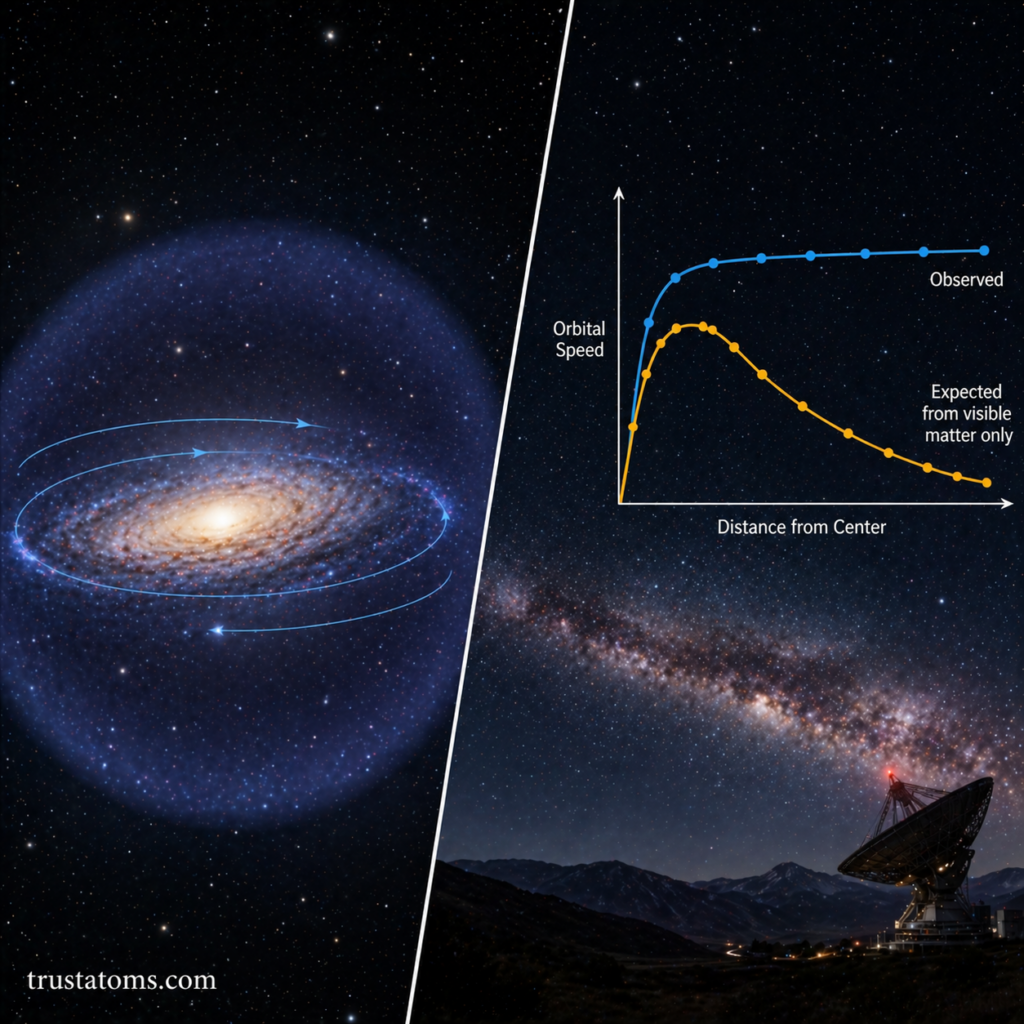
The strongest evidence for dark matter comes from galactic rotation curves.
What astronomers expected:
- Stars farther from the center should orbit more slowly
What they observed:
- Outer stars move just as fast as inner ones
This unexpected behavior suggests that galaxies contain much more mass than we can see.
Astronomer Vera Rubin played a key role in confirming this evidence.
The Dark Matter Halo
Dark matter in galaxies is believed to exist in a large, spherical region called the dark matter halo.
Characteristics of the halo:
- Extends far beyond the visible galaxy
- Contains most of the galaxy’s mass
- Surrounds the galactic disk and bulge
For example, the Milky Way is embedded within a massive dark matter halo that influences its structure and motion.
How Dark Matter Affects Galaxy Rotation
Dark matter plays a critical role in stabilizing galaxies.
Without dark matter:
- Outer stars would move too fast
- Galaxies would fly apart
- Structures would not remain stable
With dark matter:
- Additional gravity holds galaxies together
- Rotation speeds remain consistent across distances
- Galaxies maintain their shape over time
This is one of the clearest demonstrations of dark matter’s influence.
Role in Galaxy Formation
Dark matter is also essential in the early stages of galaxy formation.
Formation process:
- Dark matter clumps together due to gravity
- These clumps create gravitational wells
- Gas falls into these wells
- Stars begin to form
Without dark matter, galaxies may not have formed as efficiently—or at all.
Dark Matter and Galaxy Clusters
Dark matter doesn’t just affect individual galaxies—it also shapes larger structures.
In galaxy clusters:
- Provides most of the total mass
- Binds galaxies together gravitationally
- Influences large-scale cosmic structure
Observations of galaxy clusters show gravitational effects that cannot be explained by visible matter alone.
Gravitational Lensing
Another key piece of evidence for dark matter is gravitational lensing.
What happens:
- Massive objects bend light from distant sources
- Dark matter contributes to this bending
- The amount of bending reveals hidden mass
Astronomers use lensing to map dark matter distribution in galaxies and clusters.
What Could Dark Matter Be?
Despite decades of research, the true nature of dark matter remains unknown.
Leading theories include:
- Weakly Interacting Massive Particles (WIMPs)
- Axions (hypothetical particles)
- Other undiscovered particles
Experiments around the world aim to detect dark matter directly, but so far, it has only been observed indirectly.
Organizations like NASA and the European Space Agency continue to investigate its properties.
Why Dark Matter Matters
Understanding dark matter is one of the biggest challenges in modern astronomy.
It helps explain:
- Galaxy formation and structure
- Cosmic evolution
- Large-scale distribution of matter
- The behavior of gravitational systems
Research from institutions like Harvard-Smithsonian Center for Astrophysics continues to push the boundaries of what we know.
Final Thoughts
Dark matter may be invisible, but its effects are everywhere. From holding galaxies together to shaping the structure of the universe, it plays a fundamental role in cosmic evolution.
As scientists continue to study this mysterious substance, each discovery brings us closer to understanding one of the universe’s greatest secrets.