Galaxies are not just collections of stars—they are dynamic systems in motion. One of the most important tools astronomers use to study this motion is the galactic rotation curve. These curves reveal how stars and gas move within a galaxy and have led to one of the most surprising discoveries in modern astronomy: the existence of dark matter.
What Is a Galactic Rotation Curve?
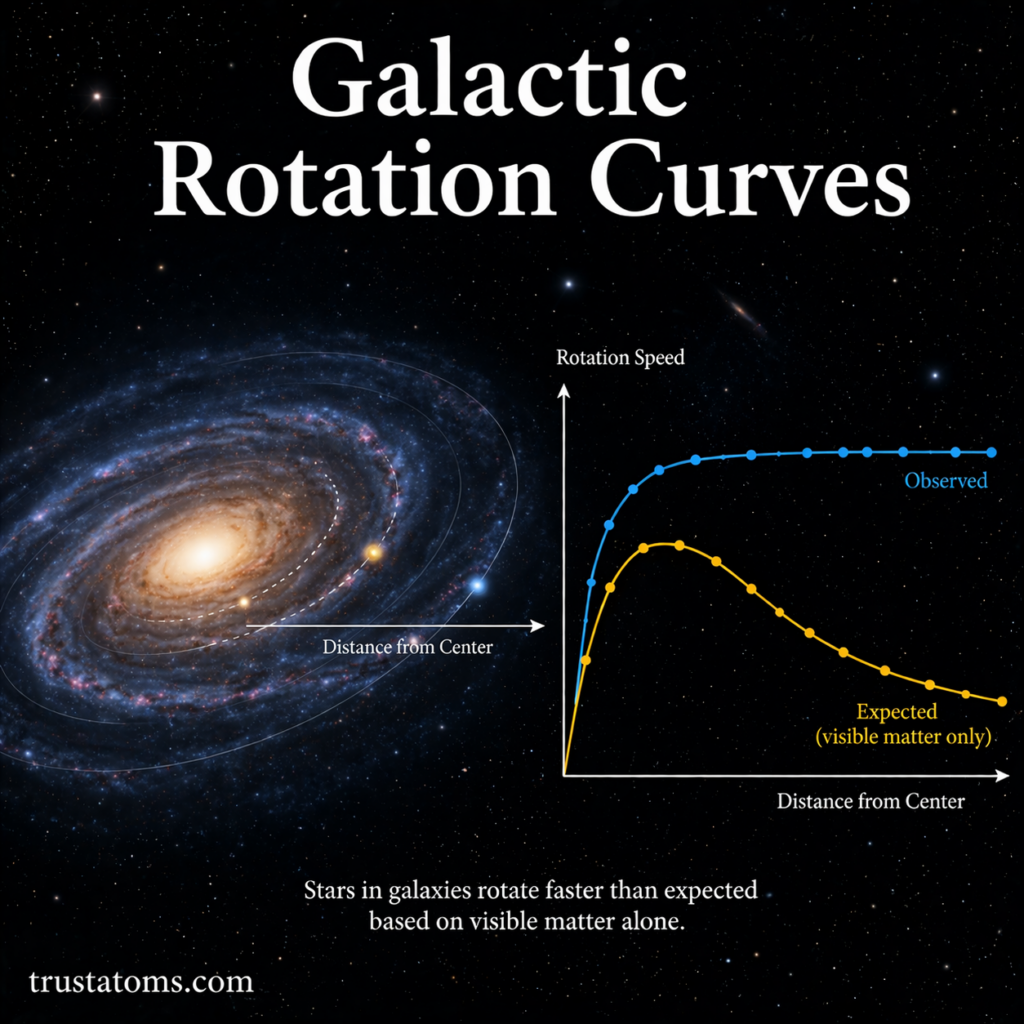
A galactic rotation curve is a graph that shows how fast stars and gas orbit the center of a galaxy at different distances.
What the curve measures:
- Orbital speed (vertical axis)
- Distance from the galactic center (horizontal axis)
By studying this relationship, astronomers can determine how mass is distributed within a galaxy.
What Scientists Expected
Based on visible matter alone—such as stars and gas—astronomers originally predicted a specific pattern.
Expected behavior:
- Stars closer to the center move faster
- Stars farther out should move slower
- Orbital speeds should decrease with distance
This prediction is similar to how planets orbit the Sun, where outer planets move more slowly than inner ones.
What Astronomers Observed
When astronomers measured real galaxies, they found something very different.
Observed behavior:
- Orbital speeds increase near the center (as expected)
- Speeds then level off instead of decreasing
- Outer stars move just as fast as inner ones
This creates a flat rotation curve, which contradicts predictions based only on visible matter.
The Role of Vera Rubin
Astronomer Vera Rubin played a crucial role in studying galactic rotation curves.
Her contributions:
- Measured rotation speeds in spiral galaxies
- Provided strong evidence for flat rotation curves
- Helped confirm the existence of unseen mass
Her work revolutionized our understanding of galaxies and led to widespread acceptance of dark matter.
Why Rotation Curves Matter
Rotation curves reveal how mass is distributed within a galaxy.
Key insights:
- Visible matter cannot account for observed speeds
- Additional unseen mass must be present
- This mass extends far beyond the visible galaxy
For example, the Milky Way shows a flat rotation curve, indicating a large amount of hidden mass.
Dark Matter and Rotation Curves
The most widely accepted explanation for flat rotation curves is dark matter.
How dark matter explains the data:
- Forms a massive halo around galaxies
- Adds gravitational pull at large distances
- Keeps orbital speeds high even far from the center
Without dark matter, galaxies would not remain stable based on observed rotation speeds.
Comparing Expected vs Observed Curves
Understanding the difference between expected and observed curves is key.
Expected curve (visible matter only):
- Peaks near the center
- Gradually declines outward
Observed curve (real galaxies):
- Rises near the center
- Flattens and remains constant
This difference is one of the strongest pieces of evidence for dark matter in the universe.
Rotation Curves in Different Galaxy Types
Rotation curves are observed across many types of galaxies.
Spiral galaxies:
- Clear, well-measured rotation curves
- Strong evidence for dark matter halos
Elliptical galaxies:
- More complex motion patterns
- Still show signs of unseen mass
Irregular galaxies:
- Less structured but still exhibit unusual velocity patterns
Despite differences in shape, the presence of dark matter appears consistent.
How Rotation Is Measured
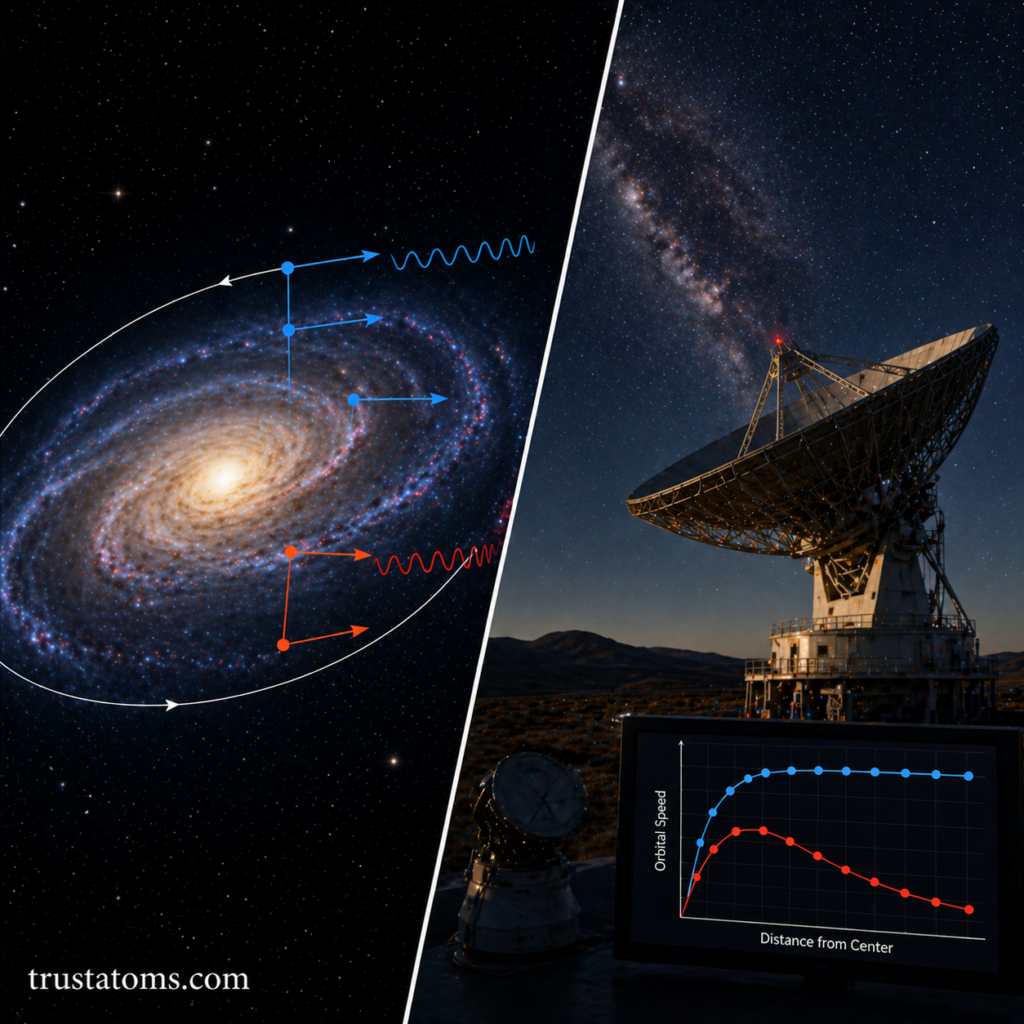
Astronomers use advanced techniques to measure galactic motion.
Methods include:
- Doppler shift of light from stars and gas
- Radio observations of hydrogen gas
- Spectroscopy from ground and space telescopes
Organizations like NASA and the European Space Agency use these methods to study galaxies across the universe.
Why Galactic Rotation Curves Are Important
Studying rotation curves helps astronomers:
- Map the distribution of mass in galaxies
- Provide evidence for dark matter
- Understand galaxy formation and evolution
- Test theories of gravity on large scales
Research from institutions like Harvard-Smithsonian Center for Astrophysics continues to refine our understanding of these phenomena.
Final Thoughts
Galactic rotation curves are a powerful tool for uncovering the hidden structure of the universe. What began as a simple measurement of star motion led to the discovery of dark matter—one of the biggest mysteries in science.
By continuing to study how galaxies rotate, astronomers move closer to understanding the true nature of the cosmos.