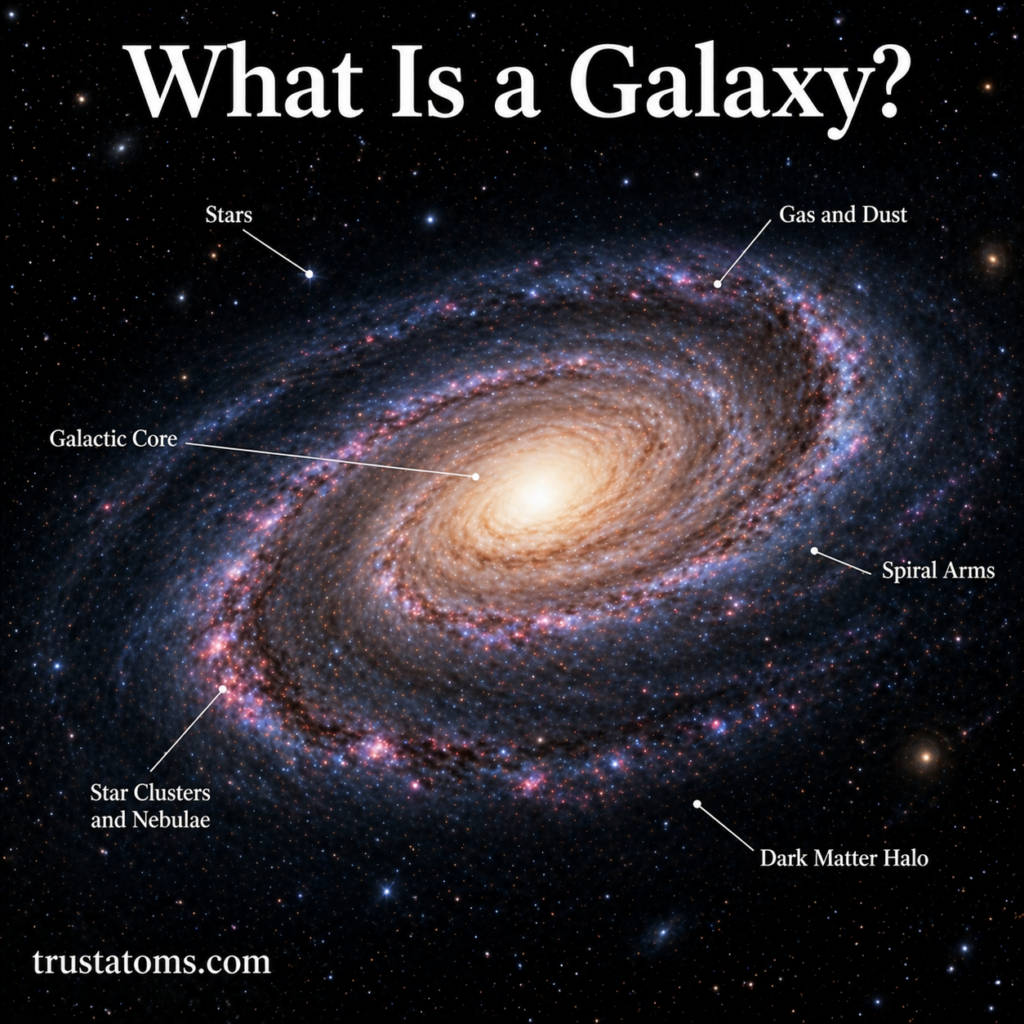
A galaxy is a vast system of stars, gas, dust, and dark matter bound together by gravity. These enormous structures are the building blocks of the universe, each containing anywhere from millions to trillions of stars.
Our home galaxy, the Milky Way, is just one of billions scattered across the observable universe.
What Makes Up a Galaxy?
Galaxies are complex systems made of several key components.
Main components:
- Stars: The most visible part of a galaxy
- Gas and dust: The raw materials for new star formation
- Dark matter: An invisible substance that provides most of the galaxy’s mass
- Star clusters: Groups of stars bound together
- Nebulae: Clouds where stars are born
At the center of most galaxies lies a supermassive black hole, which plays a role in shaping the galaxy’s structure and activity.
Types of Galaxies
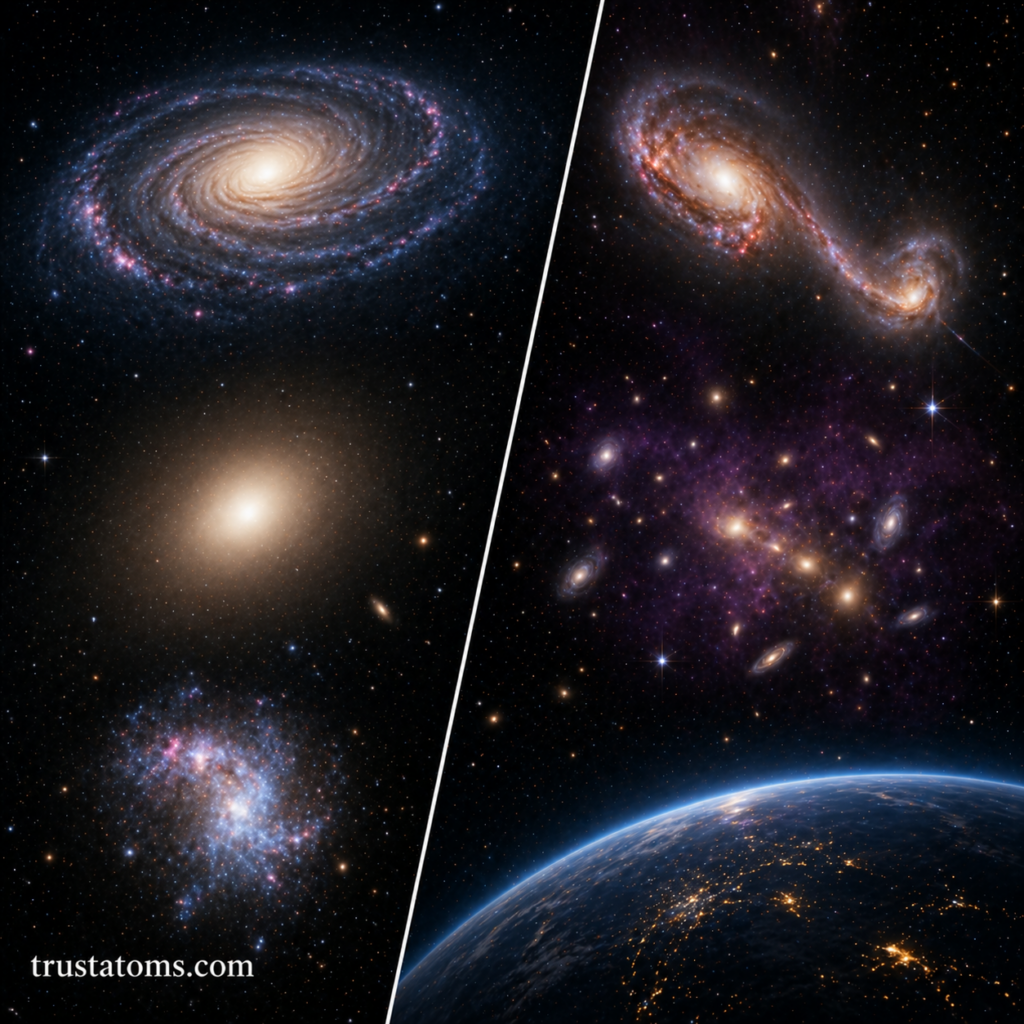
Galaxies come in different shapes and sizes. Astronomers classify them into several main types.
Spiral galaxies
- Flat, disk-shaped with spiral arms
- Contain both young and old stars
- Rich in gas and dust
The Milky Way is a spiral galaxy.
Elliptical galaxies
- Rounded or oval-shaped
- Contain mostly older stars
- Very little gas or new star formation
Irregular galaxies
- No defined shape
- Often chaotic in appearance
- Usually formed through gravitational interactions or collisions
Each type represents a different stage or outcome in galaxy evolution.
How Big Is a Galaxy?
Galaxies are enormous in scale.
Typical sizes:
- Diameter: tens of thousands to hundreds of thousands of light-years
- Number of stars: millions to trillions
- Mass: dominated by dark matter
For comparison, it takes light about 100,000 years to travel across the Milky Way.
How Galaxies Form
Galaxies formed early in the universe from small fluctuations in matter density.
Formation process:
- Regions with slightly higher density attract more matter
- Gravity pulls gas and dark matter together
- Stars begin forming within these regions
- Structures grow through mergers and accumulation
Over billions of years, galaxies evolve through interactions, collisions, and internal processes.
Galaxy Groups and Clusters
Galaxies are not isolated—they often exist in groups or clusters.
Examples:
- Small groups of a few galaxies
- Large clusters containing hundreds or thousands of galaxies
- Superclusters forming vast cosmic networks
The Milky Way is part of a small group called the Local Group, which includes galaxies like Andromeda.
The Role of Dark Matter
Dark matter plays a crucial role in holding galaxies together.
Why it matters:
- Provides most of the galaxy’s gravitational pull
- Prevents galaxies from flying apart due to rotation
- Shapes large-scale cosmic structure
Although invisible, dark matter is essential for explaining how galaxies behave.
Supermassive Black Holes
At the center of most galaxies lies a supermassive black hole.
Key facts:
- Millions to billions of times the mass of the Sun
- Influences star motion near the galactic core
- Can power energetic phenomena like quasars
These black holes are thought to play a role in regulating galaxy growth.
Why Galaxies Matter
Studying galaxies helps astronomers understand the universe on the largest scales.
Key insights:
- How matter is distributed across the cosmos
- The history and evolution of the universe
- The formation of stars and planetary systems
- The role of dark matter and dark energy
Organizations like NASA and the European Space Agency continue to explore galaxies using advanced telescopes and space missions.
Final Thoughts
Galaxies are the grand structures of the universe, containing the stars, planets, and systems that make up cosmic life. From elegant spirals to chaotic irregular shapes, each galaxy tells a story of gravity, time, and evolution.
As we continue to study galaxies, we deepen our understanding of where we come from—and how vast the universe truly is.