At the center of nearly every large galaxy lies one of the most extreme objects in the universe: a supermassive black hole. These cosmic giants contain millions to billions of times the mass of the Sun and exert a powerful influence over their surroundings.
Despite their name, black holes are not empty voids—they are incredibly dense regions where gravity is so strong that nothing, not even light, can escape.
What Is a Supermassive Black Hole?
A supermassive black hole (SMBH) is the largest type of black hole, typically found at the core of galaxies.
Key Characteristics:
- Mass: Millions to billions of solar masses
- Location: Galactic centers
- Gravity: Strong enough to shape entire galaxies
- Visibility: Detected indirectly through surrounding activity
One well-known example is Sagittarius A*, located at the center of the Milky Way.
How Do Supermassive Black Holes Form?
The exact origin of supermassive black holes is still an active area of research, but several leading theories explain their formation.
1. Direct Collapse of Massive Gas Clouds
- Huge clouds of gas collapse under gravity
- Form massive black holes without becoming stars first
2. Growth from Smaller Black Holes
- Stellar-mass black holes merge over time
- Gradual accumulation leads to massive sizes
3. Early Universe “Seed” Black Holes
- Formed shortly after the Big Bang
- Rapidly grew by absorbing matter and merging
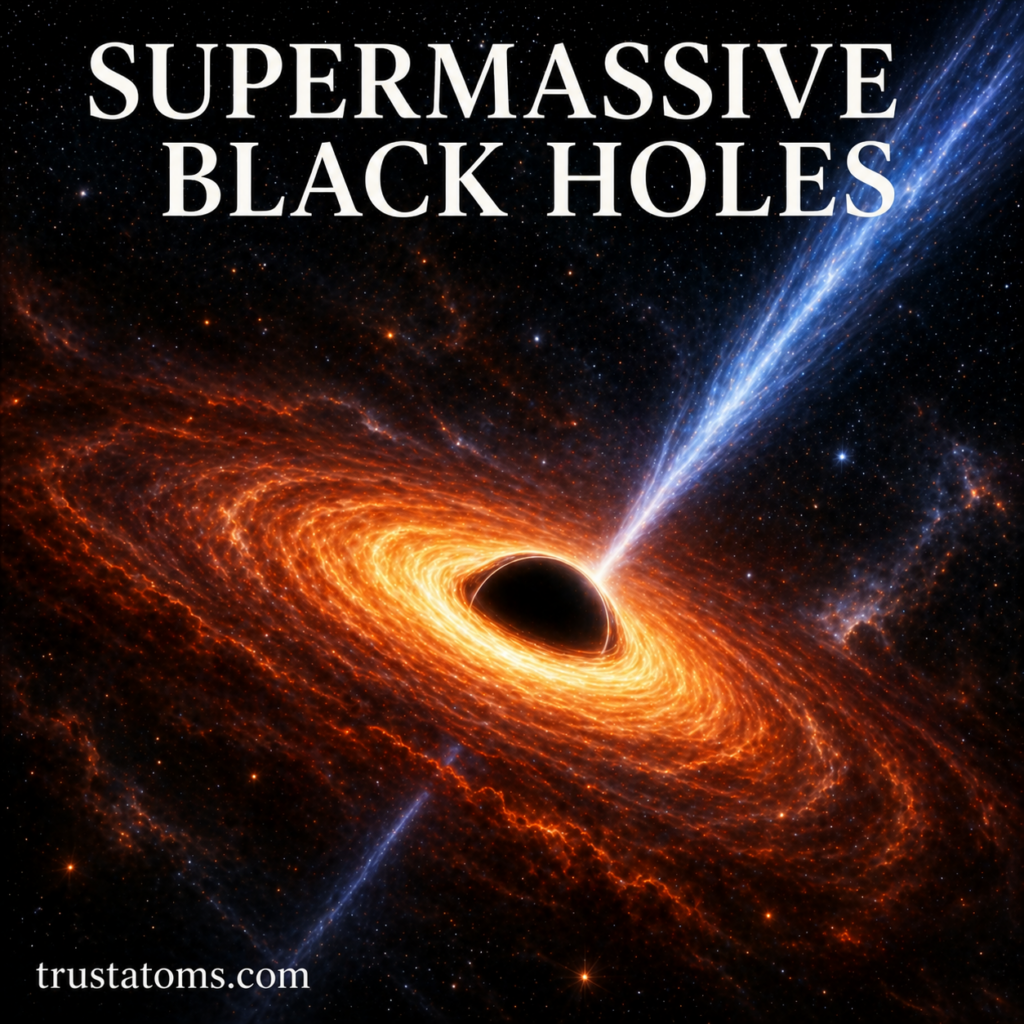
The Structure of a Supermassive Black Hole
Although black holes themselves cannot be seen, their surrounding structure can be studied.
Event Horizon
- The boundary beyond which nothing can escape
- Marks the “point of no return”
Accretion Disk
- A rotating disk of gas and dust
- Heated to extreme temperatures
- Emits intense radiation
Relativistic Jets
- High-speed streams of particles
- Ejected along the black hole’s poles
- Can extend across thousands of light-years
How Supermassive Black Holes Affect Galaxies
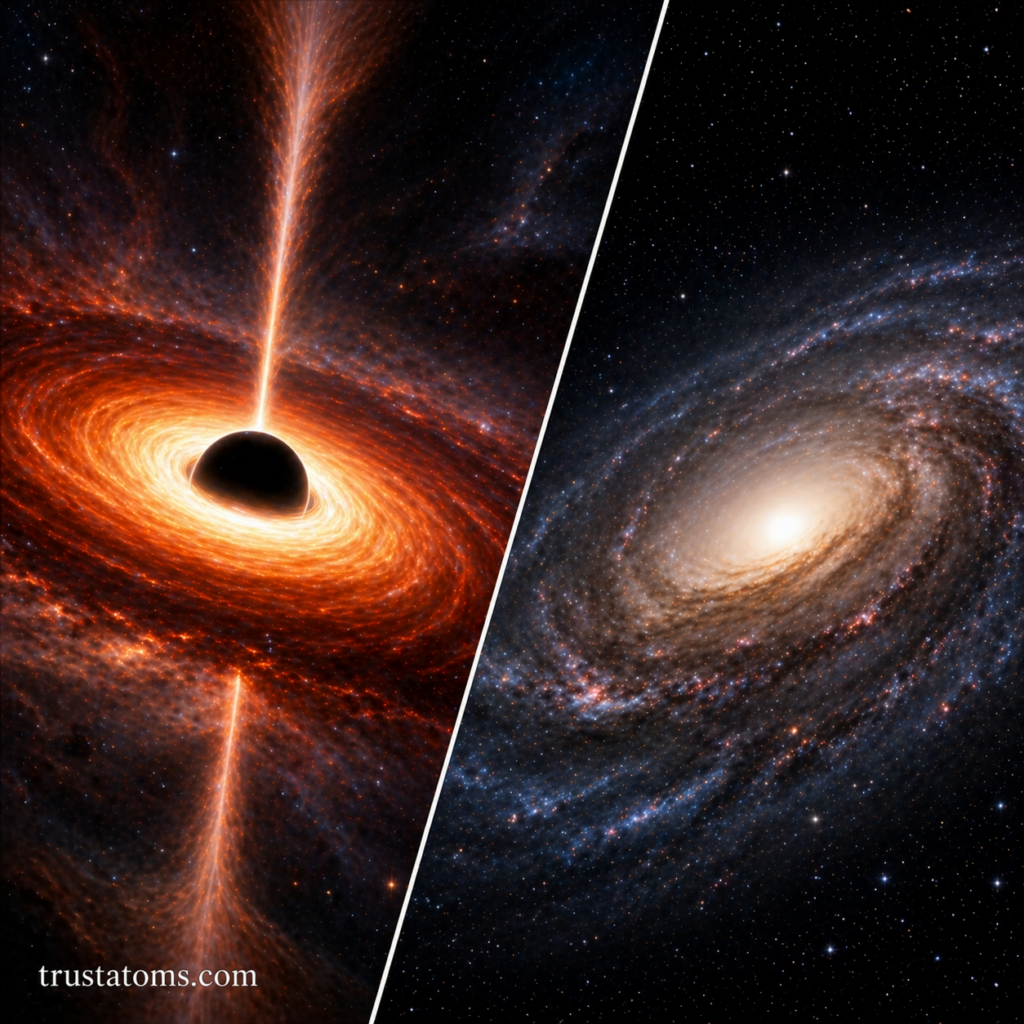
Supermassive black holes are not passive—they actively shape the galaxies around them.
Key Influences:
- Regulate star formation
- Control the flow of gas in galaxies
- Generate powerful energy outputs
- Influence galaxy structure and evolution
When actively feeding on matter, they become active galactic nuclei (AGN), some of the brightest objects in the universe.
Active vs Dormant Black Holes
Not all supermassive black holes are actively consuming matter.
Active Black Holes:
- Surrounded by bright accretion disks
- Emit strong radiation (X-rays, radio waves)
- Often produce jets
Dormant Black Holes:
- Little or no incoming material
- Much less visible
- Still exert strong gravitational influence
Sagittarius A* is currently considered relatively quiet compared to active black holes in other galaxies.
How Scientists Detect Supermassive Black Holes
Since black holes do not emit light, astronomers rely on indirect methods.
Detection Techniques:
- Stellar Motion
- Stars orbit rapidly around an invisible object
- Indicates a massive gravitational source
- Accretion Disk Radiation
- Bright emissions from heated gas
- Reveals active black holes
- Gravitational Lensing
- Light bends around massive objects
- Confirms strong gravitational fields
- Imaging
- Telescopes like the Event Horizon Telescope capture shadows of black holes
The Largest Known Black Holes
Some supermassive black holes are truly enormous.
Examples:
- Billions of times the mass of the Sun
- Found in massive galaxies and quasars
- Capable of powering extremely bright cosmic phenomena
These giants push the limits of what scientists understand about gravity and cosmic structure.
Why Supermassive Black Holes Matter
Supermassive black holes are central to understanding the universe.
Scientific Importance:
- Explain galaxy formation and growth
- Help map cosmic evolution
- Provide insight into extreme physics
- Test theories of gravity and spacetime
Without them, galaxies would likely evolve very differently.
Are Black Holes Dangerous?
Despite their immense power, supermassive black holes are not a threat to Earth.
Why Not:
- They are extremely far away
- Their gravity only affects nearby objects
- The Milky Way’s black hole is stable and distant
Black holes do not “wander” through space consuming everything—they influence only their immediate surroundings.
Final Thoughts
Supermassive black holes are among the most fascinating and mysterious objects in the universe. Hidden at the centers of galaxies, they quietly—but powerfully—shape the cosmos.
- They form through complex and still-debated processes
- They influence entire galaxies
- They can be both quiet and incredibly energetic
- They help scientists understand the limits of physics
As research continues, these cosmic giants will remain at the forefront of astronomical discovery, offering clues about the universe’s past, present, and future.