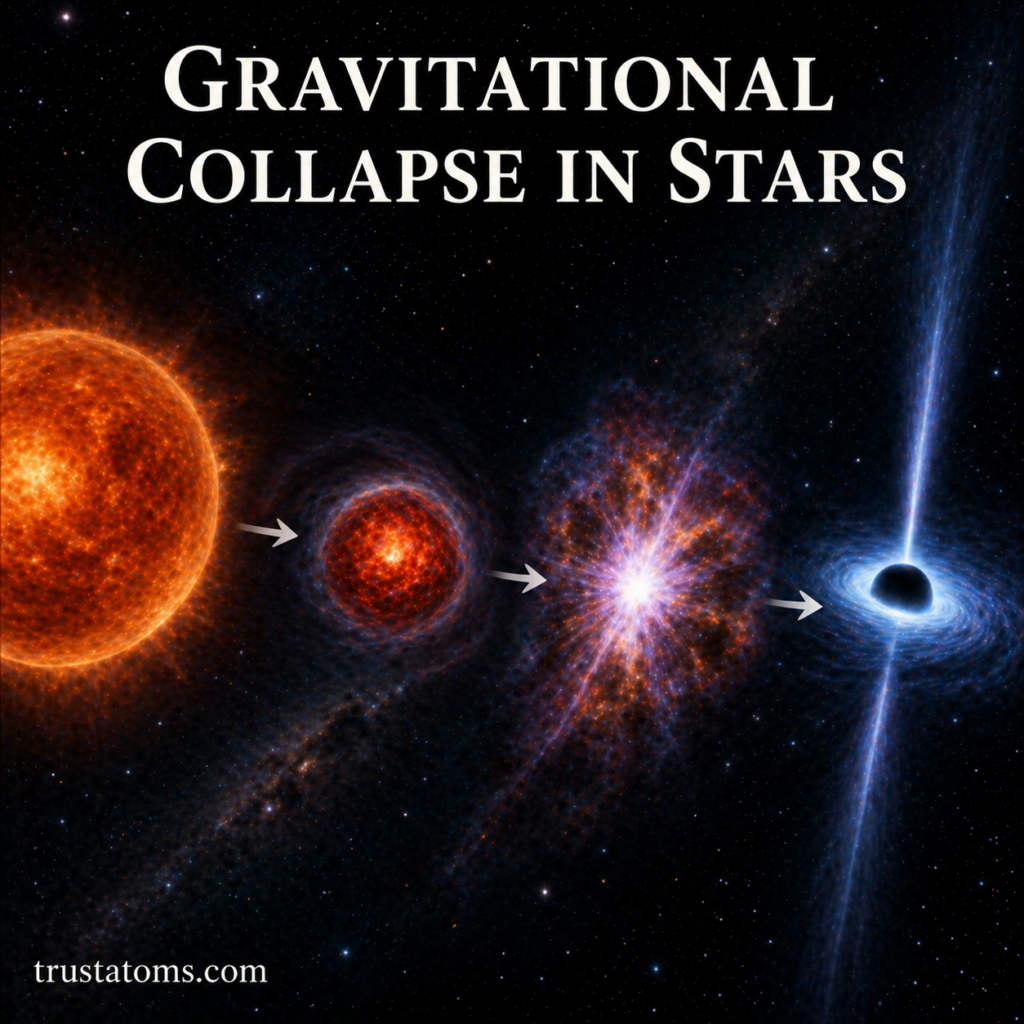
Stars spend most of their lives in a delicate balance between two opposing forces: outward pressure from nuclear fusion and inward pull from gravity. But when that balance breaks, gravity takes over—and the result is one of the most dramatic processes in the universe: gravitational collapse.
This process is responsible for the formation of some of the most extreme objects known, including white dwarfs, neutron stars, and black holes.
What Is Gravitational Collapse?
Gravitational collapse occurs when an object’s internal pressure is no longer strong enough to resist its own gravity. As a result, the material begins to fall inward, compressing into a smaller and denser state.
Key Idea:
- Gravity pulls matter inward
- Internal pressure pushes outward
- Collapse happens when gravity wins
This process can happen at different stages of a star’s life, but it is most significant at the end.
Why Stars Remain Stable (Until They Don’t)
During most of a star’s life, it exists in a stable state called hydrostatic equilibrium.
Balance of Forces:
- Outward force: Energy from nuclear fusion
- Inward force: Gravity
As long as fusion continues, the star remains stable. But once fuel runs out, the outward pressure weakens—and collapse begins.
What Triggers Gravitational Collapse?
The primary trigger is the exhaustion of nuclear fuel in the star’s core.
Step-by-Step Trigger:
- Hydrogen fusion slows or stops
- Core temperature and pressure drop
- Gravity begins to dominate
- Core starts to contract
- Collapse accelerates
In massive stars, this process can happen rapidly and violently.
Outcomes of Gravitational Collapse
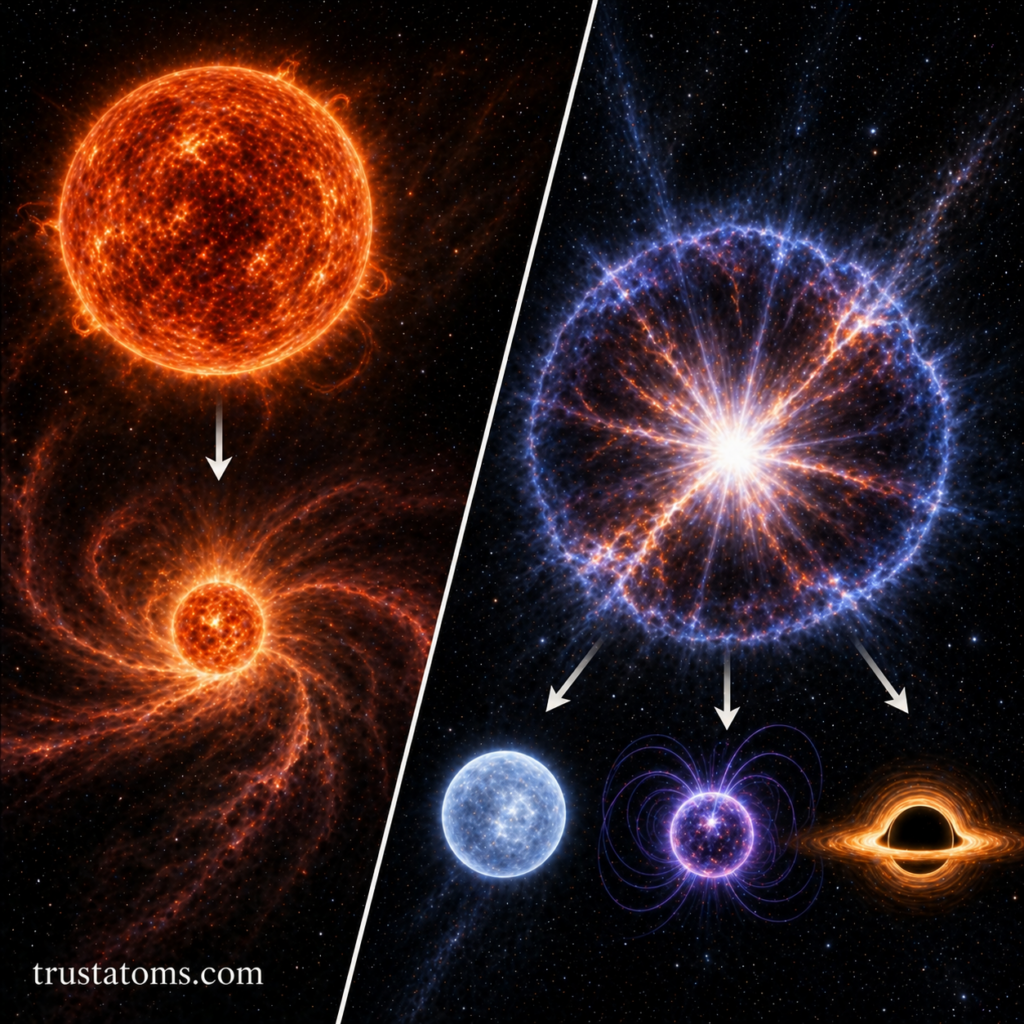
The result of collapse depends almost entirely on the star’s mass.
Low-Mass Stars: White Dwarfs
- Core contracts and stabilizes
- Electron pressure halts collapse
- Outer layers drift away
Result:
- Formation of a white dwarf
- Dense, Earth-sized remnant
Medium to High-Mass Stars: Neutron Stars
- Core collapses further under gravity
- Protons and electrons combine to form neutrons
- Neutron pressure stops collapse
Result:
- Formation of a neutron star
- Extremely dense—teaspoon weighs billions of tons
Very Massive Stars: Black Holes
- Gravity overwhelms all forms of pressure
- Collapse continues indefinitely
- No known force stops it
Result:
- Formation of a black hole
- Event horizon forms, trapping everything inside
Gravitational Collapse and Supernovae
In massive stars, gravitational collapse often leads to a supernova explosion.
What Happens:
- Core collapses suddenly
- Outer layers rebound outward
- Massive explosion releases energy
This explosion can briefly outshine an entire galaxy and spread heavy elements into space.
The Role of Pressure in Stopping Collapse
Different types of pressure can resist collapse at various stages:
Types of Pressure:
- Thermal Pressure – From heat generated by fusion
- Electron Degeneracy Pressure – Stops collapse in white dwarfs
- Neutron Degeneracy Pressure – Supports neutron stars
If gravity exceeds all these, collapse continues into a black hole.
Why Density Increases Dramatically
As a star collapses, its volume decreases while mass remains nearly the same.
Result:
- Density increases rapidly
- Matter becomes tightly packed
- Extreme physical conditions emerge
This is why collapsed objects are some of the densest in the universe.
Gravitational Collapse in Star Formation
Gravitational collapse doesn’t only happen at the end of a star’s life—it also plays a role at the beginning.
In Star Formation:
- A cloud of gas and dust begins to contract
- Gravity pulls material inward
- Core heats up as it compresses
- Fusion ignites, forming a new star
This shows that gravitational collapse is both a destructive and creative force.
Why Gravitational Collapse Matters
This process is central to many key phenomena in astronomy.
Scientific Importance:
- Explains how stars are born and die
- Leads to formation of compact objects
- Drives supernova explosions
- Distributes heavy elements across the universe
Without gravitational collapse, the universe would lack black holes, neutron stars, and even new stars.
Final Thoughts
Gravitational collapse is one of the most powerful processes in the cosmos. It marks both the end of stellar life and the beginning of new cosmic structures.
- It begins when fusion can no longer support a star
- It leads to incredibly dense remnants
- It powers some of the most energetic events in the universe
- It plays a role in both star formation and destruction
In many ways, gravitational collapse is the universe’s way of reshaping matter—compressing it into new forms and setting the stage for future cosmic evolution.