Across the universe, some of the most energetic and visually striking structures are not stars or galaxies—but swirling disks of matter spiraling into them. These are known as accretion disks, and they play a crucial role in how cosmic objects grow, emit energy, and evolve.
From newborn stars to supermassive black holes, accretion disks are found in a wide range of environments, acting as engines of both creation and destruction.
What Is an Accretion Disk?
An accretion disk is a rotating, flattened disk of gas, dust, or plasma that forms around a central object due to gravity.
Common Central Objects:
- Black holes
- Neutron stars
- White dwarfs
- Young forming stars
As material falls inward, it doesn’t drop straight in. Instead, it spirals, forming a disk due to angular momentum.
How Accretion Disks Form
Accretion disks form when material is pulled toward a massive object but retains sideways motion.
Step-by-Step Formation:
- Gas and dust are attracted by gravity
- Material begins to fall inward
- Rotation causes the material to spread into a disk
- Friction and collisions heat the disk
- Matter gradually spirals toward the center
This process converts gravitational energy into heat and radiation.
Why Accretion Disks Glow
Accretion disks are often extremely bright, sometimes outshining entire galaxies.
Reasons for Their Brightness:
- Friction between particles generates heat
- Temperatures can reach millions of degrees
- Hot material emits visible light, X-rays, and other radiation
The closer material gets to the central object, the faster it moves—and the hotter it becomes.
Types of Accretion Disks
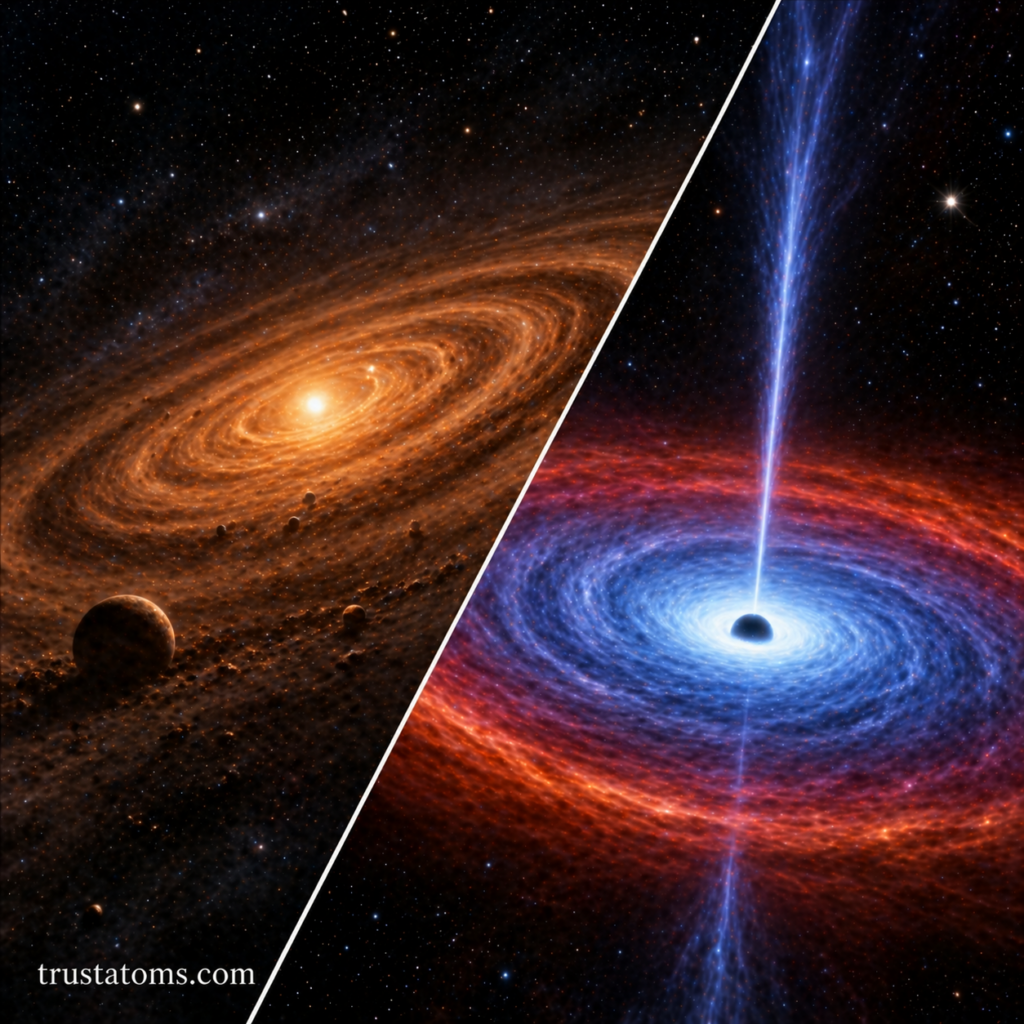
Accretion disks vary depending on the central object they surround.
Around Black Holes
- Extremely hot and fast-moving
- Can emit X-rays and gamma rays
- Often associated with powerful jets
These disks are among the most energetic structures in the universe.
Around Young Stars (Protoplanetary Disks)
- Cooler and composed of gas and dust
- Sites where planets form
- Can last millions of years
These disks are essential for building planetary systems.
Around White Dwarfs and Neutron Stars
- Found in binary systems
- Material is pulled from a companion star
- Can lead to explosive events like novae
The Role of Friction and Viscosity
A key factor in accretion disks is viscosity—the internal friction that allows material to move inward.
Why It Matters:
- Transfers angular momentum outward
- Allows matter to spiral inward
- Converts motion into heat
Without viscosity, material would simply orbit indefinitely instead of falling inward.
Accretion Disks and Jets
Many accretion disks produce narrow, high-speed jets of particles that shoot out from the poles of the central object.
Key Features:
- Travel at near-light speeds
- Extend vast distances into space
- Powered by magnetic fields and rotation
These jets are often seen in systems involving black holes and neutron stars.
Accretion Disks in Galaxy Centers
At the centers of galaxies, supermassive black holes are often surrounded by massive accretion disks.
When Active:
- The system becomes an active galactic nucleus (AGN)
- Emits enormous amounts of energy
- Can outshine the entire galaxy
These disks help regulate the growth of black holes and influence galaxy evolution.
Why Accretion Disks Matter
Accretion disks are fundamental to many processes in astronomy.
Scientific Importance:
- Explain how black holes grow
- Reveal how stars and planets form
- Produce some of the brightest objects in the universe
- Help scientists study extreme physics
What Happens to the Material?
As material moves through the disk, it eventually meets one of several fates:
Possible Outcomes:
- Falls into the central object
- Gets ejected in jets
- Forms planets (in young star systems)
- Radiates energy and disperses
Final Thoughts
Accretion disks are powerful, dynamic structures that connect many of the universe’s most important phenomena. Whether feeding a black hole or forming new planets, these disks transform matter and energy on a cosmic scale.
- They form through gravity and rotation
- They glow due to extreme heat and friction
- They drive jets and high-energy emissions
- They are essential for both stellar birth and cosmic destruction
By studying accretion disks, astronomers gain insight into how the universe builds, evolves, and recycles itself.