Gamma-ray bursts (GRBs) are the most powerful explosions ever observed in the universe. In just a few seconds, they can release more energy than the Sun will produce over its entire lifetime.
Discovered by accident in the late 20th century, these intense flashes of gamma radiation have become one of the most fascinating—and mysterious—phenomena in astronomy. Understanding where they come from helps scientists explore the most extreme conditions in the cosmos.
What Are Gamma-Ray Bursts?
Gamma-ray bursts are brief but extremely energetic flashes of gamma radiation—the highest-energy form of light.
Key Characteristics:
- Duration: Milliseconds to several minutes
- Energy: Immense, often outshining entire galaxies
- Detection: Observed by space-based telescopes
- Follow-up: Often followed by an “afterglow” in X-ray, optical, and radio wavelengths
These bursts occur randomly across the sky, making them difficult to predict but incredibly valuable to study.
Types of Gamma-Ray Bursts
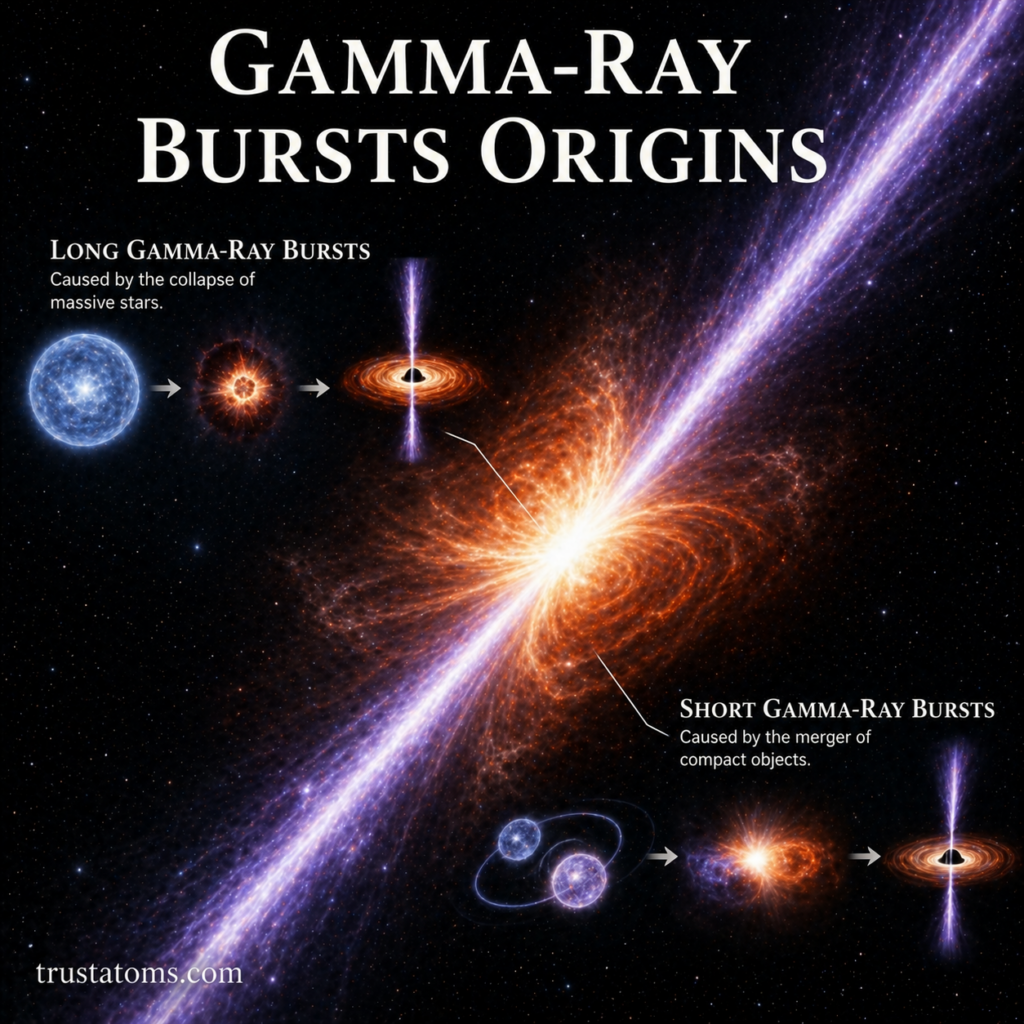
Astronomers classify GRBs into two main categories based on how long they last.
Short Gamma-Ray Bursts
- Duration: Less than 2 seconds
- Origin: Merging neutron stars or compact objects
- Characteristics: Brief but extremely intense
These bursts are often linked to gravitational wave events and are key to studying compact object collisions.
Long Gamma-Ray Bursts
- Duration: More than 2 seconds (can last minutes)
- Origin: Collapse of massive stars
- Characteristics: Associated with supernova explosions
These are more common and are typically observed in distant galaxies.
How Gamma-Ray Bursts Form
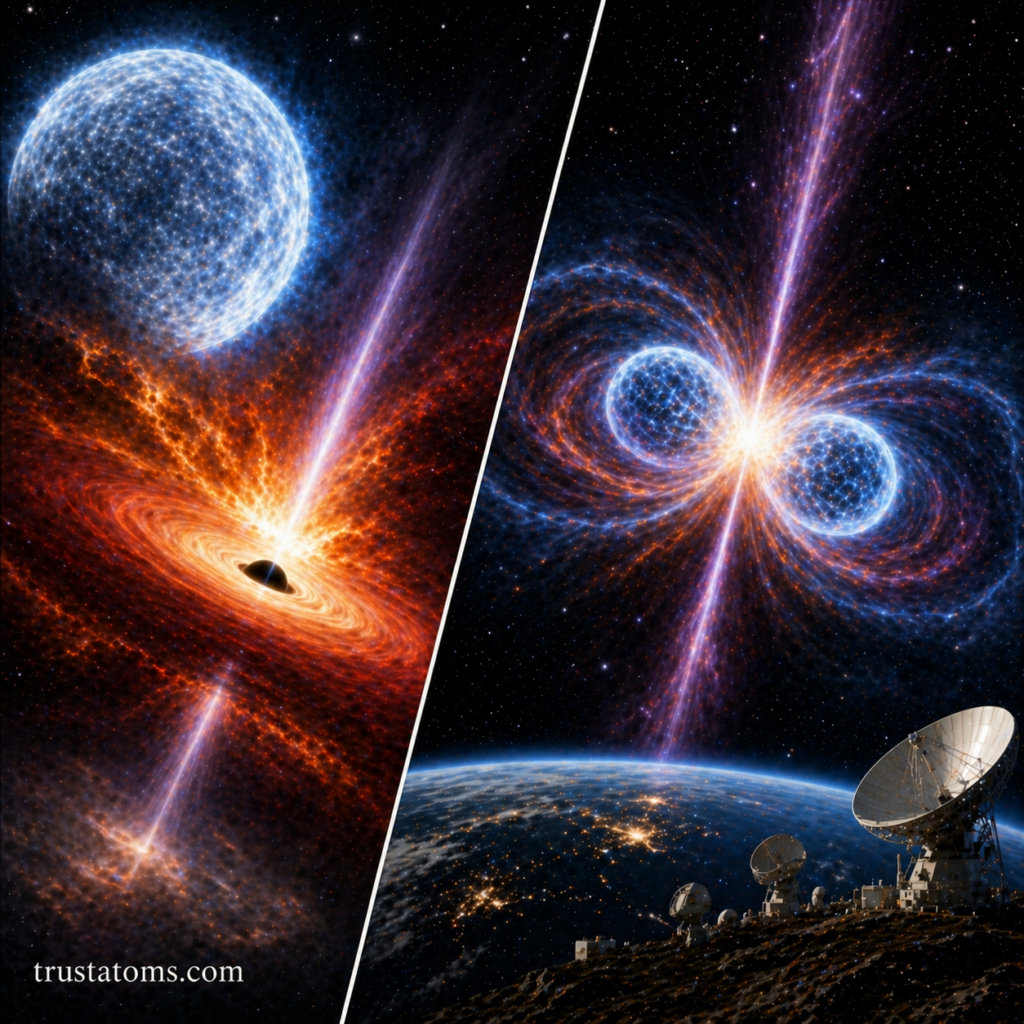
The origins of GRBs depend on the type, but both involve extreme conditions and rapid energy release.
1. Collapsing Massive Stars (Long GRBs)
When a very massive star runs out of fuel, its core collapses under gravity.
Process:
- Core collapses into a black hole
- Surrounding material forms an accretion disk
- Energy is funneled into narrow jets
- Jets blast outward at near-light speed
- If aligned with Earth, we detect a gamma-ray burst
This process is often called a “collapsar.”
2. Neutron Star Mergers (Short GRBs)
Short GRBs are typically caused by the collision of two dense objects.
Process:
- Two neutron stars orbit each other
- They gradually spiral inward
- A violent merger occurs
- A black hole forms
- Jets are launched, producing a burst
These events are also responsible for producing heavy elements like gold and platinum.
Why Jets Are Important
Gamma-ray bursts are not emitted in all directions—they are focused into narrow beams.
Key Points:
- Energy is concentrated into jets
- Jets travel at nearly the speed of light
- Only visible if pointed toward Earth
This explains why GRBs appear rare, even though they may happen frequently across the universe.
The Afterglow Effect
After the initial burst, many GRBs produce an afterglow that can last for days or even weeks.
Afterglow Features:
- Emission in X-ray, visible light, and radio waves
- Caused by interaction with surrounding gas
- Helps astronomers pinpoint the burst location
Studying afterglows provides valuable data about the environment and distance of the event.
How Powerful Are Gamma-Ray Bursts?
Gamma-ray bursts are among the most energetic events known.
Energy Comparison:
- Can release in seconds what the Sun emits over billions of years
- Bright enough to be detected across billions of light-years
Despite their power, their focused nature means they are unlikely to affect Earth directly.
Could Gamma-Ray Bursts Affect Earth?
In theory, yes—but the chances are extremely low.
Potential Effects (If Nearby and Aligned):
- Damage to Earth’s ozone layer
- Increased radiation exposure
- Possible impact on life
However, no known nearby star poses an immediate GRB threat.
Why Gamma-Ray Bursts Matter
Gamma-ray bursts are important tools for understanding the universe.
Scientific Importance:
- Reveal how massive stars die
- Provide evidence of neutron star mergers
- Help measure distances in the universe
- Offer insight into black hole formation
- Contribute to understanding extreme physics
They act like cosmic beacons, allowing astronomers to study distant regions of space.
How Scientists Detect GRBs
Because gamma rays don’t penetrate Earth’s atmosphere, detection requires space-based instruments.
Detection Methods:
- Gamma-ray satellites monitor the sky continuously
- Rapid alerts are sent to telescopes worldwide
- Follow-up observations track afterglows
This coordinated effort helps scientists gather data in real time.
Final Thoughts
Gamma-ray bursts are brief, but they reveal some of the most dramatic events in the universe. Whether caused by collapsing stars or merging neutron stars, these explosions represent the extremes of energy, gravity, and motion.
- They are the brightest explosions known
- They originate from violent cosmic events
- They produce focused jets of energy
- They help scientists study the distant universe
By unlocking the origins of gamma-ray bursts, astronomers gain a deeper understanding of how the universe evolves under its most extreme conditions.