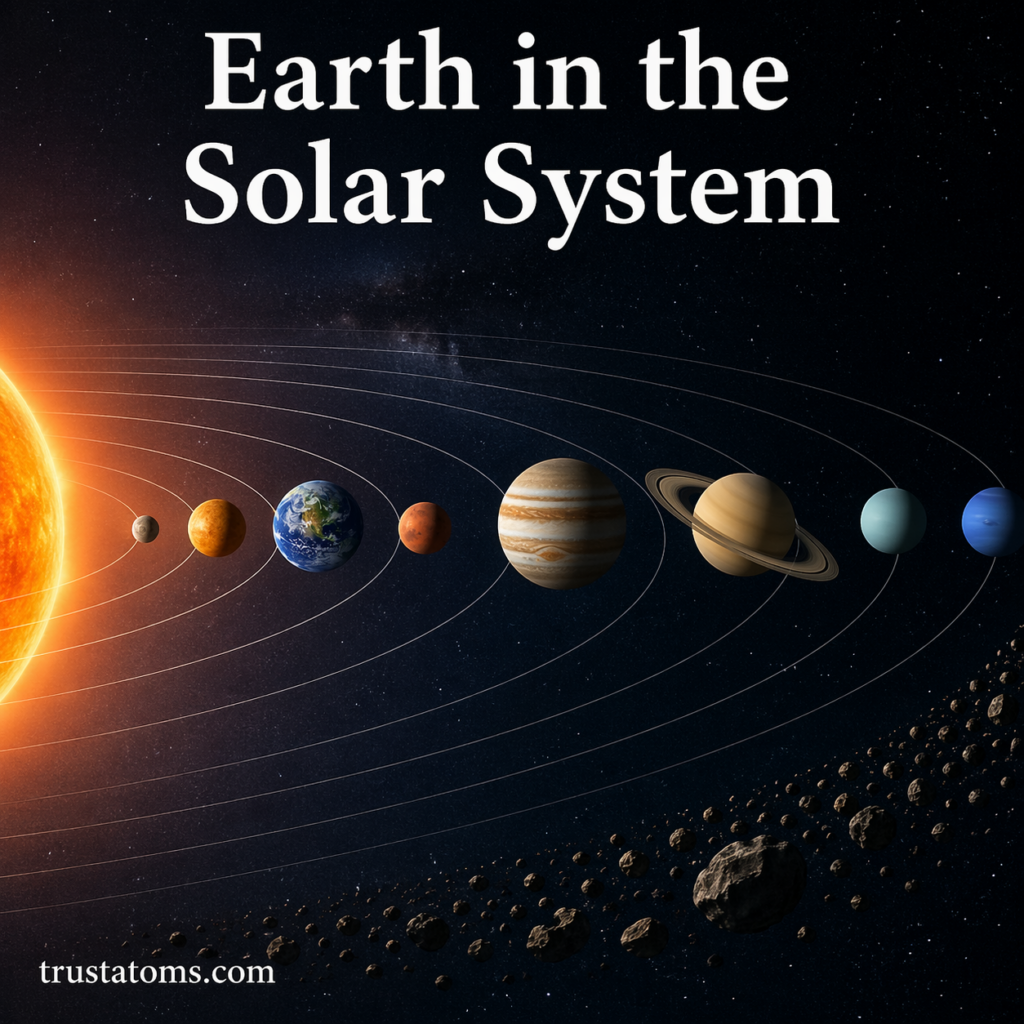
Earth is the third planet from the Sun, orbiting at an average distance of approximately 150 million kilometers (93 million miles). Its location, liquid water, atmosphere, and geological processes create conditions that support life, making Earth the only known inhabited planet in the solar system.
Understanding Earth’s position helps explain its seasons, climate, and relationship with neighboring planets. It also connects the study of our home planet to astronomy and space science, including the search for potentially habitable worlds beyond the solar system.
Where Is Earth Located in the Solar System?
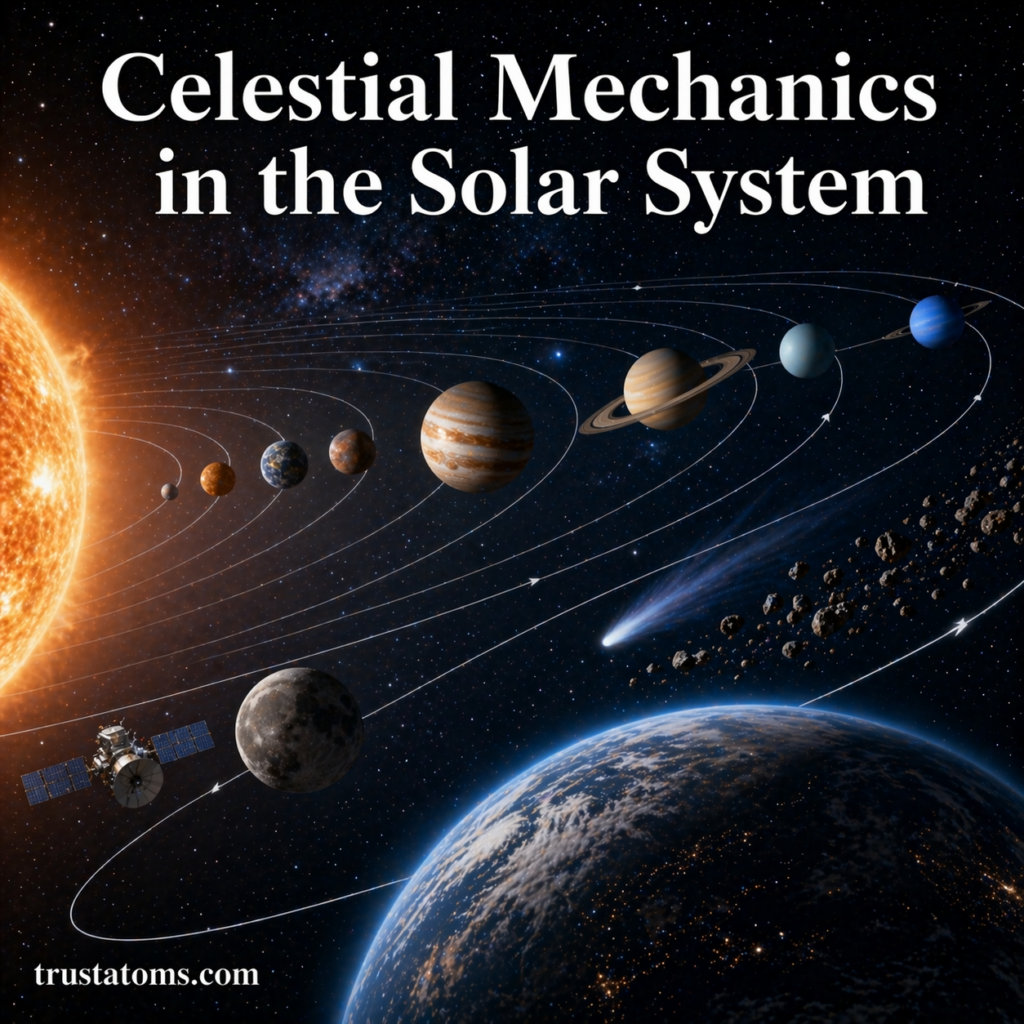
The solar system consists of the Sun and the objects gravitationally bound to it. These include eight planets, dwarf planets, natural satellites, asteroids, comets, and smaller particles.
Earth is the third planet from the Sun, sitting between Venus and Mars.
The eight planets, ordered outward from the Sun, are Mercury, Venus, Earth, Mars, Jupiter, Saturn, Uranus, and Neptune. Earth belongs to the four inner terrestrial planets, which have predominantly rocky compositions and solid surfaces.
Although planets share the same central star, their environments differ considerably. Planetary Atmospheres Compared examines how atmospheric composition and pressure influence conditions across the solar system.
Earth’s Position in the Habitable Zone
Earth orbits within the Sun’s habitable zone, sometimes called the Goldilocks zone. This is the range of distances where a rocky planet with suitable atmospheric conditions could maintain liquid water on its surface.
The Habitable Zone Concept explains how a star’s energy output and a planet’s distance influence the possibility of surface liquid water.
However, location alone does not guarantee habitability. Atmospheric pressure, greenhouse gases, planetary geology, and water availability also determine whether a world can support suitable conditions.
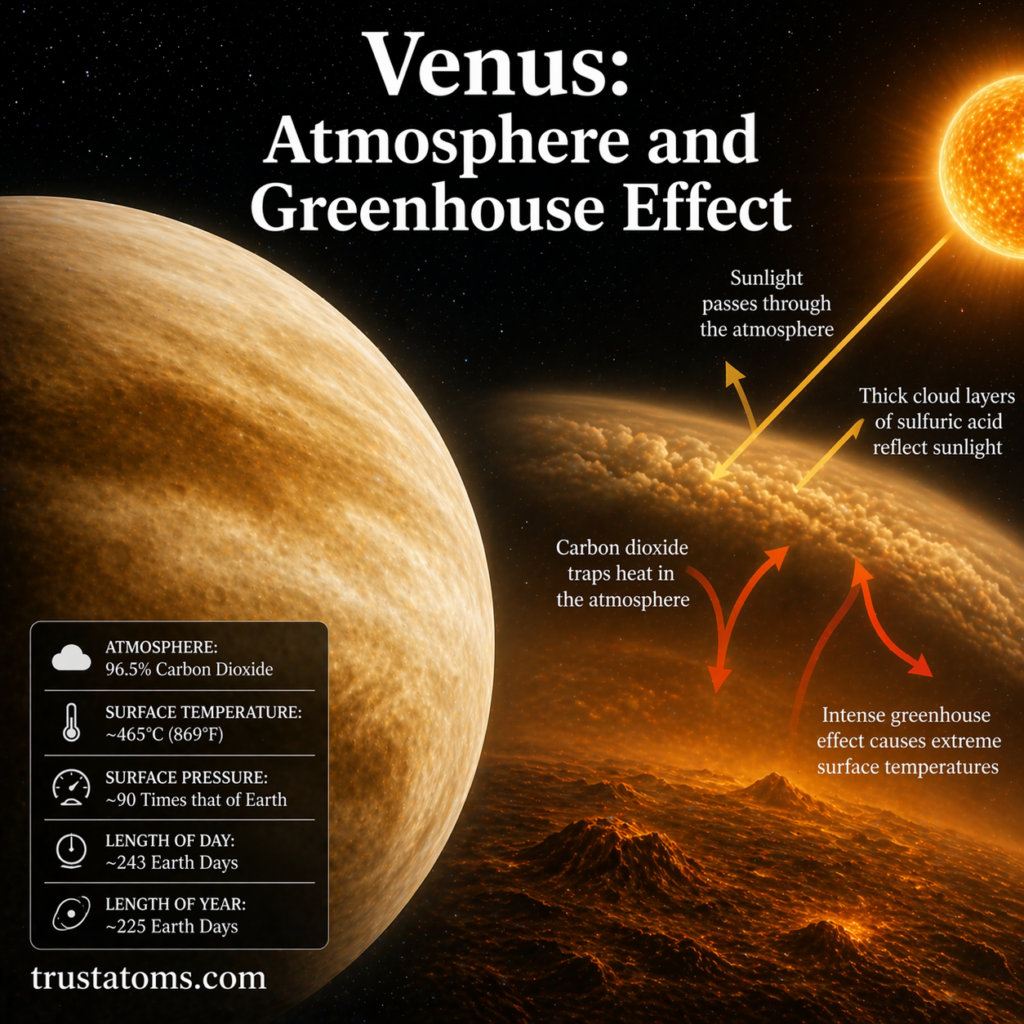
Venus illustrates this distinction. Despite being relatively close to Earth in size, its dense carbon dioxide atmosphere produces an extreme greenhouse effect. Mars, meanwhile, has a much thinner atmosphere and generally colder surface conditions.
Scientists use these comparisons when investigating Habitability Beyond Earth, including the conditions that might allow liquid water on planets orbiting other stars.
Earth’s Size, Distance, and Physical Characteristics
Earth is the largest terrestrial planet in the solar system. Its gravity is strong enough to retain a substantial atmosphere, while its interior remains geologically active.
| Characteristic | Approximate Value |
|---|---|
| Position from the Sun | Third planet |
| Average distance from the Sun | 149.6 million km |
| Mean diameter | 12,742 km |
| Orbital period | 365.25 days |
| Axial tilt | 23.4 degrees |
| Natural satellites | One Moon |
| Surface covered by water | About 71% |
These measurements help scientists compare Earth with other rocky planets and investigate how differences in size, gravity, and distance influence planetary environments.
How Earth’s Orbit and Rotation Work
Rotation Creates Day and Night
Earth rotates eastward around its axis approximately once every 24 hours relative to the Sun. As the planet turns, different regions face sunlight and then rotate into darkness.
One complete rotation relative to distant stars takes approximately 23 hours and 56 minutes. The familiar 24-hour solar day is slightly longer because Earth also moves along its orbit around the Sun.
Revolution Determines the Year
Earth completes one orbit around the Sun in approximately 365.25 days. Its path is slightly elliptical rather than perfectly circular.
Earth’s average orbital speed is approximately 29.8 kilometers per second. The planet moves continuously through space even when its motion is not noticeable from the surface.
Why Earth Has Seasons
Earth’s seasons result primarily from its axial tilt of approximately 23.4 degrees, not from changes in its distance from the Sun.
As Earth orbits the Sun, each hemisphere alternately tilts toward or away from incoming sunlight. This changes both the angle of sunlight and the number of daylight hours.
When the Northern Hemisphere tilts toward the Sun, it receives more direct sunlight and experiences longer days. At the same time, the Southern Hemisphere experiences shorter days and less direct sunlight.
Six months later, the situation reverses. This explains why summer and winter occur at opposite times in the Northern and Southern Hemispheres.
A Numerical Example: How Long Sunlight Takes to Reach Earth
Sunlight travels through space at approximately 300,000 kilometers per second. Earth is about 150 million kilometers from the Sun on average.
Dividing 150 million kilometers by 300,000 kilometers per second gives approximately 500 seconds. That equals about 8 minutes and 20 seconds.
This means sunlight reaching Earth left the Sun roughly eight minutes earlier. The calculation demonstrates both the enormous scale of the solar system and the finite speed at which light travels.
How Earth’s Atmosphere Supports Life
Earth’s atmosphere consists mainly of nitrogen, approximately 78%, and oxygen, approximately 21%, with smaller amounts of argon, carbon dioxide, water vapor, and other gases.
The atmosphere supports life through several interconnected processes:
- Temperature regulation: Greenhouse gases absorb and emit infrared radiation, helping maintain temperatures suitable for liquid water.
- Radiation protection: Atmospheric ozone absorbs much of the Sun’s harmful ultraviolet radiation.
- Surface pressure: Atmospheric pressure helps maintain conditions where liquid water can exist.
- Weather and climate: Atmospheric circulation redistributes heat and moisture around the planet.
These properties distinguish Earth’s environment from the extremely dense atmosphere of Venus and the thin atmosphere of Mars.
Earth’s Magnetic Field and Solar Protection
Earth possesses a global magnetic field generated primarily by the movement of electrically conducting liquid iron in its outer core.
This field creates a magnetosphere that deflects many charged particles carried by the solar wind. It helps shield the planet from harmful solar radiation and energetic particles, although Earth’s atmosphere provides the primary protection against much ultraviolet and other electromagnetic radiation.
Some charged particles enter regions near the magnetic poles, where interactions with atmospheric gases produce auroras.
The magnetic field does not block every particle, but it significantly influences how Earth interacts with the space environment surrounding the Sun.
How the Moon Influences Earth
Earth has one large natural satellite, the Moon, which orbits at an average distance of approximately 384,400 kilometers.
The Moon’s gravitational attraction contributes strongly to ocean tides. Solar gravity also affects tides, with the combined influences producing variations throughout the lunar cycle.
The Moon also helps stabilize Earth’s axial tilt over long periods. Scientists investigate this gravitational relationship when modeling how Earth’s orientation and climate have changed over geological time.
However, Earth’s climate depends on many interacting processes, and the Moon is not solely responsible for maintaining habitable conditions.
Earth Compared With Venus and Mars
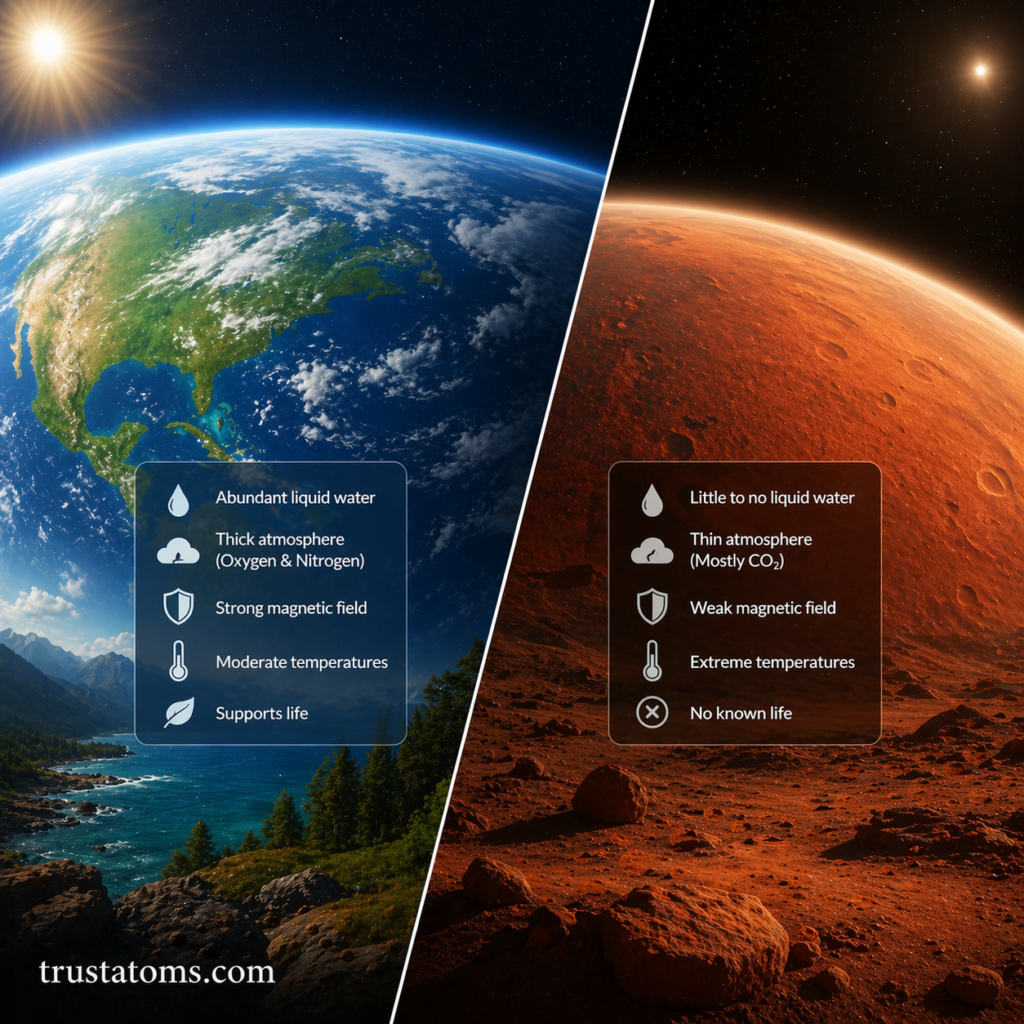
Earth’s neighboring planets demonstrate how different atmospheric and geological conditions can produce dramatically different environments.
| Feature | Earth | Venus | Mars |
|---|---|---|---|
| Position from Sun | Third | Second | Fourth |
| Atmosphere | Mainly nitrogen and oxygen | Dense carbon dioxide | Thin carbon dioxide |
| Average surface temperature | About 15°C | About 465°C | About -65°C |
| Surface liquid water today | Abundant | Not stable | Generally not stable |
Venus is hotter than Mercury despite being farther from the Sun because its thick atmosphere produces an intense greenhouse effect.
Mars shows geological evidence that liquid water existed on its surface in the past. Today, its thin atmosphere and low temperatures make persistent surface liquid water difficult to maintain.
What Makes Earth Habitable?
Earth’s habitability results from several interacting characteristics rather than one perfectly chosen distance from the Sun.
- Liquid water: Oceans and other water reservoirs support chemical and biological processes.
- Suitable temperatures: Solar energy and atmospheric conditions allow widespread surface liquid water.
- Atmospheric protection: The atmosphere moderates temperature and absorbs harmful radiation.
- Geological activity: Plate tectonics and other processes recycle materials and influence long-term carbon cycling.
- Available chemical elements: Earth contains the elements needed by all known forms of life.
Scientists have confirmed life only on Earth. Whether other planets or moons support life remains an open scientific question.
Earth’s Place in the Milky Way
The solar system belongs to the Milky Way, a large spiral galaxy containing stars, gas, dust, and dark matter.
Our solar system is located within the galaxy’s disk, roughly 26,000 light-years from its center. The Sun and its planets orbit the galactic center over a period of hundreds of millions of years.
Earth therefore participates in several kinds of motion simultaneously: rotating on its axis, orbiting the Sun, and traveling with the solar system through the Milky Way.
Frequently Asked Questions
Why is Earth the third planet from the Sun?
Earth is called the third planet because Mercury and Venus orbit closer to the Sun. Planetary order is determined by average orbital distance, not by planet size or physical characteristics.
Is Earth always the same distance from the Sun?
No. Earth’s orbit is slightly elliptical, so its distance changes throughout the year. It ranges from approximately 147 million kilometers at perihelion to 152 million kilometers at aphelion. These variations are not the primary cause of Earth’s seasons.
Could another planet support life like Earth?
Scientists consider it possible that other worlds could support life if suitable environmental conditions exist. However, no life beyond Earth has been confirmed. Researchers study Mars, icy moons, and planets around other stars to investigate potential habitability.
Earth’s position in the solar system provides an important starting point for understanding its environment, but distance from the Sun is only one factor behind its habitability. Its atmosphere, oceans, magnetic field, and geological activity interact to produce the conditions observed today. Comparing Earth with Venus, Mars, and distant planets helps scientists investigate which combinations of planetary characteristics may support life.
Sources: NASA Science, Earth Facts; NASA Science, Solar System Exploration; OpenStax, Astronomy 2e.