Matter is one of the most fundamental concepts in chemistry. Everything you see, touch, or interact with in the physical world is made of matter—from the air you breathe to the water you drink and the devices you use every day.
In chemistry, understanding matter is the first step toward understanding how substances behave, interact, and change during chemical reactions. This article explains what matter is, its defining properties, the different types of matter, and why it is central to the study of chemistry.
What Is Matter?
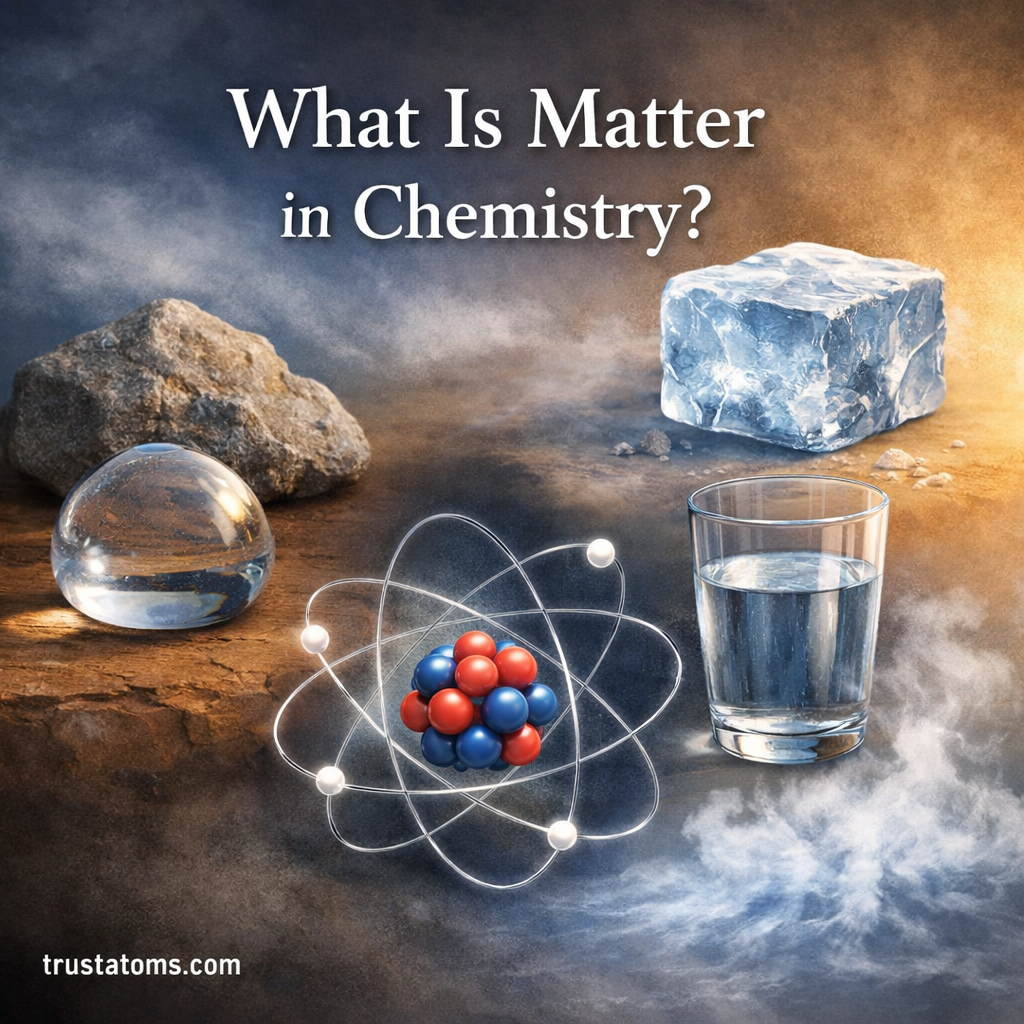
In chemistry, matter is anything that has mass and occupies space.
This definition includes a vast range of materials and substances. Solids, liquids, and gases are all forms of matter. Even objects that seem invisible, like air, are made of matter because they still have mass and take up space.
Examples of matter include:
- Water
- Oxygen
- Rocks
- Metals
- Living organisms
- Plastic
- Food
If something has measurable mass and takes up volume, it is considered matter.
The Two Key Characteristics of Matter
Chemists identify matter using two main characteristics.
1. Mass
Mass refers to the amount of material contained in an object.
It is typically measured in:
- grams (g)
- kilograms (kg)
Mass does not change depending on location. For example, an object has the same mass on Earth as it would on the Moon.
2. Volume
Volume describes the amount of space a substance occupies.
Common units for volume include:
- liters (L)
- milliliters (mL)
- cubic centimeters (cm³)
A solid object, a container of water, and even the air in a balloon all have volume.
Matter Is Made of Atoms
In chemistry, matter is composed of extremely small particles called atoms.
Atoms are the basic building blocks of all substances. Different combinations of atoms form molecules and compounds, which make up the materials we encounter every day.
For example:
- Water (H₂O) is made of hydrogen and oxygen atoms
- Carbon dioxide (CO₂) is made of carbon and oxygen atoms
- Table salt (NaCl) contains sodium and chlorine atoms
Atoms can combine in different ways, creating millions of unique substances found in nature and manufactured by humans.
The Three Main States of Matter
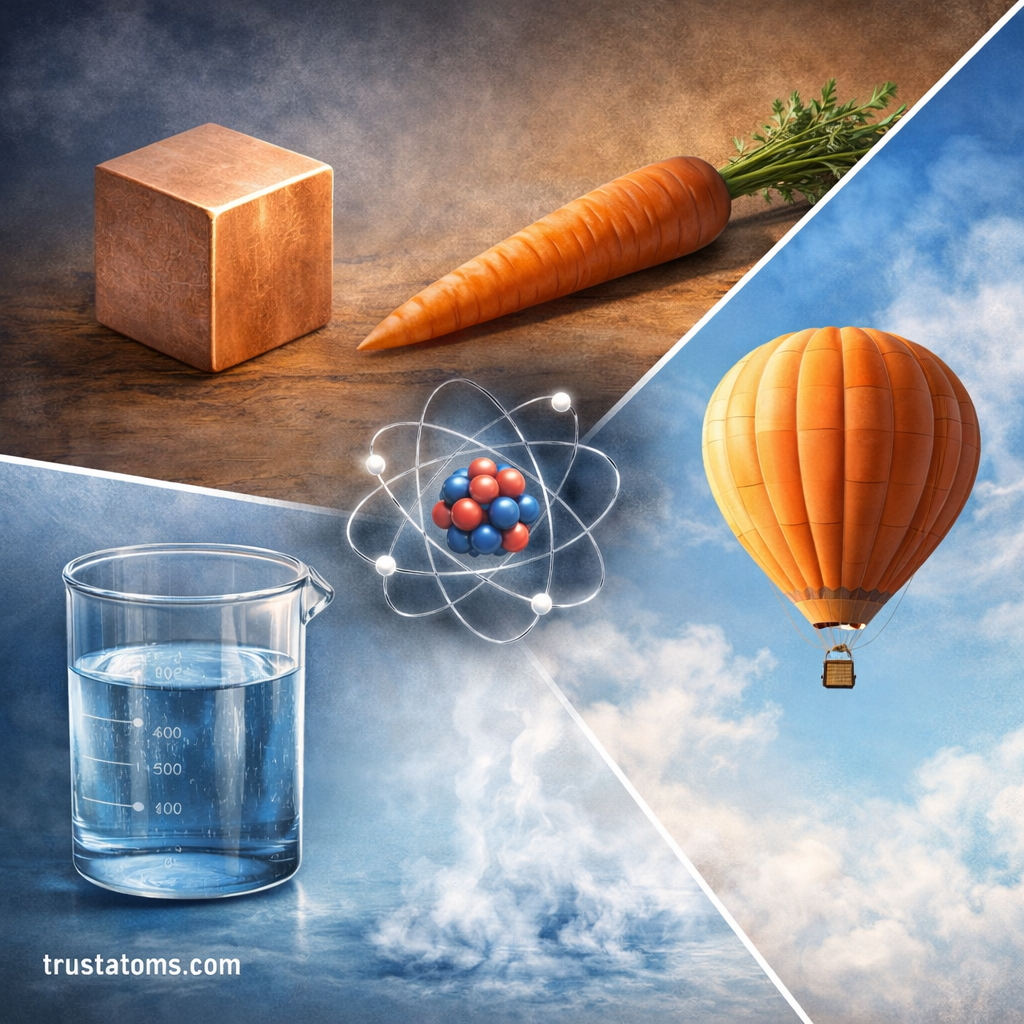
Matter exists in different physical forms known as states of matter. The three most common states are solid, liquid, and gas.
Solid
Solids have:
- A fixed shape
- A fixed volume
- Tightly packed particles
Examples include:
- Ice
- Wood
- Metal
- Stone
In solids, atoms or molecules are closely packed and vibrate in place.
Liquid
Liquids have:
- A fixed volume
- No fixed shape (they take the shape of their container)
Examples include:
- Water
- Oil
- Milk
- Alcohol
Particles in liquids are close together but can move around each other.
Gas
Gases have:
- No fixed shape
- No fixed volume
Examples include:
- Oxygen
- Carbon dioxide
- Helium
- Nitrogen
Gas particles move freely and spread out to fill any available space.
Additional States of Matter
Although solids, liquids, and gases are the most common states, matter can exist in other forms under certain conditions.
These include:
- Plasma – an ionized gas found in stars and lightning
- Bose–Einstein condensate – an extremely cold state where particles behave as a single quantum system
These states are usually studied in advanced physics and chemistry.
Physical vs Chemical Properties of Matter
Chemists study matter by observing its properties. These properties fall into two major categories.
Physical Properties
Physical properties describe characteristics that can be observed without changing the substance.
Examples include:
- Color
- Density
- Melting point
- Boiling point
- Hardness
- Conductivity
For example, ice melting into water is a physical change because the substance remains H₂O.
Chemical Properties
Chemical properties describe how a substance interacts with other substances and forms new materials.
Examples include:
- Flammability
- Reactivity
- Corrosion
- Acidity
For instance, iron rusting when exposed to oxygen is a chemical change because a new substance (iron oxide) forms.
Types of Matter in Chemistry
Chemists classify matter into different categories based on its composition.
Pure Substances
A pure substance has a fixed composition and consistent properties.
There are two types of pure substances.
Elements
Elements are the simplest form of matter and cannot be broken down into simpler substances by chemical means.
Examples include:
- Hydrogen
- Oxygen
- Carbon
- Gold
- Iron
Each element is made of only one type of atom.
Compounds
Compounds form when two or more elements chemically combine in fixed ratios.
Examples include:
- Water (H₂O)
- Carbon dioxide (CO₂)
- Sodium chloride (NaCl)
Compounds have properties that are often very different from the elements that form them.
Mixtures
A mixture consists of two or more substances that are physically combined but not chemically bonded.
Mixtures can be separated using physical methods such as filtration or distillation.
There are two main types of mixtures.
Homogeneous Mixtures
Homogeneous mixtures have a uniform composition throughout.
Examples include:
- Salt water
- Air
- Vinegar
- Metal alloys
These mixtures are often called solutions.
Heterogeneous Mixtures
Heterogeneous mixtures have visible differences in composition.
Examples include:
- Salad
- Sand in water
- Soil
- Granite
In these mixtures, different substances can often be seen separately.
Changes in Matter
Matter can undergo two main types of changes.
Physical Changes
Physical changes alter the form or appearance of matter but do not change its chemical identity.
Examples include:
- Melting ice
- Boiling water
- Cutting paper
- Dissolving sugar in water
The original substance remains the same.
Chemical Changes
Chemical changes produce new substances with different properties.
Examples include:
- Burning wood
- Rusting metal
- Cooking food
- Digesting nutrients
These changes involve rearranging atoms to form new molecules.
Why Matter Is Important in Chemistry
Matter is the central focus of chemistry because all chemical reactions involve matter changing in some way.
Understanding matter allows scientists to:
- Design new medicines
- Create advanced materials
- Develop sustainable energy technologies
- Study biological systems
- Understand environmental processes
Chemistry explores how matter behaves at the atomic and molecular level, revealing how the physical world functions.
For example, the organization of molecules and biological structures ultimately depends on the behavior of atoms and matter at extremely small scales. Even complex biological systems such as chromosomes and cells are built from chemical components and molecular structures.
Final Thoughts
Matter is the foundation of chemistry and the physical world. Defined as anything that has mass and occupies space, matter exists in many forms and can undergo both physical and chemical changes.
By studying matter—its structure, properties, and interactions—chemists gain insight into how substances behave and how new materials can be created. From the smallest atoms to complex biological systems, the study of matter helps explain the universe around us.