Plants grow in an enormous variety of environments, from deserts and rainforests to alpine mountains and aquatic ecosystems. Because plants cannot move to escape harsh conditions, they rely on adaptations—specialized structural, physiological, and behavioral traits—that allow them to survive and reproduce in their environments.
These adaptations help plants respond to challenges such as limited water, intense sunlight, poor soil nutrients, temperature extremes, and herbivory. By evolving features suited to their habitats, plants are able to thrive across nearly every ecosystem on Earth.
Understanding plant adaptations to environmental conditions is a central topic in plant biology and ecology.
What Are Plant Adaptations?
A plant adaptation is a characteristic that improves a plant’s ability to survive and reproduce in a specific environment.
Adaptations may develop over many generations through natural selection, where plants with beneficial traits are more likely to survive and pass those traits to offspring.
Plant adaptations generally fall into three categories:
- Structural adaptations – physical features that help plants survive
- Physiological adaptations – internal processes that improve survival
- Behavioral responses – growth patterns or responses to environmental signals
Together, these traits help plants cope with environmental stresses.
Structural Adaptations in Plants
Structural adaptations involve the physical characteristics of plants that help them survive in their habitats.
Leaf Modifications
Leaves may adapt in several ways depending on environmental conditions.
Examples include:
- Thick, waxy leaves to reduce water loss
- Needle-like leaves in conifer trees to conserve moisture
- Large leaves in rainforest plants to capture more sunlight
- Spines instead of leaves in desert plants to reduce water loss
These modifications allow plants to regulate water balance and light absorption.
Root System Adaptations
Roots often adapt to improve water and nutrient uptake.
Examples include:
- Deep roots that reach underground water sources
- Wide shallow roots that absorb surface water quickly
- Aerial roots that absorb moisture from the air
- Storage roots that store water and nutrients
These root systems help plants survive in challenging soil conditions.
Stem Adaptations
Plant stems can also evolve specialized functions.
Examples include:
- Water-storing stems in succulents and cacti
- Flexible stems that withstand strong winds
- Underground stems that survive cold or dry seasons
These structures support plant survival in extreme environments.
Physiological Adaptations
Physiological adaptations involve internal chemical and biological processes that help plants respond to environmental stress.
Water Conservation Mechanisms
Plants in dry environments often develop processes that reduce water loss.
Examples include:
- Closing stomata during hot conditions
- Storing water in tissues
- Producing waxy coatings that reduce evaporation
These mechanisms help plants survive drought conditions.
Temperature Tolerance
Some plants produce special proteins or chemicals that allow them to tolerate extreme temperatures.
Examples include:
- Antifreeze-like compounds in alpine plants
- Heat-tolerant enzymes in desert plants
These physiological traits protect plant cells from damage.
Chemical Defense
Plants may also produce chemical compounds that discourage herbivores or pathogens.
Examples include:
- Bitter-tasting chemicals
- Toxic compounds
- Strong scents that repel insects
These chemical defenses help plants avoid being eaten.
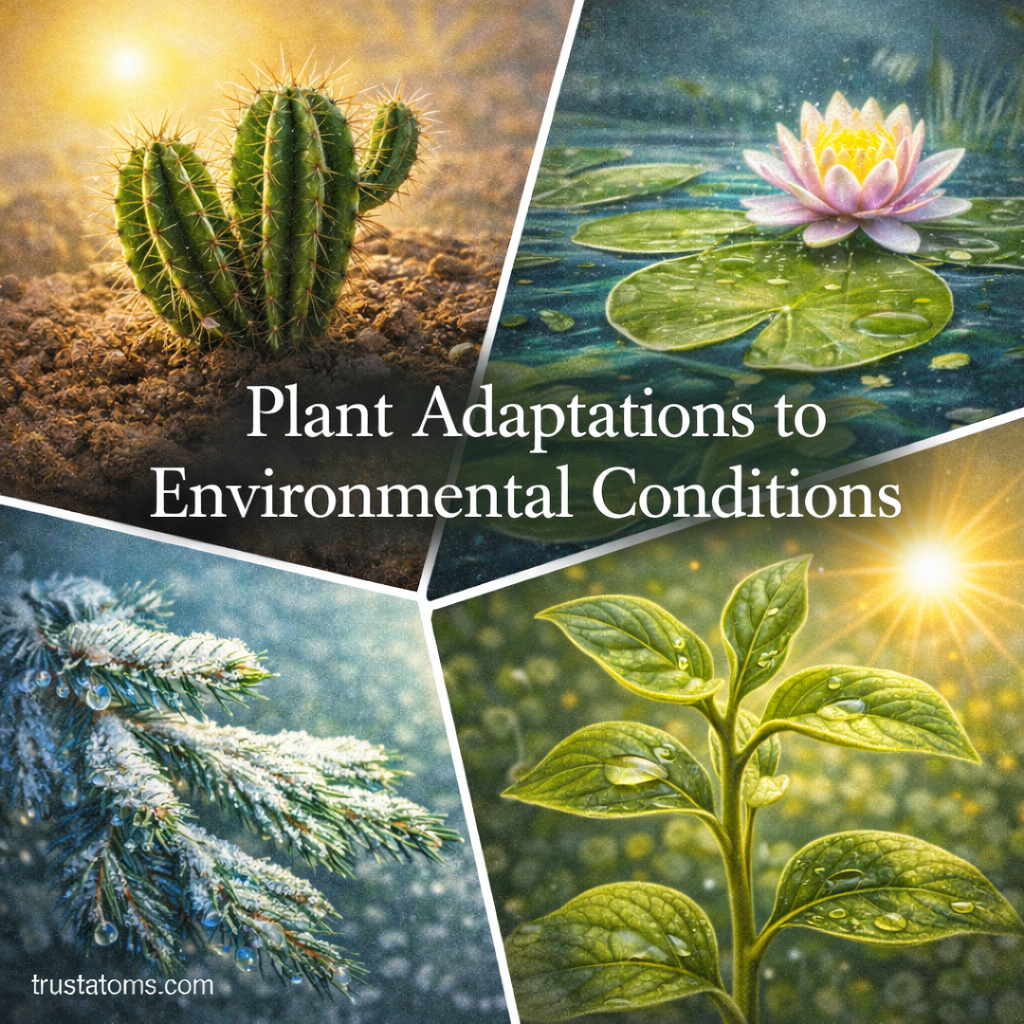
Adaptations to Dry Environments
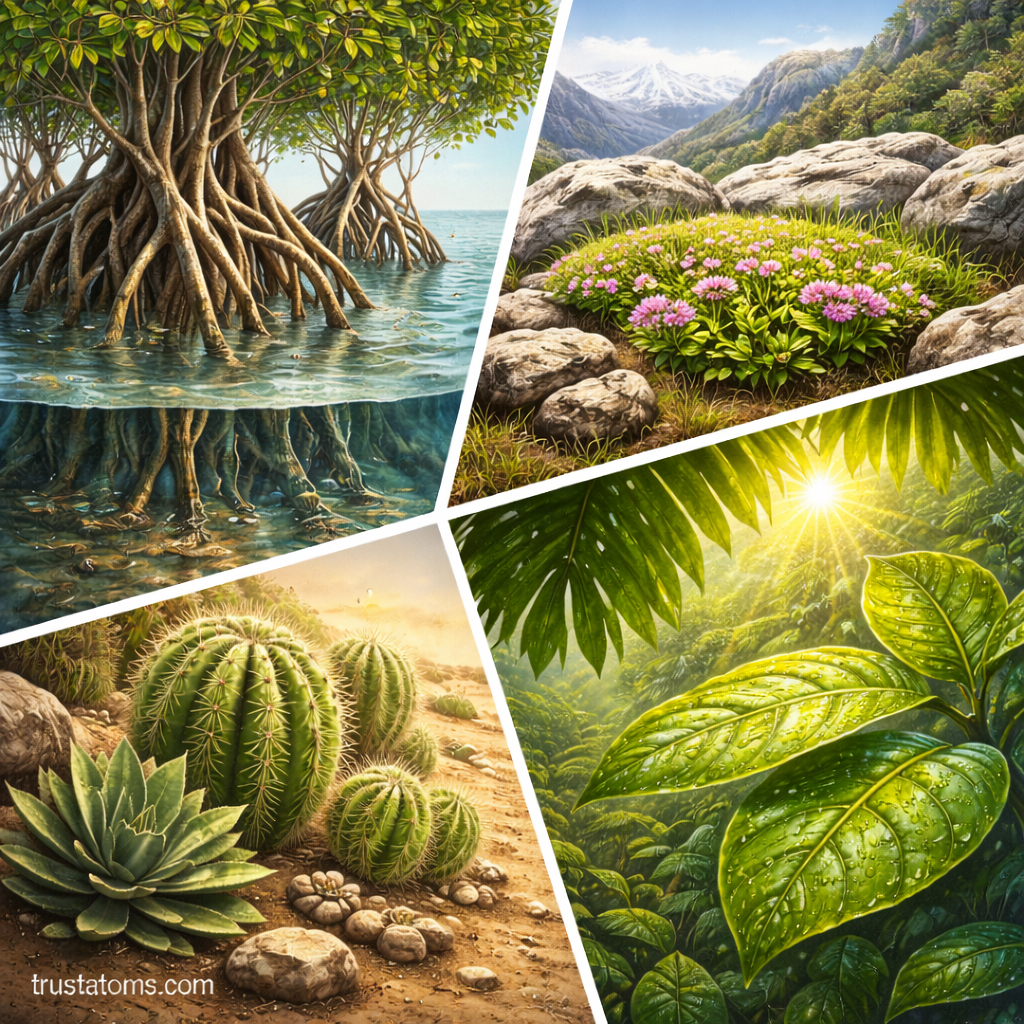
Plants living in deserts or arid regions must conserve water carefully.
Common desert plant adaptations include:
- Reduced leaf size or spines
- Thick waxy coatings
- Water-storing tissues
- Extensive root systems
For example, cacti store water in thick stems while minimizing water loss through small surface areas.
These features allow desert plants to survive long periods without rainfall.
Adaptations to Wet Environments
Plants growing in aquatic or waterlogged environments face different challenges.
Common adaptations include:
- Air-filled tissues that help plants float
- Flexible stems that move with water currents
- Shallow root systems for soft sediments
- Large surface leaves that float on water
Examples of aquatic plants include water lilies and duckweed.
These adaptations help plants access oxygen and sunlight while living in water.
Adaptations to Cold Climates
Plants in cold environments must survive freezing temperatures, strong winds, and short growing seasons.
Common cold-climate adaptations include:
- Needle-shaped leaves to reduce snow accumulation
- Evergreen foliage that retains leaves year-round
- Low-growing forms that avoid wind damage
- Seasonal dormancy during winter
These traits allow plants to conserve energy and withstand freezing conditions.
Adaptations to High Sunlight
Plants in bright environments must balance the benefits of sunlight with the risk of overheating or water loss.
Adaptations may include:
- Reflective leaf surfaces
- Thick leaf tissues
- Orientation of leaves to reduce heat absorption
- Specialized photosynthesis pathways such as C4 or CAM photosynthesis
These mechanisms help plants use sunlight efficiently while avoiding stress.
Rapid Responses to Environmental Changes
In addition to long-term adaptations, plants can respond quickly to environmental changes.
Examples include:
- Phototropism – growth toward light
- Gravitropism – growth in response to gravity
- Thigmotropism – response to touch or physical contact
These responses allow plants to adjust growth patterns and optimize resource use.
Importance of Plant Adaptations
Plant adaptations are critical for survival in diverse ecosystems.
They help plants:
- Use available resources efficiently
- Survive environmental stress
- Avoid herbivores
- Reproduce successfully
- Maintain ecosystem stability
Because plants form the base of most food chains, their ability to adapt supports entire ecological communities.
Final Thoughts
Plant adaptations to environmental conditions allow plants to survive in a wide range of habitats. Through structural features, physiological processes, and responsive growth behaviors, plants can cope with challenges such as drought, temperature extremes, nutrient limitations, and herbivory.
These adaptations have allowed plants to colonize nearly every region of Earth, from deserts and tundra to wetlands and tropical forests. Studying these strategies provides valuable insight into plant evolution, ecosystem dynamics, and the resilience of life in changing environments.