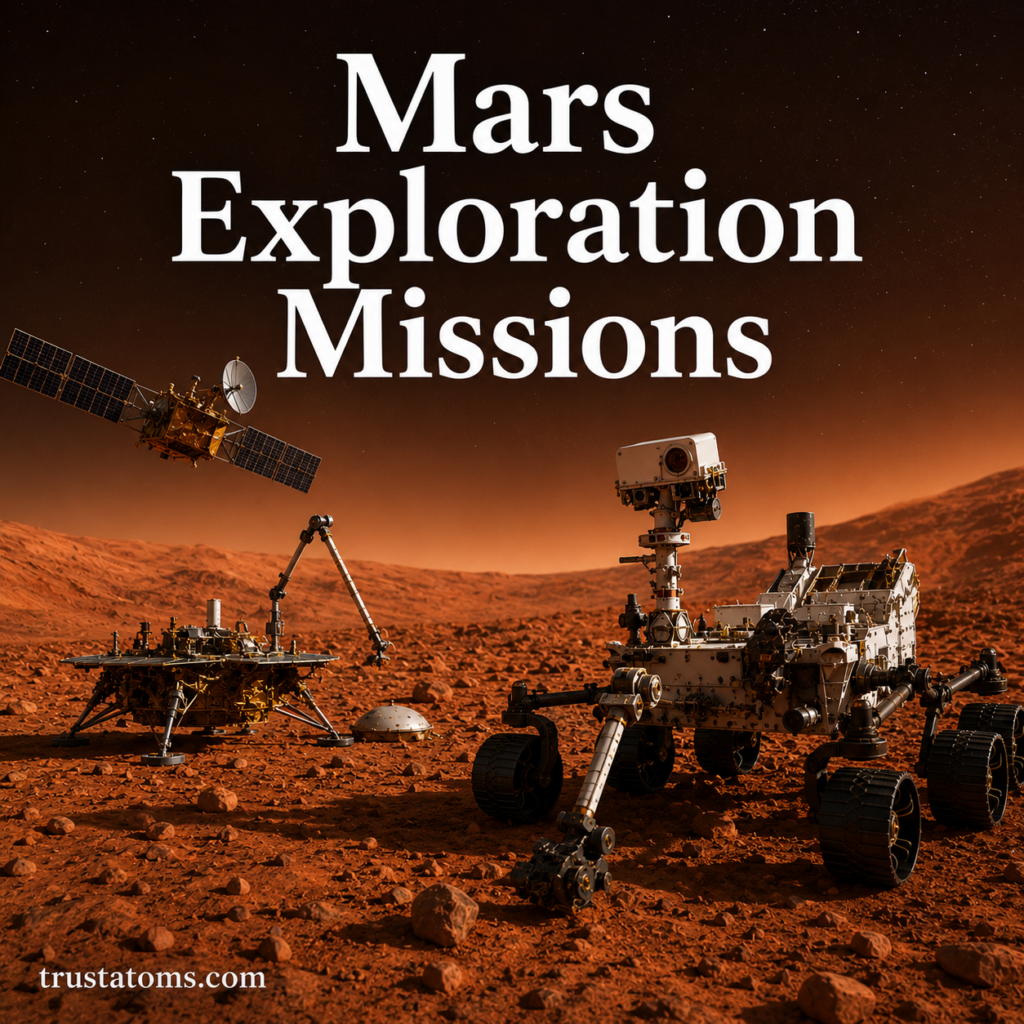
Mars has long captured human imagination as a potential destination for exploration—and even future settlement. Known as the “Red Planet,” Mars is one of the most studied bodies in our solar system, thanks largely to decades of robotic exploration missions.
These missions have revealed a world that once had flowing water, a thicker atmosphere, and conditions that may have supported life. Today, Mars exploration continues to be a major focus of modern astronomy and space science.
Why Mars?
Mars is a prime target for exploration because it shares several similarities with Earth while still offering unique scientific opportunities.
Key Reasons Scientists Study Mars
- Evidence of Past Water – Ancient riverbeds, lakebeds, and minerals suggest Mars once had liquid water
- Potential for Life – Conditions may have supported microbial life in the past
- Proximity to Earth – Relatively close compared to other planets
- Future Human Exploration – A leading candidate for human missions
Understanding Mars helps scientists learn more about planetary evolution, climate change, and the potential for life beyond Earth.
A Brief History of Mars Missions
Mars exploration began in the 1960s with early flyby missions. Over time, technology advanced, leading to orbiters, landers, and rovers.
Early Missions
- Flyby spacecraft captured the first close-up images of Mars
- Revealed a cratered, desert-like surface
Orbiter Missions
- Mapped the planet in detail
- Studied atmosphere and weather patterns
Lander and Rover Missions
- Provided direct surface analysis
- Collected data on soil, rocks, and environmental conditions
Each generation of missions has built upon previous discoveries, creating a more complete picture of Mars.
Types of Mars Exploration Missions
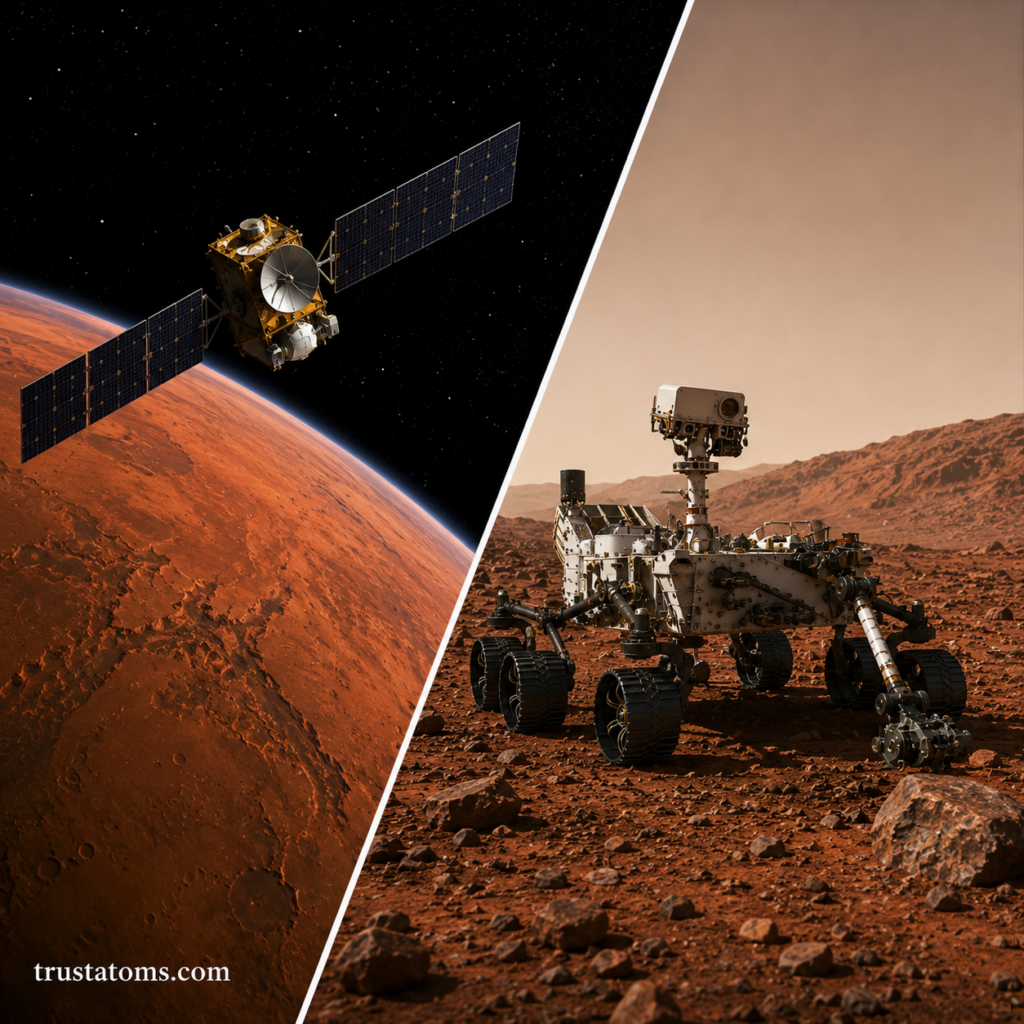
Different mission types allow scientists to study Mars from multiple perspectives.
Orbiters
Orbiters circle Mars and gather large-scale data.
They are used to:
- Map surface features
- Monitor dust storms and weather
- Relay communication for surface missions
Landers
Landers reach the Martian surface and remain in one location.
They focus on:
- Soil analysis
- Atmospheric measurements
- Stationary experiments
Rovers
Rovers are mobile robots that explore the Martian landscape.
They can:
- Travel across terrain
- Drill into rocks
- Search for signs of past life
Key Discoveries from Mars Missions
Mars exploration has led to groundbreaking discoveries that have reshaped our understanding of the planet.
Evidence of Ancient Water
- Dried river channels and lakebeds
- Minerals that form in water-rich environments
Changing Climate
- Mars once had a thicker atmosphere
- It gradually lost most of its atmosphere over time
Organic Molecules
- Detection of carbon-based compounds
- Important building blocks for life
Surface Conditions
- Extreme temperatures
- Dust storms covering the entire planet
These findings suggest that Mars was once much more Earth-like than it is today.
How Mars Missions Work
Mars missions are complex and require precise planning.
1. Launch Window
- Missions are launched when Earth and Mars are properly aligned
- Occurs roughly every 26 months
2. Interplanetary Travel
- Spacecraft travel for several months to reach Mars
3. Entry, Descent, and Landing (EDL)
- One of the most challenging phases
- Includes heat shields, parachutes, and propulsion systems
4. Surface Operations
- Rovers and landers begin collecting data
- Orbiters support communication
Technologies Used in Mars Exploration
Mars missions rely on advanced systems to survive harsh conditions.
Autonomous Navigation
- Rovers make decisions without real-time control
- Necessary due to communication delays
Scientific Instruments
- Cameras, spectrometers, and drills
- Analyze rocks, soil, and atmosphere
Power Systems
- Solar panels or nuclear power sources
- Provide long-term energy
Communication Networks
- Use orbiters to relay data back to Earth
- Ensure consistent communication
Challenges of Exploring Mars
Mars is a difficult environment to explore.
Harsh Conditions
- Extremely cold temperatures
- Thin atmosphere
- High radiation levels
Dust and Terrain
- Fine dust can cover solar panels
- Rough terrain limits mobility
Communication Delay
- Signals take several minutes to travel between Earth and Mars
Landing Difficulty
- Thin atmosphere makes slowing down difficult
- Requires precise engineering
The Future of Mars Exploration
Mars exploration is entering an exciting new phase with ambitious goals.
Sample Return Missions
- Plans to bring Martian soil and rock samples back to Earth
- Will allow detailed laboratory analysis
Advanced Rovers
- More capable and intelligent robots
- Improved mobility and autonomy
Human Missions
- Long-term goal of sending astronauts to Mars
- Requires significant technological advancements
Search for Life
- Continued efforts to find signs of past or present life
Why Mars Exploration Matters
Mars missions provide valuable insights that extend beyond one planet.
Scientific Impact
- Understanding planetary evolution
- Studying climate changes over time
Technological Innovation
- Drives advancements in robotics and engineering
Inspiration
- Encourages interest in science and exploration
Future Expansion
- Prepares humanity for living beyond Earth
Final Thoughts
Mars exploration missions have transformed our understanding of the Red Planet, revealing a dynamic world with a fascinating history. From ancient rivers to modern robotic explorers, each mission brings us closer to answering one of humanity’s biggest questions: Are we alone in the universe?
As technology advances, Mars will remain at the forefront of space exploration—serving as a stepping stone toward humanity’s future beyond Earth.