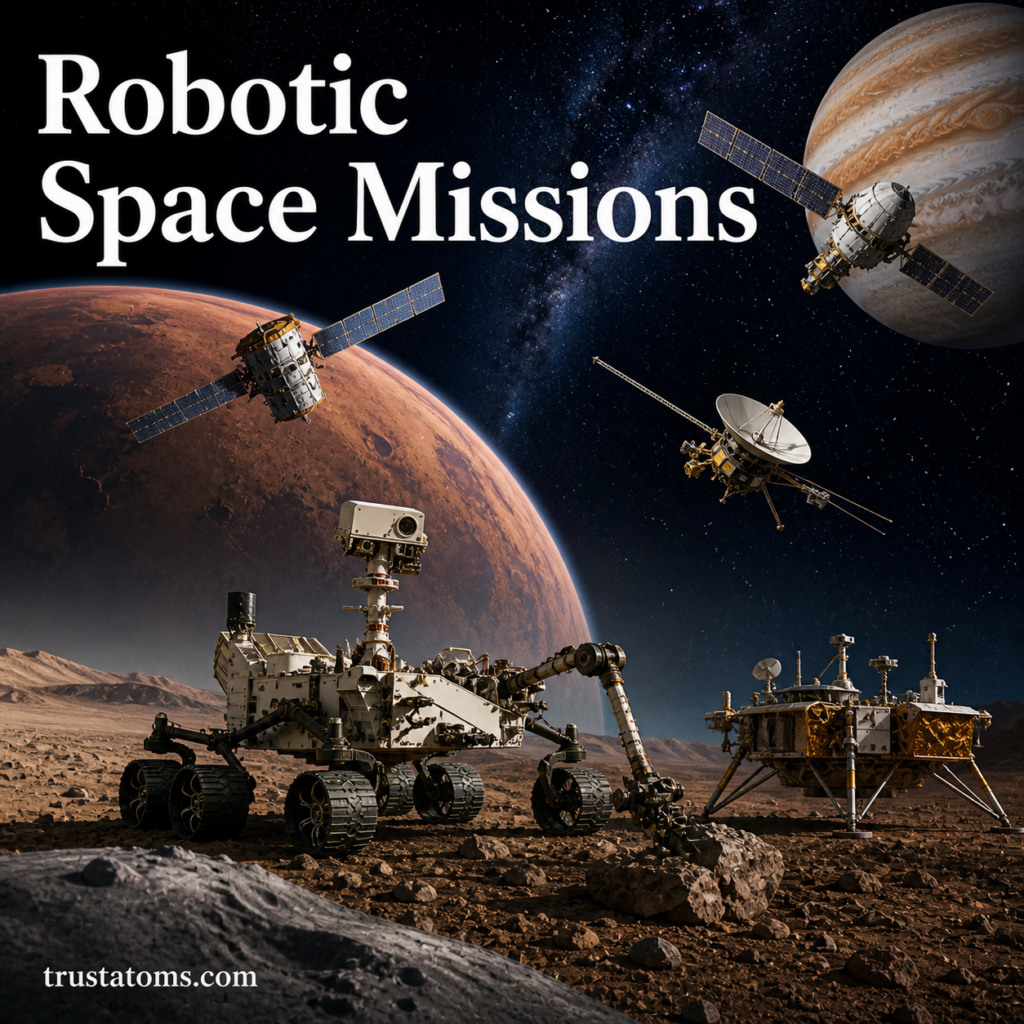
Robotic space missions are at the heart of modern space exploration. Long before humans can safely travel to distant worlds, robotic spacecraft gather data, explore extreme environments, and expand our understanding of the universe.
From Mars rovers to deep-space probes, these missions allow scientists to study planets, moons, asteroids, and beyond—without putting human lives at risk.
What Are Robotic Space Missions?
Robotic space missions involve sending unmanned spacecraft into space to perform specific scientific or exploratory tasks.
These spacecraft are controlled remotely or operate autonomously using onboard systems. They are designed to:
- Collect scientific data
- Capture images and videos
- Analyze planetary surfaces and atmospheres
- Conduct experiments in space
Robotic missions are essential because they can travel farther, endure harsher conditions, and operate for longer durations than human missions.
Types of Robotic Spacecraft
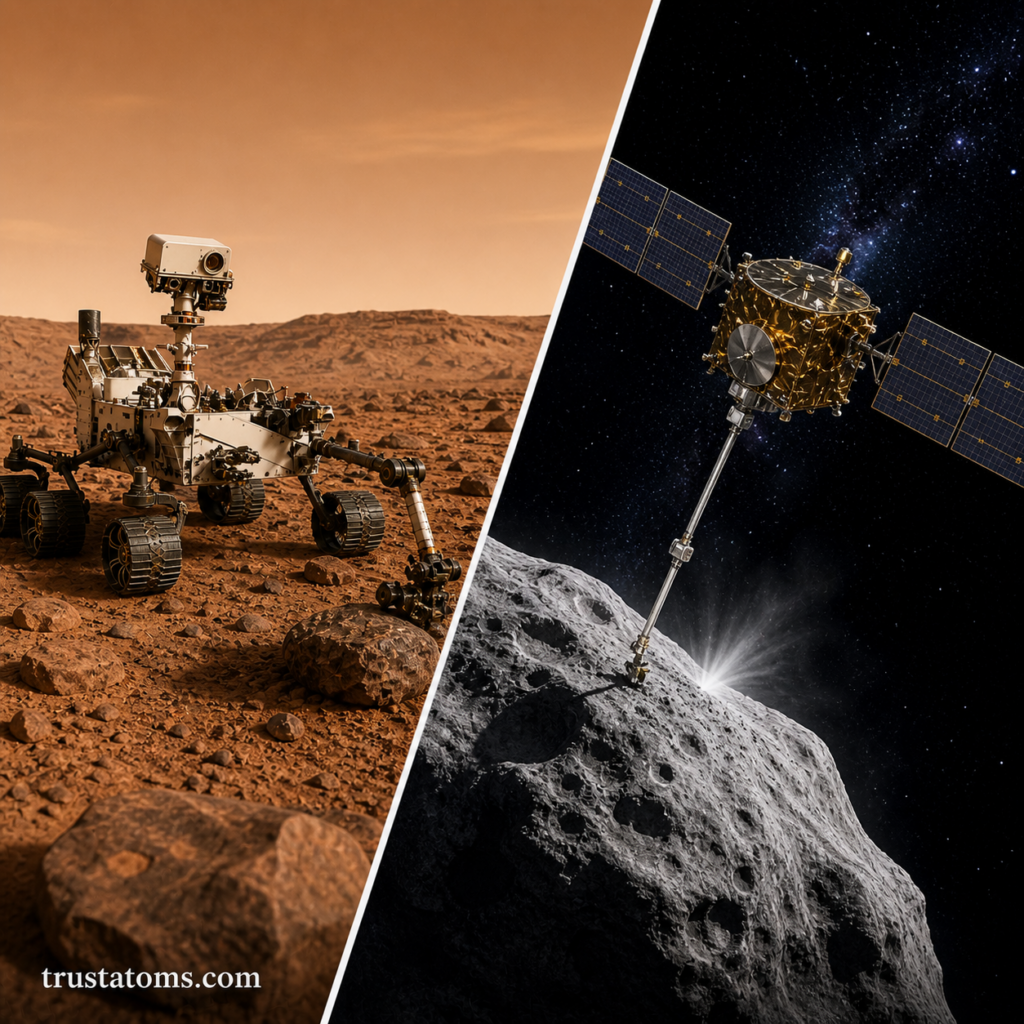
Different missions require different types of robotic systems. Each is designed for a specific environment and purpose.
Orbiters
Orbiters travel around a planet or celestial body to study it from above.
Common functions include:
- Mapping surfaces
- Monitoring weather and atmospheric conditions
- Relaying communication for other missions
Landers
Landers are designed to touch down on a surface and remain stationary.
They are used to:
- Study soil and rock composition
- Measure temperature, pressure, and radiation
- Conduct localized experiments
Rovers
Rovers are mobile robotic vehicles that explore planetary surfaces.
Key capabilities:
- Drive across terrain
- Collect samples
- Capture high-resolution images
Flyby Probes
These spacecraft pass close to a celestial body without entering orbit.
They are ideal for:
- Quick data collection
- Exploring distant or hard-to-reach targets
Space Telescopes
Space-based observatories collect data from beyond Earth’s atmosphere.
They help scientists:
- Study distant galaxies and stars
- Observe cosmic events
- Understand the structure of the universe
How Robotic Missions Work
Robotic space missions follow a structured process from launch to data transmission.
1. Launch
The spacecraft is launched aboard a rocket and placed into space.
2. Cruise Phase
It travels toward its destination, which can take months or even years.
3. Arrival and Deployment
Depending on the mission type:
- Orbiters enter orbit
- Landers descend to the surface
- Rovers deploy and begin movement
4. Data Collection
Scientific instruments gather information such as:
- Images
- Chemical compositions
- Environmental conditions
5. Communication
Data is transmitted back to Earth using radio signals and deep-space communication networks.
Key Technologies in Robotic Space Exploration
Robotic missions rely on advanced technologies to operate in extreme conditions.
Autonomous Navigation
- Allows spacecraft to make decisions without real-time human input
- Essential due to communication delays
Scientific Instruments
- Cameras, spectrometers, and sensors
- Designed to analyze surfaces and atmospheres
Power Systems
- Solar panels or nuclear power sources
- Provide long-term energy for missions
Communication Systems
- Transmit data across vast distances
- Use high-gain antennas for efficiency
Durability and Protection
- Shielding against radiation and extreme temperatures
- Rugged designs for harsh environments
Advantages of Robotic Space Missions
Robotic exploration offers several key benefits.
Safety
- Eliminates risk to human life
- Enables exploration of dangerous environments
Cost Efficiency
- Less expensive than human missions
- No need for life-support systems
Long Duration
- Can operate for years or even decades
- Ideal for long-term observation
Accessibility
- Reach distant planets and deep space
- Explore environments humans cannot survive
Challenges of Robotic Missions
Despite their advantages, robotic missions face limitations.
Communication Delays
- Signals can take minutes or hours to travel
- Limits real-time control
Limited Flexibility
- Pre-programmed systems may struggle with unexpected situations
Harsh Environments
- Extreme temperatures, radiation, and terrain can damage equipment
High Development Costs
- Complex engineering and testing required
- Missions can take years to plan and build
Notable Robotic Space Missions
Robotic missions have achieved some of the most important discoveries in space exploration.
Mars Exploration
Rovers have:
- Discovered evidence of past water
- Studied Martian geology
- Searched for signs of ancient life
Outer Planet Exploration
Probes have explored:
- Jupiter and its moons
- Saturn’s rings
- Distant icy worlds
Asteroid and Comet Missions
These missions help scientists:
- Understand the early solar system
- Study potential impact threats
Deep Space Exploration
Voyager probes have traveled beyond the solar system, sending data from interstellar space.
The Future of Robotic Space Exploration
Robotic missions will continue to lead the way in exploring the universe.
Emerging Trends
- More advanced artificial intelligence for autonomy
- Sample return missions bringing material back to Earth
- Swarm robotics using multiple small spacecraft
- Exploration of ocean worlds like Europa and Enceladus
Human and Robotic Collaboration
Future missions will likely combine:
- Robotic scouts preparing environments
- Human explorers following later
This partnership will maximize efficiency and safety.
Final Thoughts
Robotic space missions have revolutionized our understanding of the universe. They allow us to explore distant worlds, gather valuable data, and prepare for future human exploration—all without leaving Earth.
As technology advances, robotic spacecraft will continue to push the boundaries of discovery, helping humanity unlock the secrets of space.