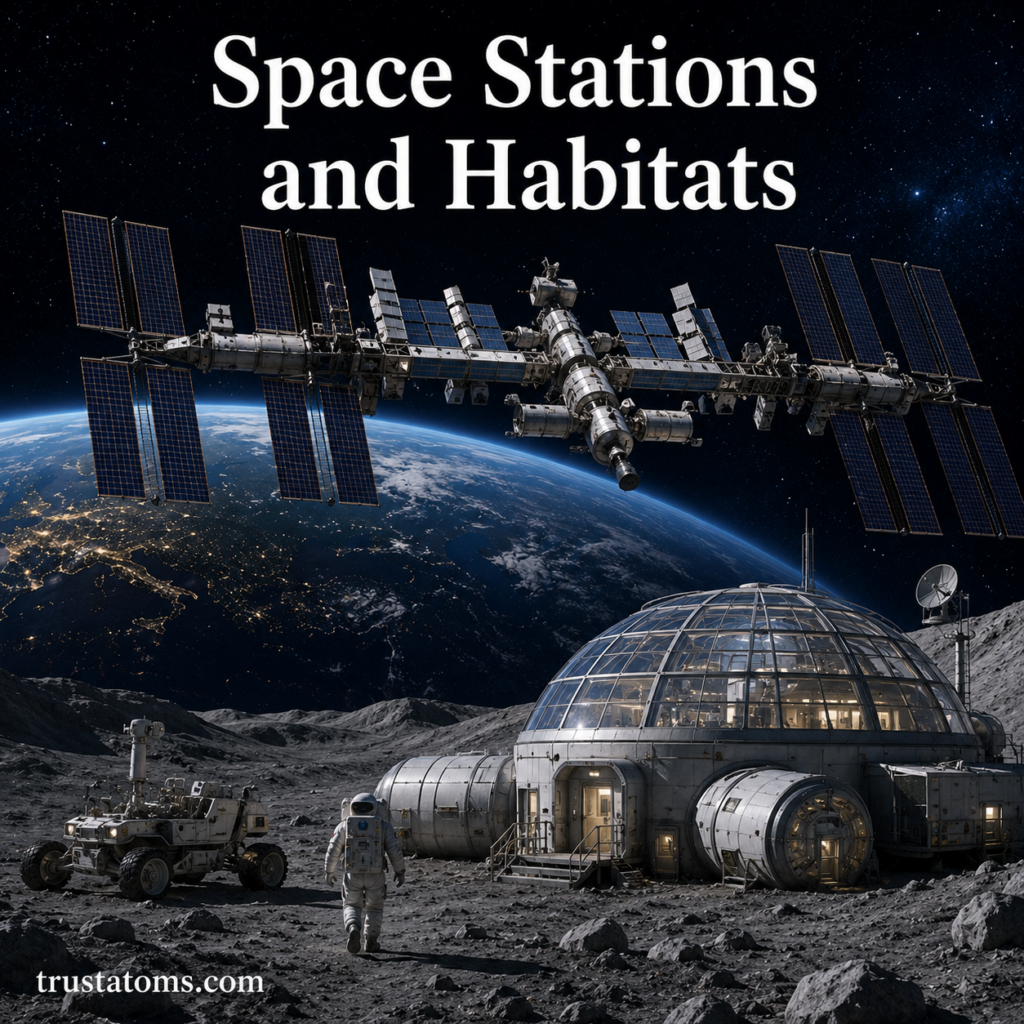
Space stations and habitats represent one of humanity’s most important achievements in space exploration. These structures allow astronauts to live, work, conduct research, and prepare for future missions far beyond Earth’s surface.
From early experimental stations to advanced orbital laboratories, space habitats have helped scientists better understand life in microgravity while laying the foundation for future settlements on the Moon, Mars, and possibly beyond.
As technology advances, space stations may eventually evolve into long-term homes for scientists, commercial workers, and even ordinary civilians in space.
This guide explores how space stations and habitats work, their history, major components, scientific importance, challenges, and what the future of space living may look like.
What Are Space Stations and Habitats?
A space station is a large spacecraft designed for humans to live and work in space for extended periods.
Unlike spacecraft built mainly for transportation, space stations are designed as long-duration living environments that support:
- Scientific research
- Human habitation
- Technology testing
- International cooperation
- Deep-space mission preparation
A space habitat refers more broadly to any structure intended to support human life in space, whether orbiting Earth, located on the Moon, or eventually built on Mars.
The Purpose of Space Stations
Space stations serve multiple scientific and operational goals.
Scientific Research
Microgravity conditions allow scientists to conduct experiments impossible on Earth.
Research areas include:
- Human biology
- Physics
- Material science
- Medicine
- Plant growth
- Robotics
These studies improve understanding of both space and Earth-based science.
Long-Duration Human Spaceflight
Space stations help researchers study how humans adapt to long-term life in space.
Astronauts experience changes involving:
- Muscle loss
- Bone density reduction
- Vision changes
- Sleep cycles
- Cardiovascular health
Understanding these effects is critical for future deep-space missions.
Technology Testing
Space habitats act as testing grounds for future exploration systems.
Technologies tested include:
- Life support systems
- Recycling systems
- Solar power
- Radiation protection
- Autonomous robotics
These innovations may eventually support missions to Mars and beyond.
A Brief History of Space Stations
Early Space Stations
The first space stations were launched during the Cold War space race.
Salyut Program
The Soviet Union launched the first space station series called Salyut in the 1970s.
These stations demonstrated that humans could survive and work in orbit for extended periods.
Skylab
The United States launched Skylab in 1973.
Skylab allowed astronauts to conduct scientific research and solar observations while testing long-duration missions.
Although temporary, it provided valuable experience for future orbital habitats.
Mir Space Station
The Soviet Union later launched Mir, one of the most successful early modular space stations.
Mir remained operational for over 15 years and hosted international crews from multiple countries.
It demonstrated:
- Long-term habitation
- Modular station assembly
- International cooperation in orbit
International Space Station (ISS)
The International Space Station is the largest and most advanced space station ever built.
The ISS is a collaboration involving multiple space agencies, including:
- NASA
- Roscosmos
- ESA
- JAXA
- CSA
Orbiting Earth continuously since 1998, the ISS serves as a major research laboratory and symbol of international cooperation.
Major Components of a Space Station
Space stations contain many interconnected systems designed to support life and operations in orbit.
Living Quarters
Astronauts need safe areas for:
- Sleeping
- Eating
- Exercising
- Hygiene
- Relaxation
Living spaces are compact and carefully designed to maximize efficiency.
Laboratory Modules
Research laboratories allow astronauts to conduct scientific experiments in microgravity.
These modules may include:
- Biological labs
- Physics equipment
- Medical research stations
- Earth observation systems
Solar Power Systems
Most space stations rely on solar panels for electricity.
Solar arrays power:
- Computers
- Communication systems
- Scientific equipment
- Lighting
- Life support systems
Docking Ports
Docking systems allow spacecraft to connect safely with the station.
These ports are used for:
- Crew transport
- Cargo delivery
- Equipment transfers
- Emergency evacuation
Life Support Systems
Life support systems are essential for survival in space.
They manage:
- Oxygen production
- Carbon dioxide removal
- Water recycling
- Temperature control
- Air filtration
Modern systems recycle much of the station’s water and air to reduce resupply needs.
Living in Space
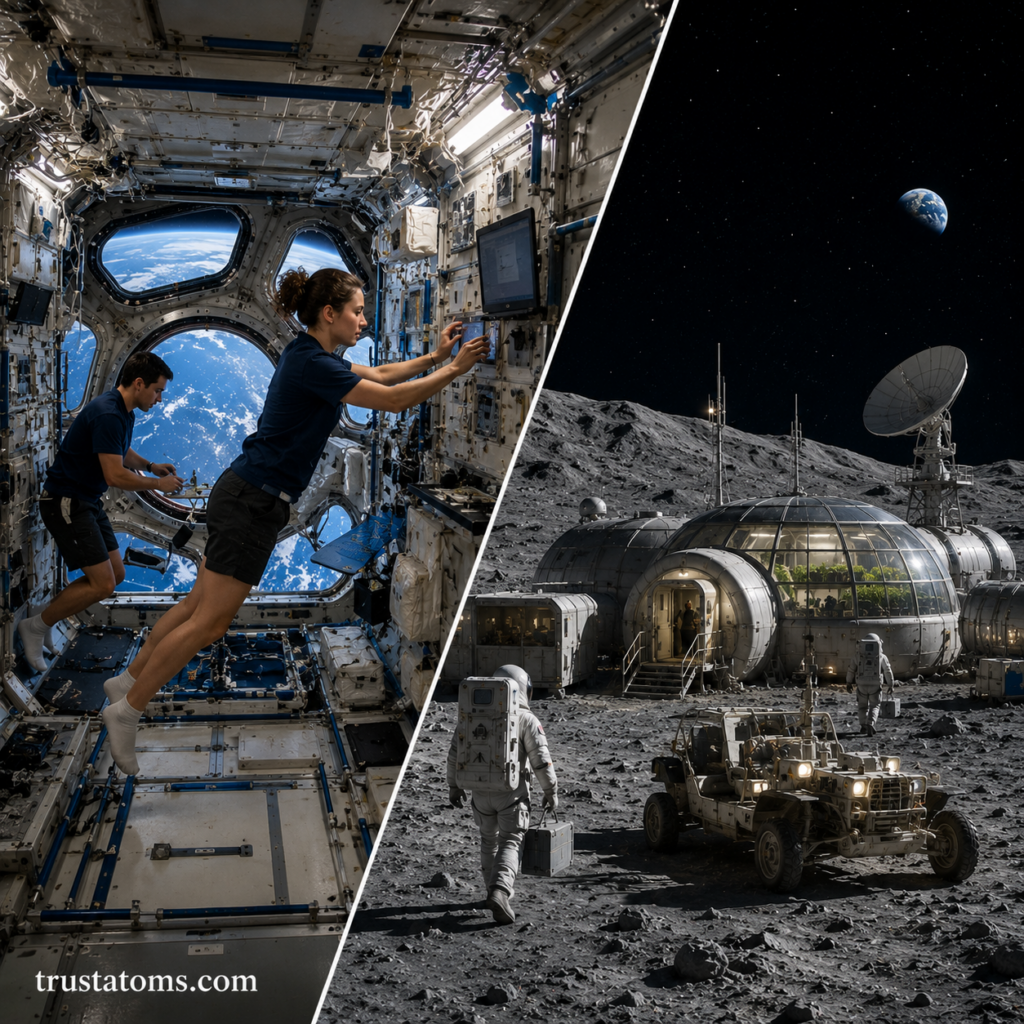
Life aboard a space station differs dramatically from life on Earth.
Microgravity Environment
Astronauts float because they are constantly falling around Earth while remaining in orbit.
Microgravity affects:
- Movement
- Eating
- Sleeping
- Exercise
- Daily tasks
Even simple activities require special techniques.
Sleeping in Space
Astronauts usually sleep in sleeping bags attached to walls or compartments to prevent drifting.
There is no true “up” or “down” in microgravity.
Food and Water
Space food is specially packaged to prevent crumbs and spills from floating through the station.
Water is carefully recycled to conserve resources.
Exercise Requirements
Astronauts must exercise regularly to reduce muscle and bone loss caused by microgravity.
Daily workouts may include:
- Treadmills
- Resistance machines
- Stationary cycling
Exercise is critical for long-term health in orbit.
Challenges of Space Habitats
Creating safe and sustainable habitats in space is extremely difficult.
Radiation Exposure
Space lacks Earth’s protective atmosphere and magnetic field.
Astronauts are exposed to higher levels of cosmic radiation, which may increase long-term health risks.
Future habitats may require advanced shielding technologies.
Isolation and Mental Health
Long-duration missions can create psychological challenges such as:
- Isolation
- Stress
- Fatigue
- Limited privacy
Supporting mental health is essential for successful missions.
Limited Resources
Every kilogram launched into space is expensive.
Space habitats must efficiently manage:
- Food
- Water
- Oxygen
- Energy
- Waste
Recycling technologies are becoming increasingly important.
Equipment Failures
A malfunction in space can become life-threatening quickly.
Critical systems require:
- Backup components
- Continuous monitoring
- Emergency procedures
Reliability is essential for astronaut safety.
Future Space Habitats
The future of space habitats extends far beyond Earth orbit.
Lunar Bases
Space agencies are planning permanent or semi-permanent habitats on the Moon.
Lunar habitats may support:
- Scientific research
- Resource mining
- Deep-space mission staging
The Moon could serve as a stepping stone for Mars exploration.
Mars Habitats
Future Mars missions will require advanced habitats capable of supporting humans for years.
Mars habitats may include:
- Inflatable structures
- Underground shelters
- Radiation-shielded modules
- Greenhouses for food production
Building sustainable systems will be one of humanity’s greatest engineering challenges.
Commercial Space Stations
Private companies are increasingly developing commercial orbital habitats.
These stations may support:
- Space tourism
- Scientific research
- Manufacturing
- Commercial partnerships
Commercialization could expand human presence in orbit significantly.
Rotating Habitats and Artificial Gravity
One major challenge in space is microgravity.
Future habitats may use rotation to create artificial gravity through centrifugal force.
Artificial gravity could help reduce:
- Bone loss
- Muscle deterioration
- Health complications
Although still experimental, rotating habitats are a major concept in future space architecture.
The Role of Space Habitats in Human Exploration
Space stations are more than research labs — they are stepping stones toward becoming a spacefaring civilization.
They help humanity:
- Learn how to survive beyond Earth
- Develop sustainable life support systems
- Test exploration technologies
- Prepare for deep-space travel
- Build international cooperation
The lessons learned aboard orbital stations will shape future exploration throughout the solar system.
Could Humans One Day Live Permanently in Space?
Many scientists believe permanent human settlements in space are possible in the future.
Potential long-term habitats may include:
- Orbital cities
- Lunar colonies
- Mars settlements
- Asteroid mining stations
However, major challenges remain involving:
- Radiation protection
- Sustainable food systems
- Long-term health
- Economic feasibility
Even so, space habitats continue moving from science fiction toward scientific reality.
Final Thoughts
Space stations and habitats are among humanity’s most ambitious engineering achievements.
They allow scientists and astronauts to live and work beyond Earth while helping researchers understand how humans may eventually expand deeper into space.
From early stations like Salyut and Skylab to the International Space Station and future lunar habitats, these structures represent important milestones in exploration and innovation.
As technology continues improving, space habitats may eventually support long-term missions, commercial industries, and even permanent human settlements beyond Earth.