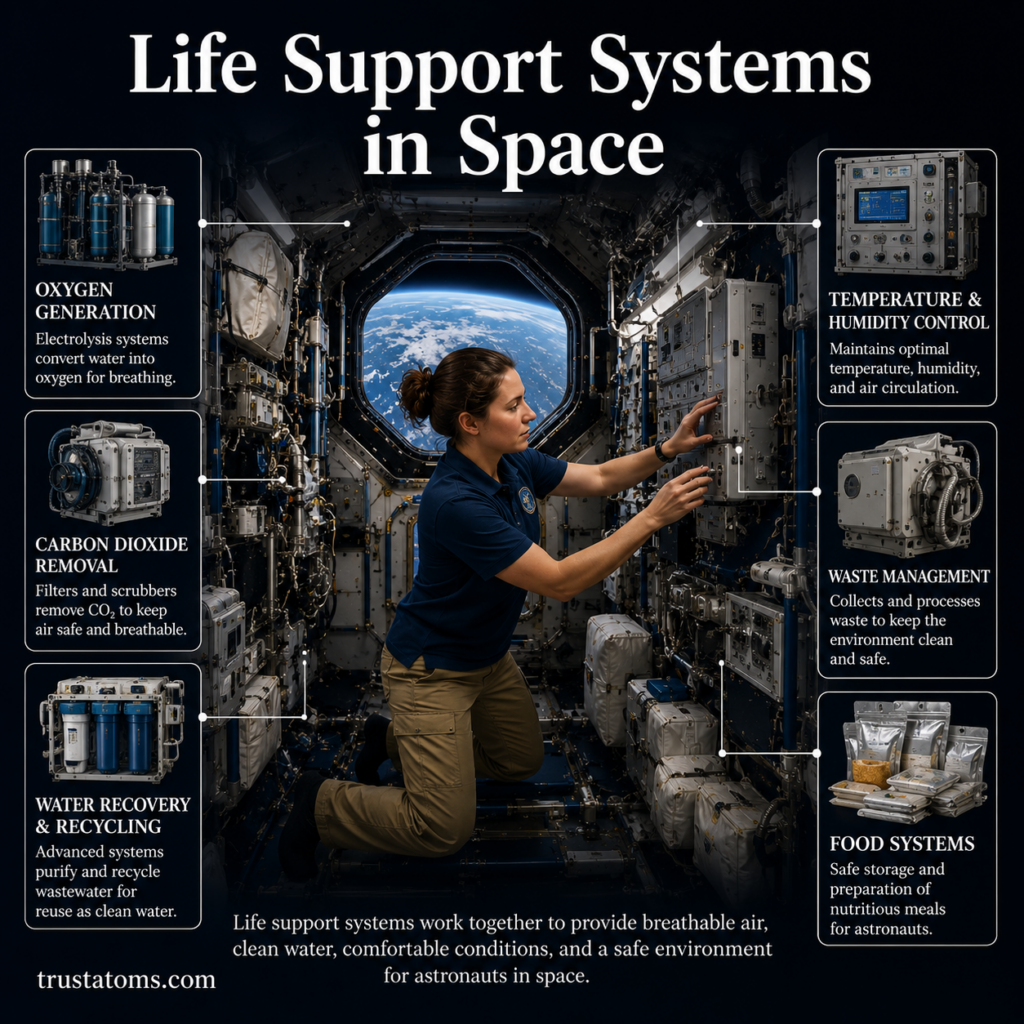
Life support systems keep astronauts alive in space by supplying breathable oxygen, removing carbon dioxide, recycling water, and maintaining safe cabin pressure and temperature. Without these technologies, humans could not survive the vacuum of space or remain aboard spacecraft for extended periods.
These systems create safe living environments inside spacecraft, space stations, and future planetary habitats by managing air, water, food, temperature, and waste. Understanding how they work connects engineering with the study of astronomy and the challenges of exploring environments beyond Earth.
As missions extend farther from Earth, engineers must develop equipment that operates reliably for months or years with limited replacement supplies. The challenge is not simply carrying enough resources but recovering and reusing them while protecting the crew.
What Are Space Life Support Systems?
Space life support systems are interconnected technologies that maintain the environmental conditions humans need to survive inside spacecraft and habitats. They perform functions that Earth’s atmosphere, water cycle, and surrounding environment normally provide.
Their primary responsibilities include:
- Providing oxygen and maintaining breathable air.
- Removing carbon dioxide and airborne contaminants.
- Maintaining appropriate atmospheric pressure.
- Recovering and purifying water.
- Controlling temperature and humidity.
- Supporting food storage, hygiene, and waste management.
Unlike many household systems, spacecraft equipment must operate in a confined environment where a malfunction can threaten the entire crew. Continuous monitoring, backup equipment, and emergency procedures are therefore built into life support planning.
Why Space Requires a Controlled Living Environment
Earth’s atmosphere supplies oxygen and pressure while helping regulate temperatures. Space offers none of these protections naturally.
Outside a spacecraft, the near-vacuum prevents normal breathing and exposes the body to dangerously low pressure. Spacecraft also encounter intense sunlight, deep cold when shaded, and radiation that requires additional protective measures.
Life support equipment maintains habitable conditions inside a sealed cabin. However, it does not eliminate every environmental danger. Structural shielding, spacecraft design, and operational safety procedures provide additional protection.
Main Components of Space Life Support Systems
Modern life support systems combine several technologies that must operate together. A problem in one component can affect the performance of others.
Oxygen Generation and Supply
Astronauts continuously consume oxygen through breathing. Spacecraft replenish it using stored oxygen, chemical oxygen generators, or systems that produce oxygen from water.
One widely used method is electrolysis, which uses electricity to separate water into hydrogen and oxygen. The oxygen enters the cabin atmosphere, while the hydrogen can be vented or used in other processes.
For perspective, NASA commonly estimates that an astronaut consumes approximately 0.84 kilograms of oxygen per day. A four-person crew would therefore need roughly 3.4 kilograms daily, or about 102 kilograms over 30 days. Actual requirements vary with activity and individual metabolism.
This illustrates why producing oxygen aboard a spacecraft can reduce the amount that must be launched from Earth.
Carbon Dioxide Removal and Air Filtration
Breathing releases carbon dioxide, which can accumulate inside sealed cabins. Excessive concentrations may cause headaches, fatigue, impaired concentration, and more serious health problems.
Spacecraft use chemical absorbents or regenerative systems to capture carbon dioxide. Regenerative equipment can release collected carbon dioxide for disposal or further processing, allowing the removal material to be reused.
Filters and other air-cleaning technologies also remove particles and trace chemical contaminants released by equipment, materials, and everyday crew activities.
Water Recovery and Purification
Water supports drinking, food preparation, hygiene, and oxygen generation. Carrying an entire mission’s water supply would add substantial launch mass, making recycling especially valuable.
Recovery systems collect moisture from cabin air and process wastewater, including urine. Filtration, chemical treatment, and other purification stages remove contaminants before recovered water is approved for reuse.
NASA has demonstrated water recovery approaching 98% aboard the International Space Station using advanced processing equipment. This achievement reduces resupply requirements, although maintaining the equipment still requires resources and replacement components.
Temperature, Humidity, and Pressure Control
Astronauts, electronics, and scientific instruments generate heat inside spacecraft. Because heat transfer behaves differently in vacuum, spacecraft use controlled airflow, liquid cooling loops, and external radiators to manage temperatures.
Humidity control removes excess moisture from cabin air, helping prevent condensation and microbial growth. Pressure regulation maintains suitable conditions for breathing and normal physiological functions.
Waste Management and Food Systems
Human waste, food packaging, and other discarded materials must be contained safely. In microgravity, waste cannot simply fall into collection containers, so specialized toilets use airflow to direct material into storage or processing systems.
Food systems emphasize nutritional quality, shelf stability, safe packaging, and efficient storage. Most current space meals are prepared on Earth, although researchers continue investigating controlled plant cultivation for longer missions.
Engineers also investigate fluid movement, filtration, and equipment behavior through microgravity experiments, helping improve systems designed for weightless conditions.
Life support extends beyond the spacecraft cabin. The technologies discussed in Space Suit Engineering provide astronauts with portable environmental protection during activities outside their spacecraft.
How Environmental Control and Life Support Systems Work Together
Environmental Control and Life Support Systems, commonly abbreviated ECLSS, integrate equipment responsible for maintaining habitable spacecraft conditions.
On the International Space Station, interconnected systems monitor cabin air, recover water, generate oxygen, and remove unwanted gases. Sensors help crews and ground controllers identify abnormal conditions before they become emergencies.
Some resources can move through multiple processing stages. For example, recovered water may supply an oxygen-generation system, while certain carbon dioxide processing technologies can recover additional water.
This approach reduces dependence on stored supplies, although current systems are not completely closed loops.
Major Engineering Challenges in Space
Limited Supplies and Equipment Reliability
Every kilogram launched into space requires transportation capacity. Engineers must balance equipment mass, electrical power, maintenance needs, and resource recovery efficiency.
Reliability is equally demanding. Pumps, filters, valves, and sensors can fail, so spacecraft carry replacement parts and emergency supplies. Critical functions may have independent backup equipment to prevent a single malfunction from immediately endangering the crew.
Fluid Behavior in Microgravity
On Earth, gravity helps separate liquids from gases. In orbit, water can form floating droplets, and bubbles may remain trapped in liquid systems.
Engineers address these problems using airflow, centrifugal separators, pumps, and specially designed fluid pathways. Reliable separation is necessary for water purification, humidity removal, and waste collection.
Protection Beyond Environmental Control
Maintaining breathable air does not protect astronauts from every hazard. Radiation, micrometeoroids, fire, and pressure leaks require additional safety measures.
Spacecraft therefore combine life support equipment with structural protection, fire detection, emergency procedures, and continuous environmental monitoring.
Life Support on the International Space Station
The International Space Station provides a working example of long-duration life support. Its systems have supported rotating crews for extended missions while allowing engineers to study equipment performance and maintenance requirements.
Water recovery reduces the amount of fresh water delivered from Earth. Oxygen-generation equipment produces breathable oxygen through electrolysis, while carbon dioxide removal systems help maintain cabin air quality.
Despite these capabilities, the station still depends on deliveries of food, replacement parts, and other supplies. This distinction matters when comparing today’s orbital operations with proposed missions to Mars, where routine resupply would be much more difficult.
Spacesuits Provide Portable Life Support
During spacewalks, astronauts rely on spacesuits that function as small, self-contained spacecraft. Their portable life support systems provide oxygen, regulate pressure, remove carbon dioxide, and manage body heat.
Cooling garments circulate water to help remove metabolic heat. Suit ventilation and filtration equipment maintain breathable conditions while astronauts work outside the spacecraft.
Because portable supplies are limited, spacewalk duration must account for oxygen availability, cooling capacity, battery power, and emergency reserves.
Future Life Support Technologies for the Moon and Mars
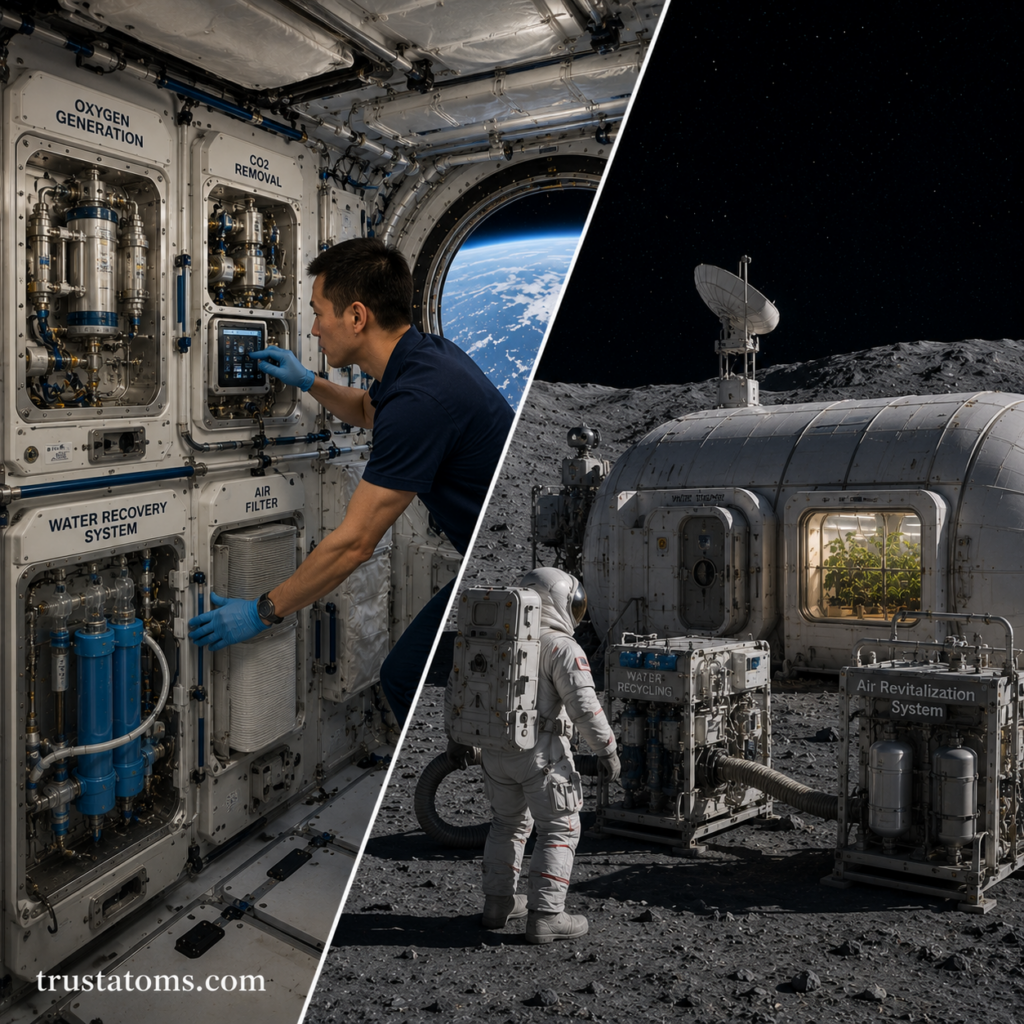
Future missions will require life support equipment capable of operating longer with fewer deliveries from Earth. Researchers are investigating several approaches to increase independence.
More Complete Resource Recycling
Closed-loop life support aims to recover and reuse as much water, oxygen, and other useful material as practical. Improved carbon dioxide processing could help recover resources that would otherwise be discarded.
Complete recycling remains difficult because every processing stage requires energy, maintenance, and some replacement materials.
Growing Food in Controlled Habitats
Space agriculture could supplement stored food while contributing to resource recycling. Researchers are testing hydroponic growing methods, artificial lighting, and controlled environments for plant production.
Plants absorb carbon dioxide and release oxygen during photosynthesis, but providing a substantial fraction of a crew’s food and oxygen would require carefully managed growing systems.
Automation and Local Resource Use
Automated monitoring may help identify leaks, detect equipment problems, and adjust operating conditions before failures become serious.
Future lunar and Martian habitats may also use locally available resources. Extracting water from accessible ice deposits or producing oxygen from suitable materials could reduce the supplies transported from Earth, provided these technologies prove reliable under local conditions.
Can Humans Eventually Live Independently in Space?
Long-term independent habitation is theoretically possible, but current spacecraft still depend on Earth for essential supplies, equipment, and maintenance support.
Greater independence would require durable recycling equipment, dependable power generation, food production, effective repairs, and protection against environmental hazards.
Human preparation matters alongside engineering. Astronaut Training Programs help crews practice equipment maintenance, emergency responses, and survival procedures before missions.
Long-duration habitats must also address radiation exposure. Research into radiation protection in space examines shielding and operational strategies that complement environmental control systems.
Permanent settlements would need to combine these technologies into an infrastructure capable of supporting people through equipment failures, resource shortages, and changing environmental conditions.
Frequently Asked Questions
How do astronauts get oxygen in space?
Astronauts obtain oxygen from stored supplies or onboard generation equipment. On the International Space Station, electrolysis separates water into oxygen and hydrogen, providing oxygen for the cabin atmosphere.
Do astronauts drink recycled water?
Yes. Space station water recovery equipment purifies wastewater and moisture collected from cabin air. Recovered water undergoes treatment and quality monitoring before astronauts use it for drinking or other purposes.
Could astronauts survive if life support stopped working?
Survival would depend on which component failed, the available backup systems, and how quickly the crew responded. Spacecraft include emergency supplies and redundant equipment because losing pressure, oxygen, or carbon dioxide removal can become dangerous.
Space life support systems transform sealed spacecraft into environments where humans can breathe, drink, work, and remain healthy during extended missions. The International Space Station demonstrates how resource recovery and environmental control can sustain crews, while future Moon and Mars missions will test whether these technologies can operate reliably with far less support from Earth.
Sources: NASA, Environmental Control and Life Support System (ECLSS); NASA, International Space Station Water Recovery System; European Space Agency (ESA), MELiSSA life support research program.