Interstellar probe concepts represent some of the most ambitious ideas in modern astronomy and space exploration. These proposed spacecraft are designed to travel beyond our solar system and explore the vast regions between stars.
Although humans have not yet built a true interstellar spacecraft capable of reaching another star system within a practical timeframe, scientists and engineers continue developing advanced concepts that may eventually make such missions possible.
Interstellar probes could help answer some of humanity’s biggest questions about the universe, including whether habitable planets exist around nearby stars and how planetary systems form beyond our own solar neighborhood.
What Is an Interstellar Probe?
An interstellar probe is a spacecraft designed to travel outside the solar system and potentially reach another star system.
Unlike ordinary planetary probes, interstellar spacecraft must operate over:
- Extremely long distances
- Massive travel times
- Harsh radiation environments
- Limited communication conditions
These missions require propulsion technologies far beyond most current spacecraft capabilities.
Why Scientists Want Interstellar Probes
Exploring other star systems could dramatically expand our understanding of the universe.
Major Scientific Goals
Interstellar probes may help scientists:
- Study nearby stars
- Analyze exoplanets
- Search for habitable environments
- Examine interstellar space
- Investigate cosmic radiation
- Understand stellar evolution
These missions could also help determine whether life exists elsewhere in the galaxy.
The Challenge of Interstellar Distances
The main obstacle to interstellar travel is distance.
How Far Away Are the Stars?
The nearest star system beyond the Sun is Alpha Centauri, located about 4.37 light-years away.
A light-year equals the distance light travels in one year:
Even traveling at extremely high speeds, spacecraft would require decades or centuries to reach nearby stars using current technology.
Current Spacecraft Speeds
Voyager 1, the fastest and farthest-traveling human-made object, would still take tens of thousands of years to reach another star system.
This demonstrates why entirely new propulsion methods are necessary.
Existing Interstellar Missions
Although no spacecraft has reached another star, some probes are already traveling through interstellar space.
Voyager 1 and Voyager 2
NASA’s Voyager spacecraft launched in 1977 and eventually crossed the heliopause, the boundary where the Sun’s influence weakens.
What the Voyagers Study
The probes continue collecting data about:
- Cosmic rays
- Magnetic fields
- Interstellar particles
- Solar wind boundaries
These missions provide valuable insight into conditions beyond the solar system.
Golden Records
Each Voyager spacecraft carries a Golden Record containing sounds and images representing life and culture on Earth.
These records were designed as symbolic messages for potential future discoverers.
Propulsion Challenges for Interstellar Travel
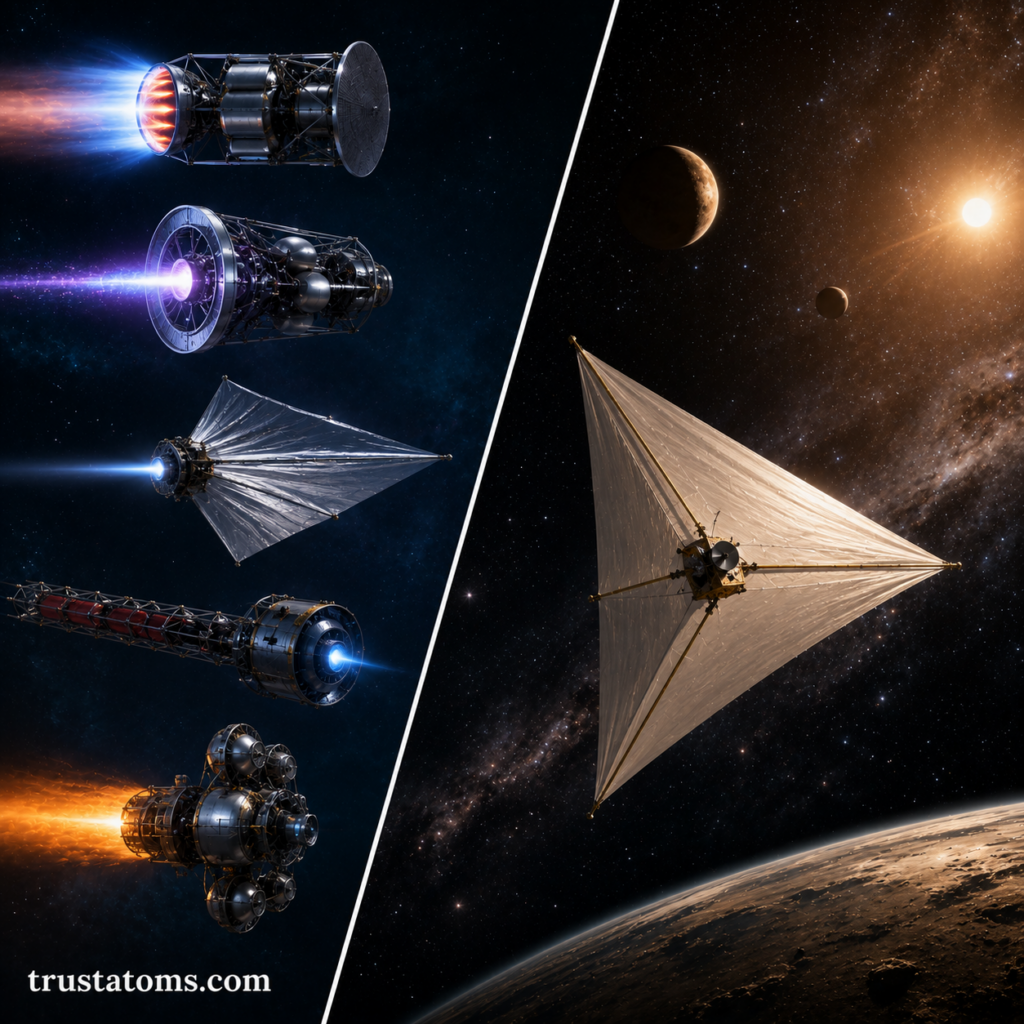
Interstellar probes require propulsion systems capable of reaching extremely high velocities.
Why Chemical Rockets Are Limited
Traditional chemical rockets provide strong launch thrust but lack sufficient efficiency for long interstellar journeys.
Fuel limitations make it difficult to sustain acceleration over enormous distances.
Desired Propulsion Features
Future interstellar propulsion systems would ideally provide:
- Extremely high efficiency
- Long operational lifespan
- Low fuel mass requirements
- Continuous acceleration capability
Scientists are exploring many possible propulsion solutions.
Nuclear Propulsion Concepts
Nuclear propulsion is considered one of the most promising approaches for interstellar missions.
Nuclear Thermal Propulsion
Nuclear thermal rockets heat propellant using a nuclear reactor.
Potential advantages include:
- Higher efficiency than chemical rockets
- Faster travel speeds
- Reduced travel time
Nuclear Pulse Propulsion
Nuclear pulse concepts involve detonating controlled nuclear explosions behind a spacecraft to generate thrust.
One famous concept was Project Orion.
Advantages of Nuclear Pulse Systems
Potential benefits include:
- Extremely powerful thrust
- High interstellar travel speeds
- Ability to transport larger payloads
However, major engineering and safety challenges remain unresolved.
Ion and Electric Propulsion
Electric propulsion systems accelerate charged particles using electricity.
Ion Engines
Ion propulsion is already used in deep-space missions because of its exceptional efficiency.
Advantages include:
- Long-duration operation
- Low fuel consumption
- Precise trajectory control
Limitations of Ion Propulsion
Ion engines generate low thrust, making them unsuitable for rapid acceleration using current technology.
Researchers continue improving electric propulsion systems for future interstellar missions.
Solar Sail Concepts
Solar sails use pressure from sunlight to propel spacecraft without conventional fuel.
How Solar Sails Work
Large reflective sails capture momentum from photons emitted by the Sun.
This allows spacecraft to accelerate gradually over long periods.
Benefits of Solar Sails
Solar sails offer:
- Fuel-free propulsion
- Long operational life
- Continuous acceleration
Challenges of Solar Sail Missions
Problems include:
- Very slow acceleration
- Large sail requirements
- Material durability concerns
Despite challenges, solar sails remain promising for lightweight interstellar probes.
Laser Sail Concepts
Scientists are also studying laser-driven sails for extremely high-speed missions.
Breakthrough Starshot
One of the best-known concepts is Breakthrough Starshot.
The project proposes:
- Tiny lightweight probes
- Ultra-thin reflective sails
- Powerful Earth-based lasers
These lasers could accelerate miniature spacecraft to a significant fraction of light speed.
Potential Advantages
Laser sail systems may allow probes to:
- Reach Alpha Centauri within decades
- Transmit images of exoplanets
- Conduct interstellar observations
Although highly experimental, the concept has generated serious scientific interest.
Fusion Propulsion
Fusion propulsion could potentially provide enormous energy for interstellar travel.
What Is Fusion?
Fusion combines atomic nuclei to release large amounts of energy, similar to processes inside stars.
One possible fusion relationship is:
Benefits of Fusion Propulsion
Fusion systems may offer:
- Very high exhaust velocities
- Reduced travel times
- Greater mission capability
Current Challenges
Fusion propulsion remains largely theoretical because scientists have not yet achieved stable, practical fusion systems for spacecraft.
Antimatter Propulsion Concepts
Antimatter propulsion is one of the most extreme theoretical concepts.
How Antimatter Works
When matter and antimatter collide, they release enormous amounts of energy.
Potential advantages include:
- Extremely high energy density
- Very fast theoretical spacecraft speeds
Why Antimatter Is Difficult
Current challenges include:
- Extremely high production costs
- Safe containment difficulties
- Tiny available quantities
At present, antimatter propulsion remains far beyond current engineering capabilities.
Communication Challenges for Interstellar Probes
Communication becomes increasingly difficult over interstellar distances.
Signal Delays
Radio signals travel at the speed of light, meaning messages between Earth and distant probes could take years to arrive.
Weak Signal Strength
As distance increases:
- Signals weaken dramatically
- Data transmission slows
- Antenna precision becomes critical
Future probes may require advanced laser communication systems.
Power Systems for Long Missions
Interstellar probes must operate for decades or even centuries.
Long-Term Energy Sources
Possible power systems include:
- Radioisotope thermoelectric generators (RTGs)
- Nuclear reactors
- Advanced battery systems
- Energy harvesting technologies
Long-term reliability is essential because repairs would be impossible.
Artificial Intelligence and Autonomous Navigation
Interstellar probes would need advanced autonomy due to long communication delays.
Why AI Is Important
Artificial intelligence may help spacecraft:
- Navigate independently
- Avoid hazards
- Manage systems automatically
- Prioritize scientific observations
Autonomous systems will likely play a major role in future deep-space missions.
Scientific Instruments on Interstellar Probes
Future interstellar spacecraft may carry sophisticated instruments for studying distant environments.
Possible Scientific Equipment
Probes could include:
- Cameras
- Spectrometers
- Particle detectors
- Magnetometers
- Radiation sensors
Miniaturization technology may allow advanced instruments on smaller spacecraft.
Searching for Habitable Worlds
One of the primary goals of interstellar probes is studying exoplanets.
Why Exoplanets Matter
Scientists want to learn whether nearby planetary systems contain:
- Liquid water
- Atmospheres
- Organic chemistry
- Potential biosignatures
Interstellar probes could provide direct measurements impossible from Earth alone.
The Role of Interstellar Space Research
Interstellar probes would also study the environment between stars.
What Exists Between Stars?
Interstellar space contains:
- Gas clouds
- Dust particles
- Cosmic rays
- Magnetic fields
Studying these regions could improve understanding of galaxy formation and stellar evolution.
Ethical and Practical Questions
Interstellar missions raise important scientific and philosophical questions.
Key Concerns
Researchers must consider:
- Mission cost
- Planetary protection
- Long-term reliability
- International cooperation
- Resource allocation
These missions may require generations of scientific planning and development.
Future Possibilities for Human Exploration
Although current interstellar concepts focus on robotic probes, some scientists study the possibility of future human interstellar travel.
Challenges for Human Missions
Human interstellar travel faces enormous obstacles, including:
- Radiation exposure
- Life support duration
- Psychological effects
- Massive energy requirements
Robotic probes will likely remain the primary approach for the foreseeable future.
How Interstellar Probes Inspire Astronomy
Interstellar exploration pushes science and engineering to their limits.
Research into interstellar probes advances:
- Propulsion technology
- Artificial intelligence
- Materials science
- Communication systems
- Energy research
Even concepts that remain theoretical today may influence future technological breakthroughs.
Final Thoughts
Interstellar probe concepts represent humanity’s desire to explore beyond the boundaries of the solar system. Although current technology is not yet capable of rapid interstellar travel, scientists continue developing innovative ideas that could one day make such missions possible.
From nuclear propulsion and laser sails to fusion engines and autonomous spacecraft, these concepts offer exciting possibilities for future astronomy and deep-space exploration.
As technology advances, interstellar probes may eventually help humanity study nearby stars, analyze distant exoplanets, and better understand our place within the galaxy.