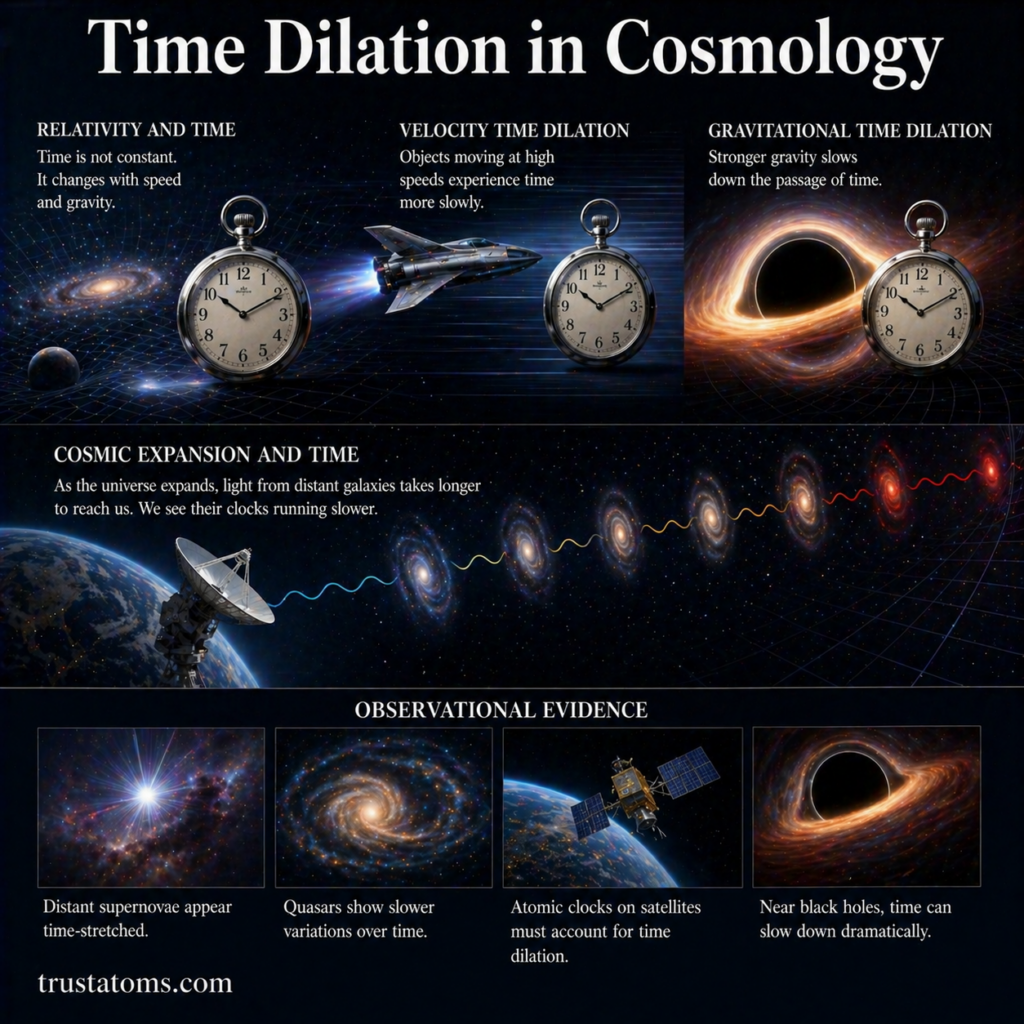
Time is often thought of as constant and universal—but in cosmology, that assumption breaks down. Under extreme conditions involving high speeds, strong gravity, and cosmic expansion, time can flow at different rates. This phenomenon is known as time dilation.
Understanding time dilation is essential for explaining how the universe behaves on both small and large scales—from orbiting satellites to the evolution of distant galaxies.
What Is Time Dilation?
Time dilation refers to the difference in the passage of time between two observers due to relative motion or gravitational effects.
Two Main Types
- Velocity-based time dilation – occurs when objects move at very high speeds
- Gravitational time dilation – occurs in strong gravitational fields
Both are predicted by Einstein’s theories of relativity and have been confirmed through experiments and observations.
Time Dilation and Relativity
Time dilation is rooted in two major theories:
Special Relativity
- Developed to describe motion at high speeds
- Time slows down for objects moving close to the speed of light
- The faster you move, the slower your clock appears to tick (to an outside observer)
General Relativity
- Describes how gravity affects space and time
- Stronger gravity slows the passage of time
- Time passes more slowly near massive objects like black holes
Together, these theories redefine time as flexible rather than fixed.
Gravitational Time Dilation in Cosmology
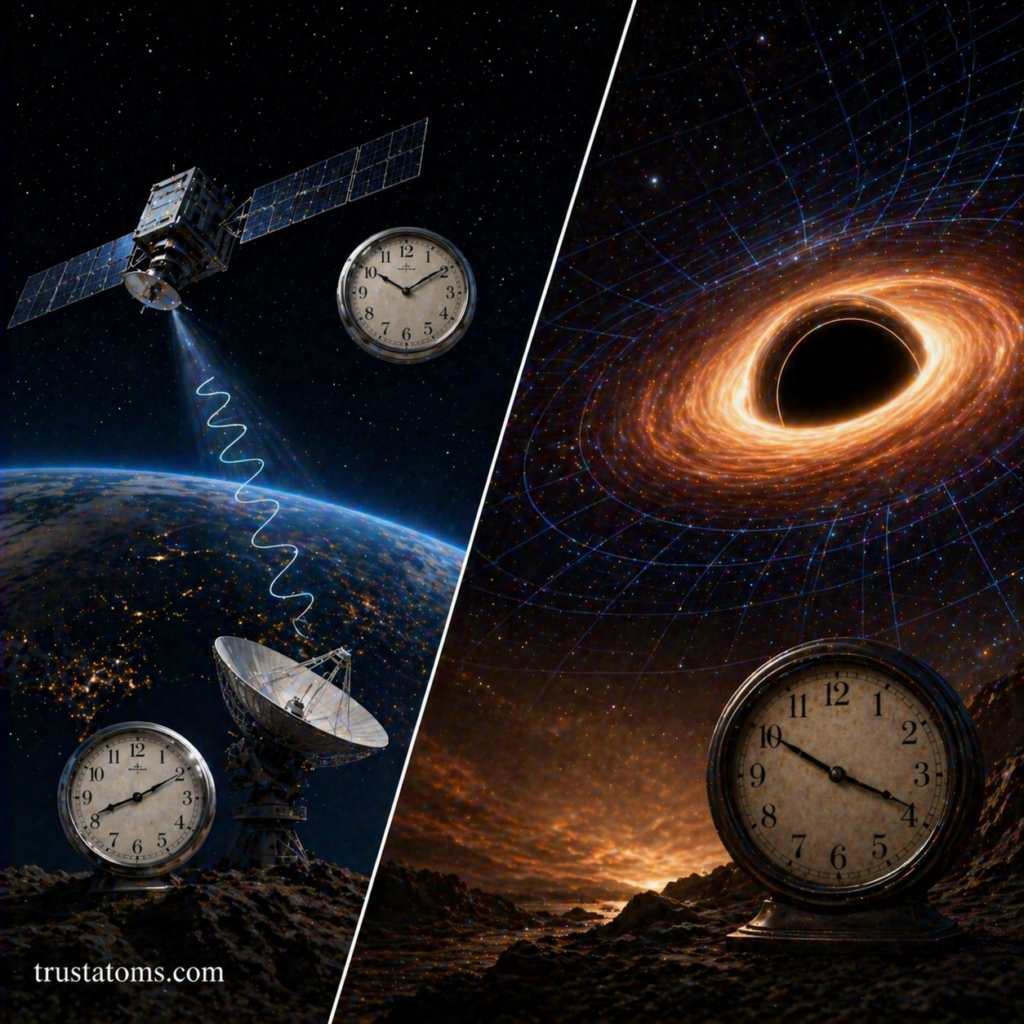
In cosmology, gravity plays a major role in shaping how time behaves.
Where It Occurs
- Near black holes
- Around neutron stars
- In dense galaxy clusters
What Happens
- Clocks closer to massive objects run slower
- Observers farther away experience faster time
This effect becomes extreme near black holes, where time can nearly “freeze” from an outside perspective.
Time Dilation Due to Cosmic Expansion
The expansion of the universe also affects how we observe time.
Key Idea
- Light traveling through expanding space is stretched
- This stretching affects both wavelength and timing
What We Observe
- Events in distant galaxies appear slower
- Light curves of supernovae are stretched over time
- The farther away an object is, the greater the time dilation effect
This phenomenon is sometimes called cosmological time dilation.
Observational Evidence of Time Dilation
Time dilation is not just theoretical—it has been directly observed.
Key Evidence
- Distant supernovae
- Their brightness changes more slowly than nearby ones
- Confirms time dilation at cosmological distances
- Quasars and variable galaxies
- Show time-stretched variations in brightness
- Atomic clock experiments
- Clocks on fast-moving aircraft or satellites run slightly slower
These observations match predictions from relativity.
Time Dilation and the Early Universe
Time dilation also provides insights into the early universe.
Why It Matters
- Helps interpret signals from distant objects
- Allows scientists to measure how fast the universe is expanding
- Reveals how conditions have changed over billions of years
By accounting for time dilation, astronomers can reconstruct cosmic history more accurately.
Everyday Effects of Time Dilation
Although it’s most noticeable in extreme conditions, time dilation affects modern technology.
Real-World Examples
- GPS satellites
- Experience both velocity and gravitational time dilation
- Must correct their clocks to maintain accuracy
- Particle accelerators
- Fast-moving particles live longer due to time dilation
These effects are small but measurable—and essential for precision systems.
Time Dilation Near Black Holes
Black holes create the most extreme examples of time dilation.
What Happens
- Time slows dramatically near the event horizon
- An outside observer sees objects appear to freeze
- The falling object experiences time normally from its own perspective
This leads to fascinating and sometimes counterintuitive effects.
Key Takeaways
- Time dilation means time does not pass at the same rate everywhere
- It occurs due to high speeds and strong gravity
- Cosmic expansion also stretches observed time intervals
- Observations of supernovae confirm time dilation on large scales
- It plays a crucial role in both cosmology and modern technology
Final Thoughts
Time dilation challenges our everyday understanding of time as constant and unchanging. In the universe, time is dynamic—shaped by motion, gravity, and the expansion of space itself.
By studying time dilation, scientists gain deeper insight into the nature of reality, the behavior of extreme cosmic objects, and the history of the universe. It’s a reminder that even the most familiar concepts can behave in extraordinary ways when viewed on a cosmic scale.