Asteroids have shaped the history of Earth for billions of years. From creating massive craters to contributing to the extinction of the dinosaurs, these rocky objects remain one of the few natural threats capable of affecting the entire planet.
Today, scientists and space agencies are developing asteroid deflection strategies designed to prevent catastrophic impacts before they occur. Rather than waiting for an emergency, researchers focus on early detection, orbital calculations, and technologies that could safely alter an asteroid’s path long before it reaches Earth.
Understanding how these strategies work helps explain one of the most important areas of modern planetary defense.
What Is Asteroid Deflection?
Asteroid deflection refers to methods used to slightly change the orbit or trajectory of an asteroid that could collide with Earth.
The goal is not usually to destroy the asteroid outright. Instead, scientists aim to make a small adjustment to its path early enough that the asteroid safely misses Earth years later.
Even a tiny change in velocity can produce a massive shift in location over long periods of time.
Key objectives include:
- Detecting hazardous asteroids early
- Tracking orbital paths accurately
- Determining asteroid size and composition
- Applying controlled force to alter the trajectory
- Preventing fragmentation that could worsen the threat
Planetary defense focuses heavily on preparation and timing.
Why Early Detection Matters
The earlier an asteroid is discovered, the easier it becomes to redirect it.
A small push applied decades before impact may be enough to move the asteroid thousands of miles away from Earth’s future position.
Late detection creates serious challenges because:
- Larger force becomes necessary
- Fewer mission options remain
- Launch windows become limited
- Evacuation planning becomes harder
- Risk of mission failure increases
This is why modern astronomy programs constantly monitor near-Earth objects (NEOs).
Major tracking systems include:
- Ground-based observatories
- Infrared space telescopes
- Radar tracking facilities
- Automated sky surveys
- International asteroid databases
Scientists catalog thousands of near-Earth asteroids every year.
The Kinetic Impactor Method
One of the most realistic asteroid deflection strategies is the kinetic impactor.
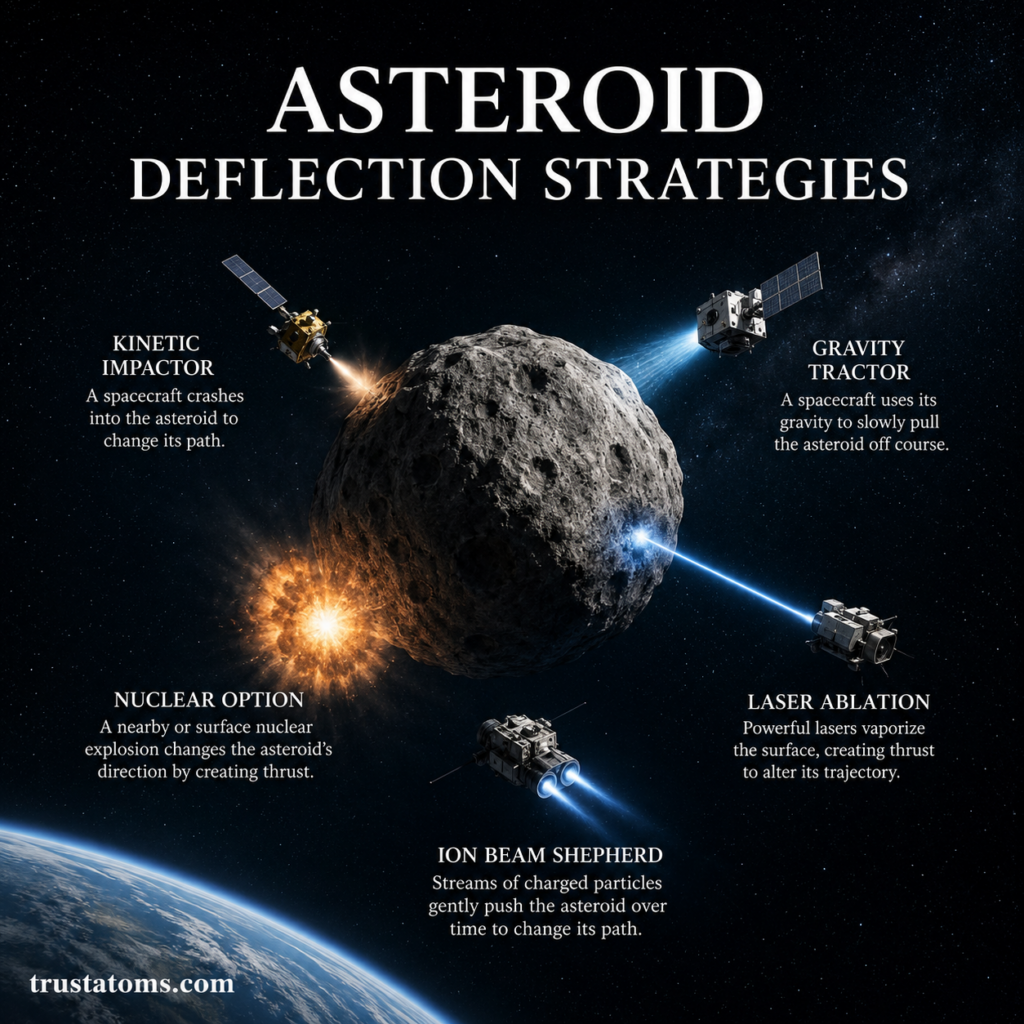
This method involves crashing a spacecraft into the asteroid at high speed to slightly change its velocity.
How It Works
The spacecraft acts like a cosmic battering ram.
By transferring momentum during the collision, the asteroid’s orbit changes enough to avoid Earth in the future.
Key advantages include:
- Uses existing technology
- Relatively straightforward mission design
- No nuclear materials required
- Effective with sufficient warning time
NASA’s DART Mission
The most famous real-world test was NASA’s Double Asteroid Redirection Test (DART).
The mission intentionally impacted the asteroid moonlet Dimorphos in 2022 and successfully changed its orbital period.
This proved that humanity can physically alter an asteroid’s motion in space.
The success of DART marked a major milestone in planetary defense research.
Gravity Tractor Strategy
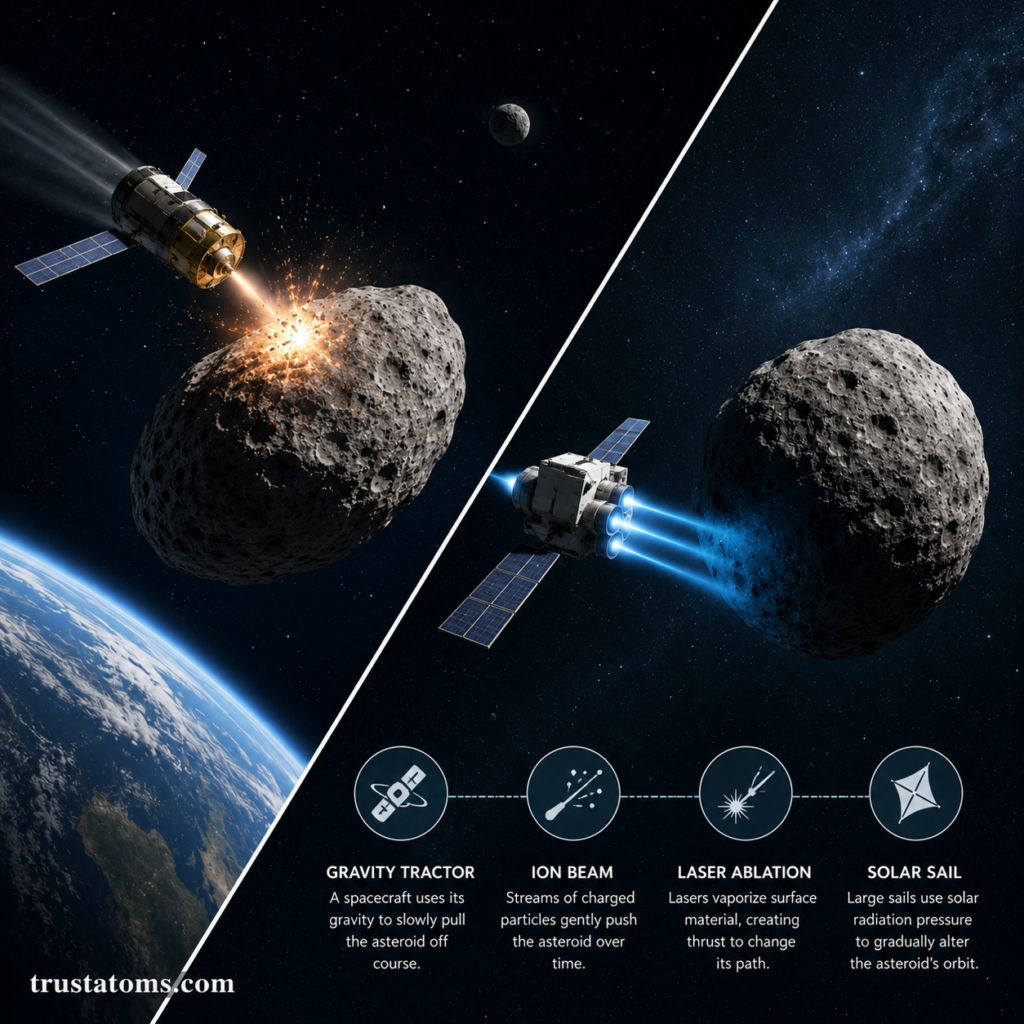
A gravity tractor uses the gravitational pull of a spacecraft to slowly shift an asteroid’s orbit over time.
Rather than colliding with the asteroid, the spacecraft hovers nearby for years.
How It Works
Every object with mass exerts gravity.
A large spacecraft positioned close to an asteroid would create a tiny gravitational attraction that gradually alters the asteroid’s path.
Benefits include:
- Highly controlled method
- Precise orbital adjustments
- Minimal fragmentation risk
- Useful for uncertain trajectories
Challenges include:
- Requires long mission durations
- Works slowly
- Needs advanced propulsion systems
- Less effective for very large asteroids
This strategy works best when scientists have decades of warning.
Nuclear Deflection Concepts
Nuclear options are considered a last resort for large or late-detected asteroids.
Scientists typically discuss two approaches:
Nuclear Standoff Explosion
A nuclear device detonates near the asteroid rather than directly on it.
The intense radiation vaporizes part of the surface, creating thrust that changes the asteroid’s orbit.
Potential benefits:
- Powerful enough for large objects
- Works faster than gradual methods
- May help with short warning times
Surface or Subsurface Detonation
A nuclear device placed on or beneath the asteroid could potentially break it apart.
However, this creates major risks:
- Fragmented debris may still hit Earth
- Multiple impact zones could occur
- Predicting fragment trajectories is difficult
Because of these dangers, fragmentation strategies are generally less preferred.
International laws and political concerns also complicate nuclear approaches.
Laser Ablation Systems
Laser ablation is a theoretical deflection method involving powerful lasers directed at an asteroid’s surface.
How It Works
The laser heats the asteroid surface until material vaporizes.
As gas escapes, it produces thrust that slowly changes the asteroid’s motion.
Possible advantages:
- No physical collision required
- Continuous fine adjustments
- Potentially automated operation
Challenges include:
- Extremely high power requirements
- Long operational timelines
- Major engineering complexity
- Currently experimental technology
While promising, laser systems remain largely conceptual today.
Ion Beam Shepherd Concept
An ion beam shepherd uses streams of charged particles to push an asteroid gently over time.
The spacecraft never touches the asteroid directly.
Potential Benefits
- Precise control
- Reduced fragmentation risk
- Adjustable thrust direction
- Works for fragile asteroids
Current Limitations
- Requires advanced propulsion technology
- Very low force output
- Long mission durations needed
This method remains under active theoretical study.
Challenges in Asteroid Deflection
Asteroid deflection is far more complicated than simply “blowing up a rock.”
Several factors make planetary defense difficult.
Unknown Asteroid Composition
Asteroids vary greatly in structure:
- Solid metallic bodies
- Rocky formations
- Loose rubble piles
- Ice-rich objects
- Porous materials
A method effective for one asteroid may fail against another.
Rotation Problems
Many asteroids spin rapidly.
Irregular rotation complicates:
- Spacecraft landing
- Impact timing
- Directional control
- Surface operations
Size Differences
Small asteroids may burn up naturally in Earth’s atmosphere, while larger ones could cause regional or global destruction.
The required deflection strategy depends heavily on size.
Time Constraints
Warning time is critical.
A decade of preparation allows many options. A few months may leave almost none.
International Cooperation and Planetary Defense
Asteroid defense is a global issue that requires international collaboration.
Organizations involved include:
- NASA
- ESA (European Space Agency)
- JAXA
- National observatories
- University research programs
- United Nations planetary defense groups
Cooperation helps with:
- Data sharing
- Telescope coverage
- Mission funding
- Emergency planning
- Technology development
Because asteroid impacts affect the entire planet, planetary defense is considered one of the most internationally cooperative areas of space science.
Could Humanity Actually Stop a Large Asteroid?
In many cases, yes — if detected early enough.
Current research suggests humanity could likely deflect many hazardous asteroids given sufficient warning time and proper mission planning.
However, several uncertainties remain:
- Extremely large objects
- Late discovery scenarios
- Complex asteroid structures
- Mission reliability
- Political coordination
Planetary defense is still evolving, but modern astronomy and spacecraft technology have already demonstrated meaningful progress.
The Future of Asteroid Defense
Future planetary defense efforts may include:
- Dedicated asteroid interceptor spacecraft
- Continuous infrared sky monitoring
- Artificial intelligence tracking systems
- Faster launch capabilities
- Robotic mining and asteroid study missions
- Permanent planetary defense coordination networks
Scientists also continue studying asteroid composition through sample-return missions and robotic exploration.
The more humanity learns about asteroids, the better prepared Earth becomes against future threats.
Final Thoughts
Asteroid deflection strategies represent one of humanity’s most important scientific safety efforts.
Rather than science fiction, planetary defense is now an active field involving astronomy, engineering, physics, and international cooperation.
The key to success is early detection and preparation. Even small changes to an asteroid’s trajectory can prevent catastrophic impacts years later.
As technology advances, humanity’s ability to monitor and redirect dangerous objects will likely continue improving, helping protect Earth from one of nature’s most powerful cosmic hazards.