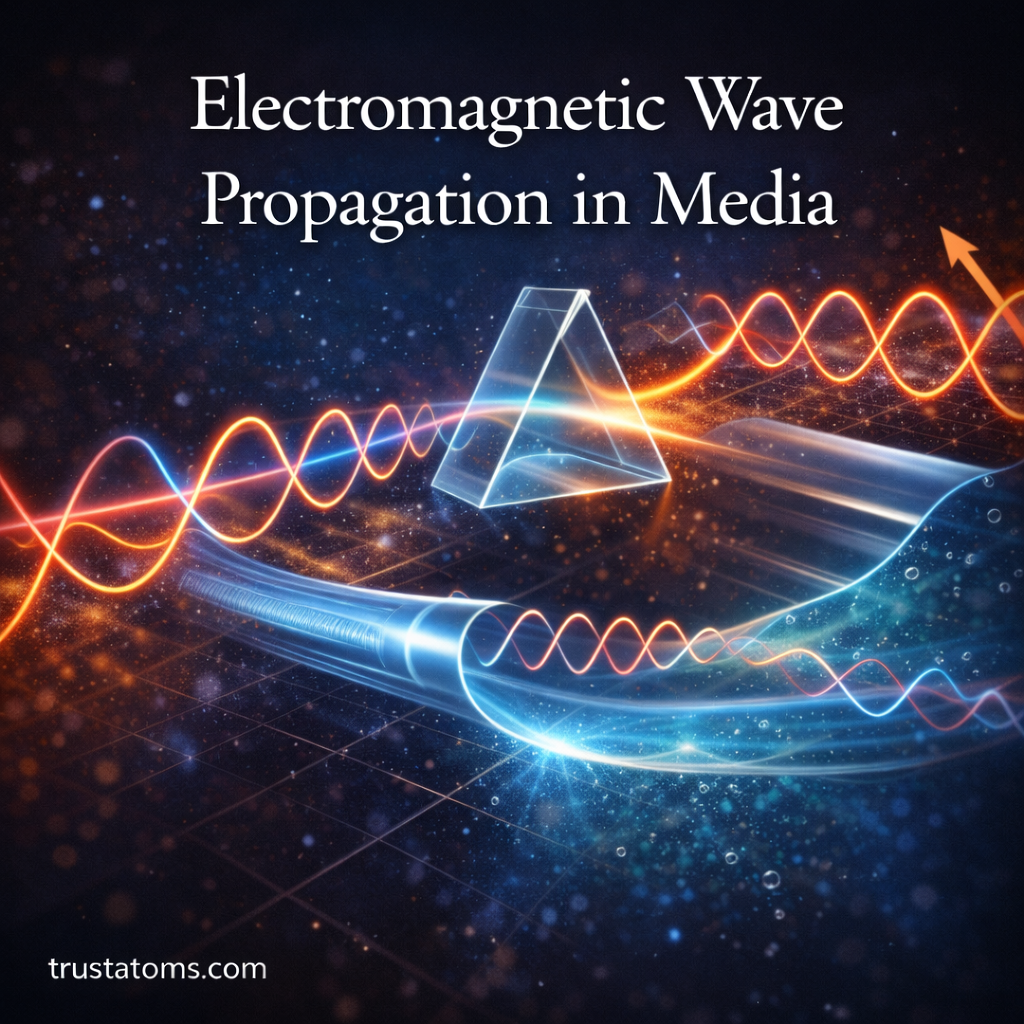
Electromagnetic waves — including radio waves, microwaves, visible light, X-rays, and gamma rays — are fundamental carriers of energy and information. In a vacuum, they travel at the speed of light.
But most real-world applications involve waves moving through materials, not empty space.
When electromagnetic waves enter a medium like air, water, glass, or fiber optic cable, their behavior changes. They can slow down, bend, reflect, weaken, or even get absorbed.
Understanding electromagnetic wave propagation in media is essential for telecommunications, optics, materials science, and modern engineering.
What Is an Electromagnetic Wave?
An electromagnetic (EM) wave consists of:
- An oscillating electric field
- An oscillating magnetic field
- Both perpendicular to each other
- Both perpendicular to the direction of travel
Unlike mechanical waves (like sound), EM waves do not require a material medium to propagate. They can travel through empty space.
However, when they enter a material medium, interactions with atoms and molecules modify their behavior.
What Happens When EM Waves Enter a Medium?
When an electromagnetic wave moves into a material, its electric field interacts with charged particles (mostly electrons) in that material.
These interactions cause:
- Re-emission of radiation
- Energy absorption
- Changes in wave speed
- Directional bending (refraction)
The collective response of the material determines how the wave propagates.
Speed of Light in a Medium
In a vacuum, light travels at its maximum speed.
In a medium, it slows down.
The reduction in speed is described by the refractive index of the material.
Key idea:
- Higher refractive index → slower wave speed
- Lower refractive index → faster wave speed
For example:
- Air: slightly slower than vacuum
- Water: significantly slower
- Glass: slower than water
This slowing occurs because the wave continually interacts with bound charges in the material.
Refraction: Why Light Bends
When light passes from one medium to another (such as air to water), its speed changes.
If it enters at an angle:
- One side of the wave slows first.
- The direction changes.
- The wave bends.
This bending is called refraction.
Refraction explains:
- Why a straw looks bent in a glass of water
- How lenses focus light
- How fiber optics guide signals
Reflection at Boundaries
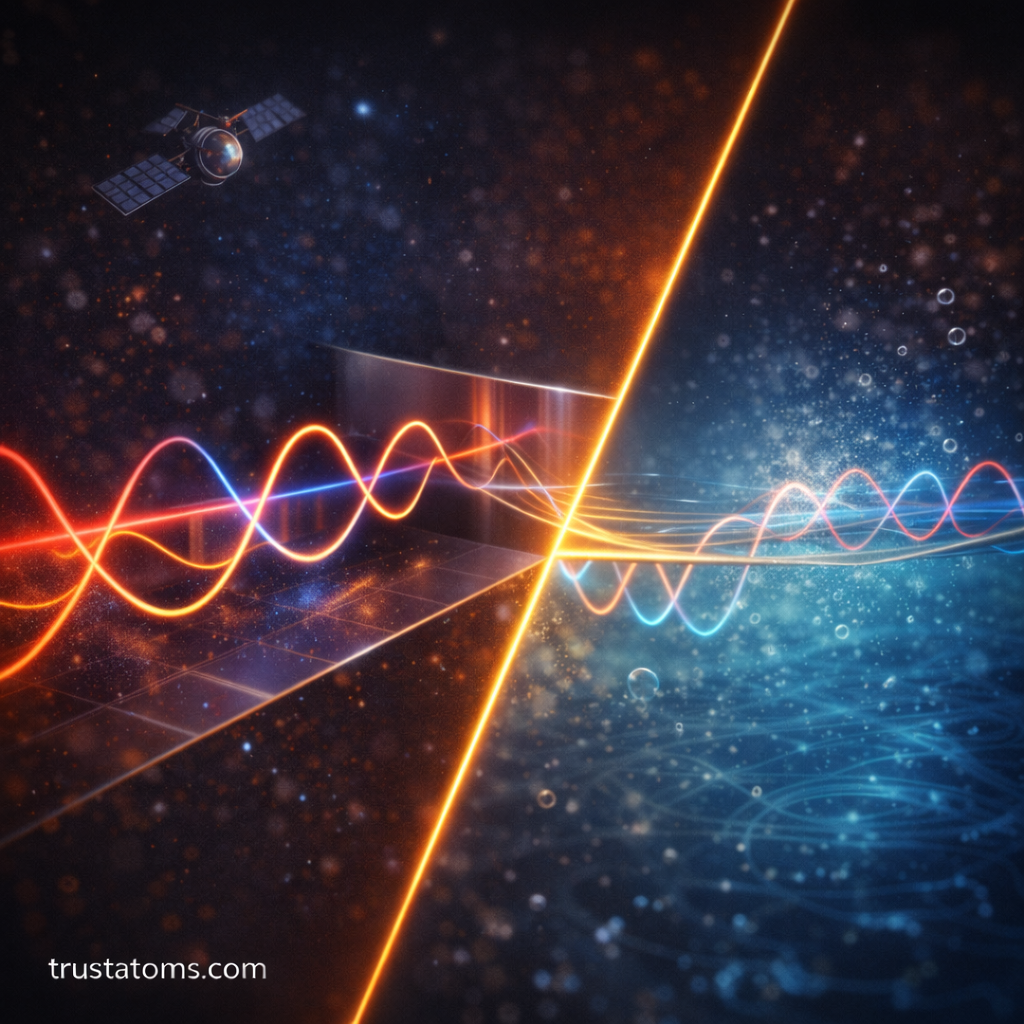
When a wave hits the boundary between two materials, part of the energy may reflect back.
The amount reflected depends on:
- The difference in refractive index
- The angle of incidence
- The polarization of the wave
Large differences in material properties produce stronger reflections.
This principle is used in:
- Mirrors
- Radar systems
- Anti-reflective coatings
Absorption and Attenuation
Not all energy continues forward.
Some of the wave’s energy may:
- Be absorbed by the material
- Convert into heat
- Excite atomic or molecular vibrations
This causes attenuation — a gradual reduction in wave intensity.
Examples:
- Microwaves heat food by being absorbed by water molecules.
- UV radiation can be absorbed by skin.
- Radio signals weaken as they pass through walls.
Different materials absorb different frequencies more strongly.
Dispersion: Frequency-Dependent Speed
In many materials, wave speed depends on frequency.
This phenomenon is called dispersion.
Consequences include:
- White light separating into colors in a prism
- Signal distortion in communication cables
- Chromatic aberration in lenses
Because each frequency travels at a slightly different speed, a pulse of mixed frequencies can spread out over time.
Polarization Effects
Electromagnetic waves can be polarized, meaning their electric field oscillates in a specific direction.
In certain media:
- Some polarizations travel more easily than others.
- Certain orientations may be absorbed more strongly.
Examples:
- Polarized sunglasses reduce glare by filtering specific orientations.
- Liquid crystals control light polarization in display screens.
Media can therefore affect not just speed and direction, but orientation as well.
Conductors vs. Dielectrics
Different types of materials influence wave propagation differently.
Dielectrics (Insulators)
- Weak electrical conductivity
- Allow EM waves to propagate
- Example: glass, plastic, air
These materials mainly cause refraction and partial reflection.
Conductors
- High electrical conductivity
- Strongly attenuate EM waves
- Example: metals
In conductors:
- Waves penetrate only a short distance.
- Energy rapidly converts into heat.
This limited penetration is called the skin effect.
Wave Impedance in Media
Every medium has an associated electromagnetic impedance.
Impedance determines:
- How much of a wave is transmitted
- How much is reflected
When impedance is matched between materials:
- Reflection is minimized
- Energy transfer is maximized
This is crucial in:
- Antenna design
- Transmission lines
- Microwave engineering
Propagation in Optical Fibers
Optical fibers use controlled wave propagation to transmit information.
They rely on:
- Total internal reflection
- A high refractive index core
- A lower refractive index cladding
Light entering at the correct angle reflects internally and travels long distances with minimal loss.
This technology powers:
- Internet infrastructure
- Long-distance communications
- Medical imaging systems
EM Waves in Plasma
Plasma — an ionized gas — affects EM waves differently.
In plasma:
- Free charges respond strongly to electric fields.
- Certain frequencies cannot propagate.
- Reflection or absorption may occur.
This behavior explains:
- Radio wave reflection in Earth’s ionosphere
- Solar flare disruptions of communication
- Astrophysical signal filtering
Practical Applications
Understanding electromagnetic wave propagation in media enables:
- Wireless communication
- Fiber optic networks
- Radar and sonar systems
- Satellite transmission
- Medical imaging technologies
- Material characterization
Modern society depends on precise control of wave behavior in different materials.
Why It Matters in Physics
Electromagnetic wave propagation in media reveals a deeper truth:
Waves are not isolated entities.
They interact continuously with matter.
The material’s microscopic structure determines:
- Wave speed
- Energy transfer
- Signal clarity
- Reflection and transmission properties
This interplay between fields and matter lies at the heart of classical electromagnetism and modern photonics.
Final Thoughts
Electromagnetic waves travel freely in a vacuum — but in materials, their behavior becomes rich and complex.
They slow down.
They bend.
They reflect.
They disperse.
They weaken.
These effects are not random. They arise from predictable interactions between oscillating electric fields and charged particles within matter.
From internet data transmission to optical lenses and microwave ovens, electromagnetic wave propagation in media is one of the most practical and powerful concepts in physics.