Inside every atom lies a world governed by forces far stronger than gravity and far more subtle than everyday electromagnetism. These are the nuclear interactions — the weak nuclear force and the strong nuclear force.
Together, they shape:
- The stability of atoms
- Radioactive decay
- Nuclear fusion in stars
- The very existence of matter
In this guide, we’ll clearly explain what the weak and strong nuclear interactions are, how they differ, and why they are fundamental to modern physics.
The Four Fundamental Forces of Nature
Physics currently recognizes four fundamental interactions:
- Gravity
- Electromagnetism
- Strong nuclear force
- Weak nuclear force
While gravity governs planets and galaxies, and electromagnetism governs chemistry and light, the strong and weak forces operate at the subatomic scale.
They control the behavior of particles inside atomic nuclei.
The Strong Nuclear Force
The strong nuclear force is the most powerful force in nature.
Its job is simple but profound:
It binds quarks together to form protons and neutrons — and binds those protons and neutrons together inside atomic nuclei.
Without it, matter as we know it would not exist.
What Does the Strong Force Do?
The strong interaction operates at two levels:
- Quark level
- Binds quarks into protons and neutrons.
- Prevents quarks from existing freely (a phenomenon called confinement).
- Nuclear level
- Binds protons and neutrons together in the nucleus.
- Overcomes the electromagnetic repulsion between positively charged protons.
How Strong Is It?
Compared to other forces:
- Strong force: strongest at short distances
- Electromagnetism: weaker
- Weak force: much weaker
- Gravity: extremely weak at atomic scales
However, the strong force only acts over very short distances — roughly the size of a nucleus.
Beyond that, it rapidly decreases.
The Carrier of the Strong Force
In particle physics, forces are transmitted by particles.
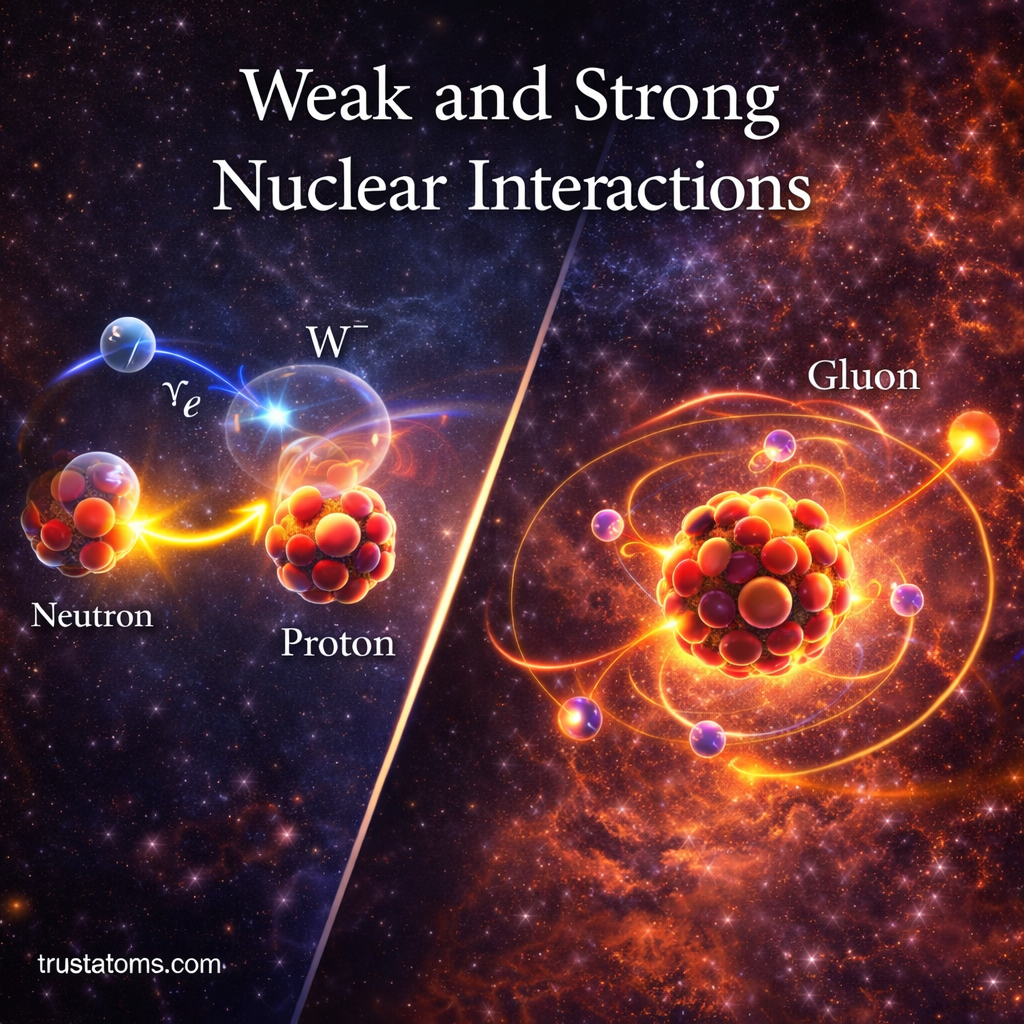
The strong interaction is mediated by particles called gluons.
Gluons:
- Bind quarks together
- Carry a property called “color charge”
- Are described by quantum chromodynamics (QCD)
The theory of the strong force is one of the pillars of the Standard Model of particle physics.
The Weak Nuclear Force
The weak nuclear force is responsible for processes that change one type of particle into another.
Its most famous role is:
Radioactive beta decay.
What Does the Weak Force Do?
The weak interaction allows:
- A neutron to transform into a proton
- A proton to transform into a neutron
- Emission of electrons or positrons
- Production of neutrinos
Without the weak force:
- The Sun would not shine.
- Nuclear fusion would not occur.
- Many radioactive processes would not exist.
Why Is It Called “Weak”?
It is called “weak” because:
- It is much weaker than the strong force.
- Its range is extremely short.
- It only operates at subatomic distances.
But despite its name, it is essential to the evolution of the universe.
The Carriers of the Weak Force
The weak interaction is mediated by heavy particles:
- W⁺ boson
- W⁻ boson
- Z boson
Because these particles are massive, the weak force has a very short range.
This is why weak interactions only occur at very small scales.
Strong vs. Weak Nuclear Interactions: Key Differences
Here’s a clear comparison:
Strong Nuclear Force
- Binds quarks and nucleons
- Extremely strong at short range
- Carrier particles: gluons
- Acts inside protons, neutrons, and nuclei
- Described by quantum chromodynamics
Weak Nuclear Force
- Changes particle types (flavor)
- Responsible for radioactive decay
- Carrier particles: W and Z bosons
- Much weaker than the strong force
- Enables fusion in stars
Both are essential, but they play very different roles.
How These Forces Shape the Universe
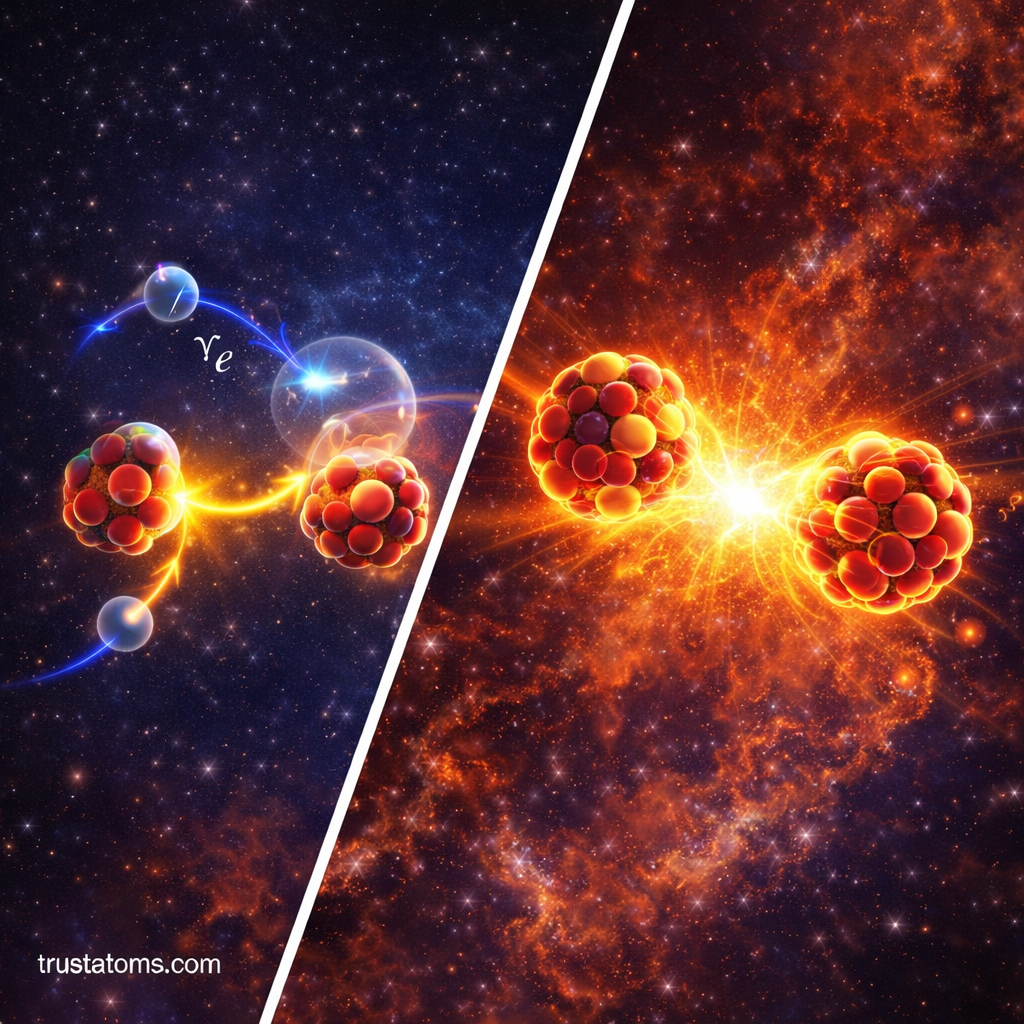
The strong and weak forces together determine:
- Whether atomic nuclei are stable
- Which elements can exist
- How stars produce energy
- How supernovae create heavy elements
For example:
- The strong force holds hydrogen nuclei together in stars.
- The weak force enables proton-to-neutron conversions during fusion.
- Heavy elements form because of the balance between these forces.
Even slight changes in their strength could prevent life from existing.
The Strong Force and Nuclear Binding Energy
One of the key results of the strong interaction is nuclear binding energy.
Binding energy:
- Is the energy required to separate a nucleus into protons and neutrons.
- Explains why fusion and fission release energy.
- Is the source of nuclear power and stellar energy.
The strong force is responsible for this stored energy inside nuclei.
The Weak Force and Radioactive Decay
Radioactive decay processes — such as beta decay — depend on the weak interaction.
In beta decay:
- A neutron converts into a proton.
- An electron is emitted.
- A neutrino is emitted.
This transformation changes one element into another.
The weak force makes nuclear transmutation possible.
Unification in the Standard Model
In modern particle physics:
- The weak force and electromagnetism are unified into the electroweak interaction.
- At very high energies, they behave as one force.
The strong force remains separate in the Standard Model framework.
Scientists continue searching for a deeper unification that includes all forces.
Why These Forces Matter in Modern Physics
Understanding weak and strong interactions is essential for:
- Particle accelerators
- Nuclear energy research
- Astrophysics
- Cosmology
- Neutrino physics
- High-energy experiments
They are also central to ongoing research into:
- Grand unified theories
- Proton decay
- Matter–antimatter asymmetry
Common Misconceptions
“Are nuclear forces only relevant in bombs or reactors?”
No.
They are active in every atom and every star in the universe.
“Is the weak force unimportant because it’s weak?”
Absolutely not.
Without the weak force, stars could not fuse hydrogen into helium.
“Does the strong force act like gravity?”
No.
It does not pull objects at large distances. It only operates at extremely short ranges inside nuclei.
Final Thoughts
The strong and weak nuclear interactions are two of the fundamental building blocks of reality.
The strong force:
- Holds quarks together
- Binds nuclei
- Makes matter stable
The weak force:
- Enables particle transformations
- Drives radioactive decay
- Powers stellar fusion
Together, they shape atomic structure, stellar evolution, and the chemical complexity of the universe.
Understanding these forces is essential for anyone exploring modern physics — from the smallest particles to the largest cosmic structures.