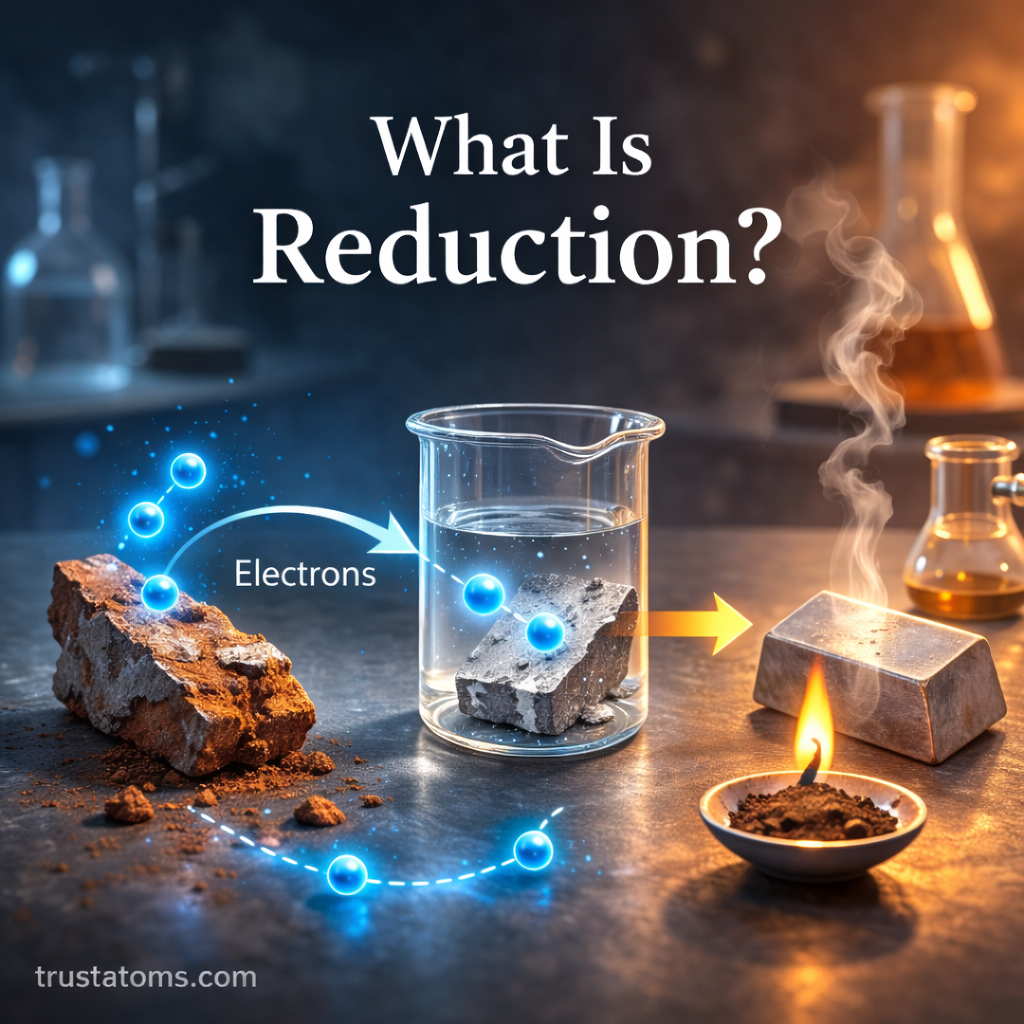
Reduction is a fundamental chemical process in which a substance gains electrons during a reaction. It always occurs alongside oxidation in what chemists call a redox (reduction–oxidation) reaction.
In simple terms:
Reduction = gain of electrons.
Although reduction is often discussed together with oxidation, it has its own important role in chemistry, biology, energy systems, and industrial processes.
The Modern Definition of Reduction
In modern chemistry, reduction is defined as:
The gain of one or more electrons by a substance during a chemical reaction.
When reduction happens:
- The substance becomes more negatively charged (or less positively charged)
- Its oxidation number decreases
- It receives electrons from another substance
Because electrons cannot exist freely in most chemical reactions, whenever one substance is reduced, another must be oxidized.
A helpful memory device:
- OIL = Oxidation Is Loss
- RIG = Reduction Is Gain
The Historical Meaning of Reduction
Originally, reduction referred to the removal of oxygen from a compound.
For example:
Metal ore → metal (after oxygen is removed)
Later, scientists discovered that many reactions without oxygen behaved the same way — they involved electron gain. This led to the broader, electron-based definition used today.
What Happens During Reduction?
When reduction occurs:
- A substance gains electrons
- Its oxidation state decreases
- It often becomes more stable or less reactive
Electron gain can happen through:
- Direct contact between substances
- Reactions in solution
- Electrochemical processes (like batteries)
Reduction cannot occur alone. It is always paired with oxidation.
Reduction in Redox Reactions
A redox reaction involves both:
- Oxidation (electron loss)
- Reduction (electron gain)
For example:
- A metal atom may lose electrons (oxidation)
- Another substance gains those electrons (reduction)
This transfer of electrons drives the reaction forward.
Redox reactions are essential for:
- Energy production
- Metal extraction
- Corrosion processes
- Biological systems
Everyday Examples of Reduction
Reduction happens constantly in both natural and industrial environments.
1. Photosynthesis
In plants, carbon dioxide gains electrons during photosynthesis.
This reduction process helps form glucose, storing energy from sunlight.
2. Metal Refining
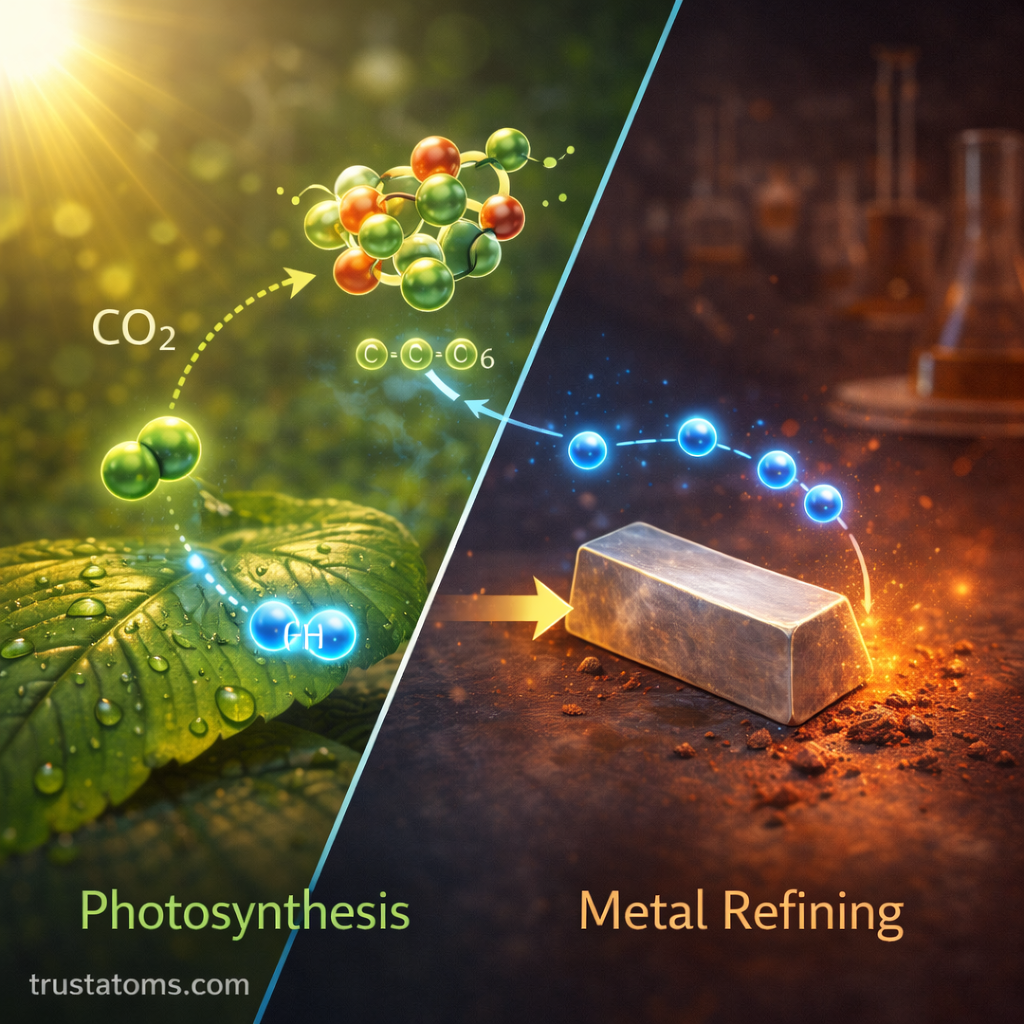
Many metals are extracted from ores through reduction.
For example:
- Iron is reduced from iron oxide in a blast furnace
- Aluminum is reduced during electrolysis
Without reduction, usable metals would not be available for construction or manufacturing.
3. Batteries
In a battery:
- One material oxidizes (loses electrons)
- Another material reduces (gains electrons)
Reduction occurs at the cathode, where electrons are accepted.
This electron movement generates electrical energy.
4. Cellular Respiration
Inside your cells, oxygen gains electrons at the end of the electron transport chain.
This reduction process helps produce ATP, the molecule that powers cellular activity.
Reduction and Oxidation Numbers
Chemists track reduction using oxidation numbers (oxidation states).
If an oxidation number decreases:
Reduction has occurred.
For example:
- If a substance changes from +2 to 0, it has gained electrons.
- A lower oxidation state indicates reduction.
Monitoring oxidation numbers makes balancing redox reactions more systematic.
Reduction vs. Oxidation: Key Differences
Although they occur together, reduction and oxidation are opposites.
Reduction:
- Gains electrons
- Oxidation number decreases
- Occurs at the cathode in electrochemical cells
Oxidation:
- Loses electrons
- Oxidation number increases
- Occurs at the anode
Understanding both processes provides a complete picture of redox chemistry.
Why Reduction Is Important in Chemistry
Reduction is essential for:
- Producing metals from ores
- Generating electrical energy
- Supporting biological life
- Fuel cell operation
- Industrial chemical synthesis
It helps explain how matter transforms and how energy moves through chemical systems.
Without reduction, many of the technologies and biological processes we rely on would not function.
How to Identify Reduction in a Reaction
To determine whether reduction is occurring:
- Look for electron gain
- Check if oxidation numbers decrease
- Identify the substance acting as the oxidizing agent (it gets reduced)
If electrons are accepted by a substance, reduction is taking place.
Final Thoughts
Reduction is the process by which a substance gains electrons in a chemical reaction. It always occurs alongside oxidation and plays a central role in redox chemistry.
From powering batteries to enabling photosynthesis and refining metals, reduction is a foundational concept that explains how chemical reactions transfer energy and transform matter.
Understanding reduction gives you a clearer view of how chemistry operates at both microscopic and real-world scales.