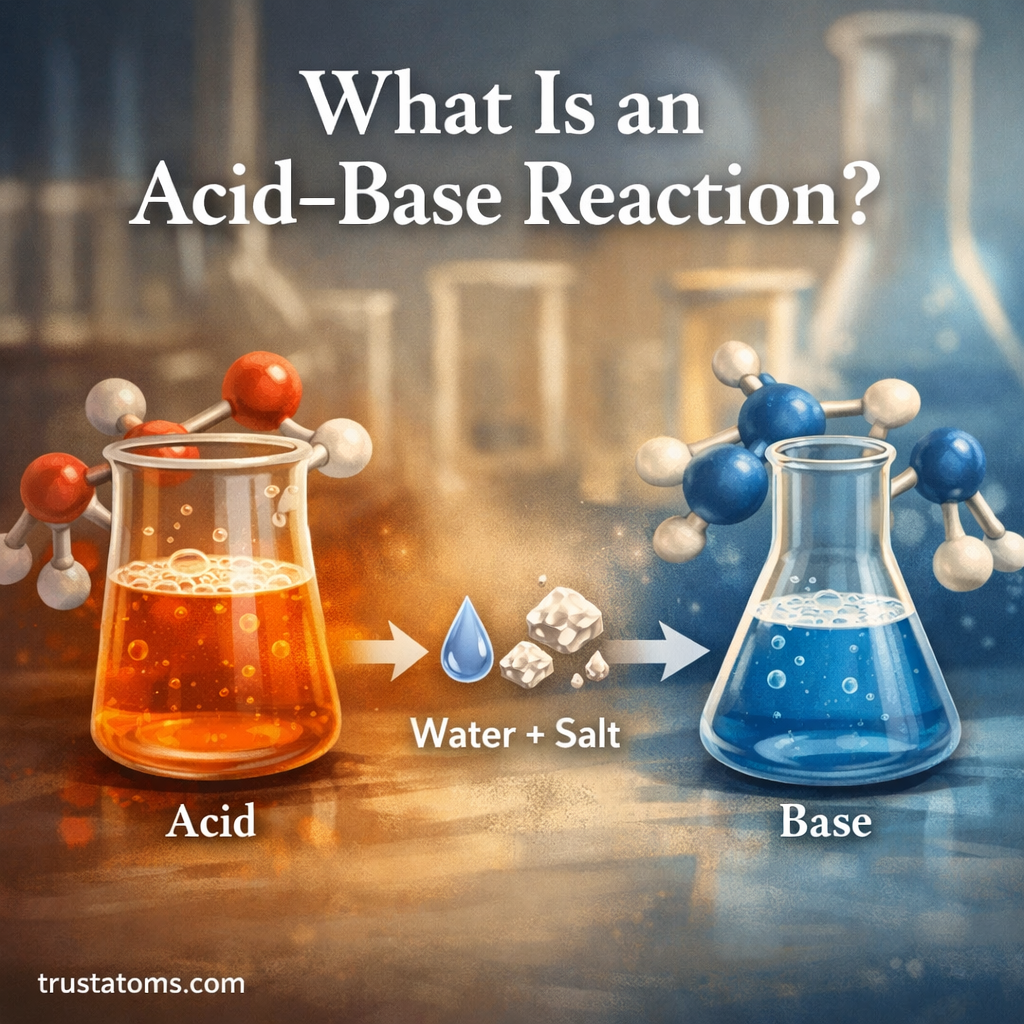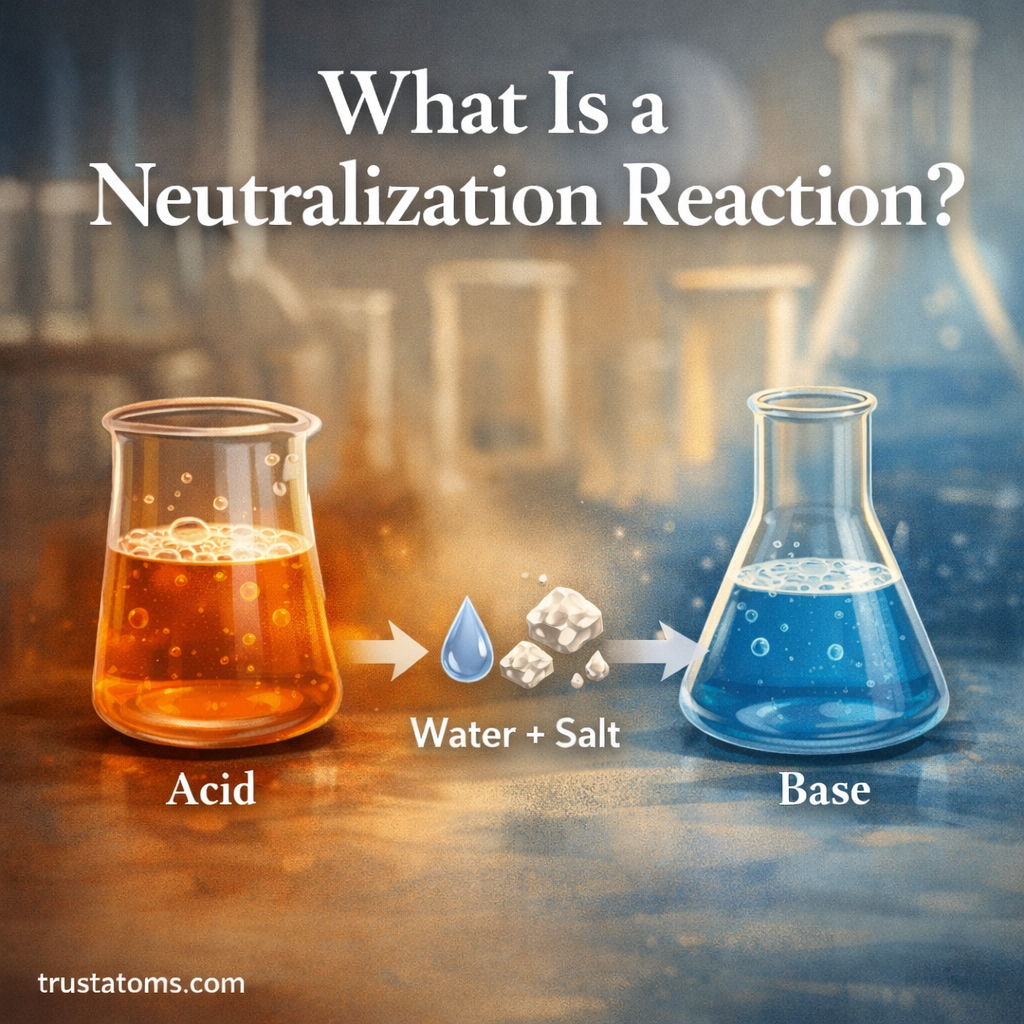
A neutralization reaction is a chemical reaction in which an acid reacts with a base, reducing their acidic and basic properties. In a common type of neutralization, hydrogen ions from the acid react with hydroxide ions from the base to form water, while the remaining ions form a salt.
Neutralization is studied in chemistry because it explains how substances can change the acidity of solutions. Understanding neutralization reactions helps explain how acids and bases interact and how chemical balance can be restored when solutions become too acidic or too basic.
The Basic Concept of Neutralization
In aqueous solutions, acids can donate protons (H⁺), while bases can accept protons. A familiar neutralization reaction occurs when an acid supplies hydrogen ions and a hydroxide base supplies hydroxide ions.
The central reaction can be written as:
H⁺(aq) + OH⁻(aq) → H₂O(l)
In water, hydrogen ions are more accurately represented as hydronium ions (H₃O⁺). The corresponding equation is H₃O⁺ + OH⁻ → 2H₂O. Both representations describe the same basic process at different levels of detail.
A base in chemistry is not always a substance containing hydroxide ions. Ammonia, for example, acts as a base by accepting a proton. Consequently, not every acid–base reaction produces water directly.
The pH scale helps describe changes in acidity during neutralization. In laboratory analysis, acid–base titration in analytical chemistry uses measured quantities of acid and base to determine an unknown concentration.
How a Neutralization Reaction Works
Consider hydrochloric acid (HCl) reacting with sodium hydroxide (NaOH). In water, both are strong electrolytes that dissociate essentially completely into ions.
The balanced chemical equation is:
HCl(aq) + NaOH(aq) → NaCl(aq) + H₂O(l)
Hydrogen ions supplied by hydrochloric acid react with hydroxide ions supplied by sodium hydroxide. Sodium and chloride ions remain dissolved in the solution as spectator ions.
If the water is later evaporated, sodium chloride can crystallize from the solution. The salt does not necessarily appear as a solid immediately when the neutralization occurs.
Products of a Neutralization Reaction
For reactions between common acids and metal hydroxide bases, the typical products are water and a salt. The precise products depend on the substances involved, so the familiar acid + base → salt + water pattern is useful but not universal.
Neutralization is one example of an acid–base reaction, a broader category involving proton transfer or other acid–base interactions.
Water Formation
When a hydroxide base neutralizes an acid, hydrogen-containing ions and hydroxide ions combine to form water. This reaction is generally exothermic, meaning it releases heat.
Salt Formation
A salt is an ionic compound containing positively and negatively charged ions. Different acid–base combinations produce different salts, including sodium chloride, potassium nitrate, and calcium sulfate.
Some neutralization reactions also produce gases. For example, an acid reacting with a carbonate or bicarbonate can produce carbon dioxide along with water and a salt.
How Neutralization Changes pH
pH measures acidity in terms of hydrogen ion activity. At approximately 25°C, a neutral aqueous solution has a pH of 7, acidic solutions have lower values, and basic solutions have higher values.
Adding a base to an acidic solution generally raises its pH, while adding an acid to a basic solution generally lowers its pH. However, neutralization does not guarantee that the final pH will be exactly 7.
When a strong acid reacts with a strong base in equivalent amounts, the resulting solution is often approximately neutral at 25°C. Reactions involving weak acids or weak bases may produce solutions that remain acidic or basic because the resulting ions interact with water.
| Acid–Base Combination | Typical Equivalence-Point pH at 25°C | Reason |
|---|---|---|
| Strong acid + strong base | Approximately 7 | Neither resulting ion significantly affects pH |
| Weak acid + strong base | Above 7 | Conjugate base reacts with water |
| Strong acid + weak base | Below 7 | Conjugate acid reacts with water |
Worked Example: Neutralizing Hydrochloric Acid
Suppose a laboratory contains 100 mL of 0.10 M hydrochloric acid. How much 0.10 M sodium hydroxide is needed for complete neutralization?
First, calculate the amount of hydrochloric acid. Since 100 mL equals 0.100 L:
Moles of HCl = 0.10 mol/L × 0.100 L = 0.010 mol
The balanced equation shows a 1:1 mole ratio between HCl and NaOH. Therefore, 0.010 mol of NaOH is required.
Volume of NaOH = 0.010 mol ÷ 0.10 mol/L = 0.100 L = 100 mL
Under the idealized assumptions of this calculation, 100 mL of 0.10 M sodium hydroxide neutralizes 100 mL of 0.10 M hydrochloric acid. The result follows from the mole ratio, not simply from mixing equal volumes; solutions with different concentrations would require different volumes.
Examples of Neutralization in Everyday Life
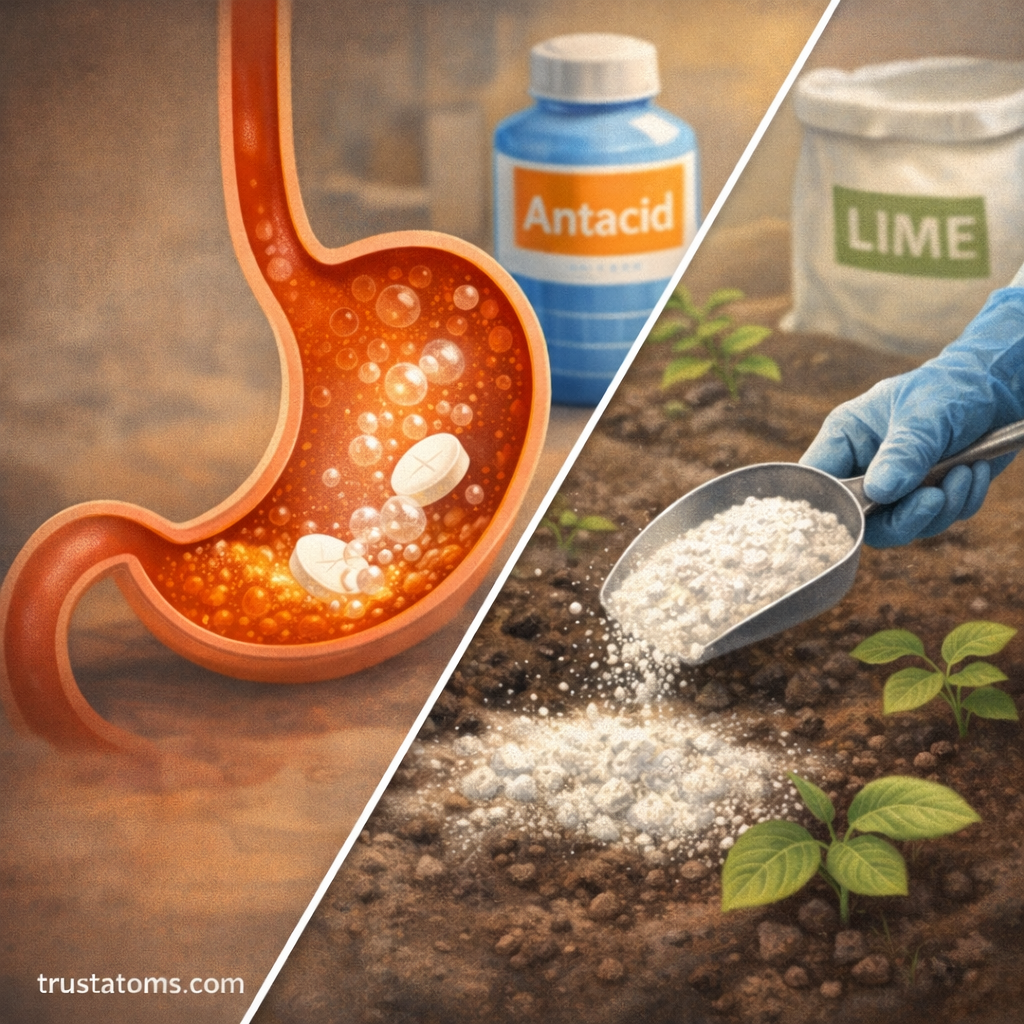
Antacids and Stomach Acid
The stomach naturally contains hydrochloric acid. Some antacids contain calcium carbonate or magnesium hydroxide, which react with stomach acid and reduce its acidity. Calcium carbonate antacids also release carbon dioxide during the reaction.
Agricultural Lime and Acidic Soil
Farmers may apply crushed limestone containing calcium carbonate to acidic soils. It reacts with acidic components and raises soil pH, potentially improving nutrient availability for crops that grow best under less acidic conditions.
Wastewater Treatment
Some industrial wastewater requires pH adjustment before further treatment or discharge. Controlled addition of acids or bases can bring the water into an appropriate pH range, although additional treatment may still be necessary to remove pollutants.
Neutralization in Laboratory Titrations
In an acid–base titration, a solution of known concentration is gradually added to a measured amount of another solution. The purpose is often to determine the unknown concentration using the reaction’s stoichiometric relationship.
The equivalence point occurs when chemically equivalent amounts of acid and base have reacted. A pH meter or suitable indicator can help identify an endpoint close to this point.
The endpoint is the observed signal used to stop the titration, while the equivalence point is the theoretical stoichiometric condition. They are ideally close but are not necessarily identical.
Common Misunderstandings About Neutralization
- Neutralization does not always produce a solution with pH 7. The strengths of the acid and base affect the final pH.
- Not every base contains hydroxide ions. Some bases, including ammonia, accept protons without initially supplying OH⁻ directly.
- Salt does not always mean sodium chloride. Many different ionic compounds qualify as salts.
- Neutralization is not necessarily safe to perform without precautions. Mixing concentrated acids and bases can release enough heat to cause splashing or burns.
Frequently Asked Questions
Does neutralization always produce water?
Water forms in many familiar neutralization reactions, particularly when acids react with hydroxide bases. However, the broader category of acid–base reactions includes proton-transfer reactions that do not directly produce water, such as hydrogen chloride reacting with ammonia to form ammonium chloride.
Is a neutralized solution always safe to touch?
No. A solution near neutral pH can still contain toxic, irritating, or otherwise hazardous substances. Neutralizing acidity does not automatically remove dissolved contaminants or make a mixture safe to handle.
Why does neutralization sometimes release heat?
Many neutralization reactions are exothermic because the overall reaction releases energy as reactants form products. The amount of heat depends on the substances, concentrations, and reaction conditions.
Neutralization changes a solution’s acidity through reactions between acids and bases, often producing water and a dissolved salt. The hydrochloric acid and sodium hydroxide example shows how balanced equations determine the quantities needed, while titrations use the same principle to measure unknown concentrations. Understanding the distinction between neutralization and a neutral pH also helps explain why antacids, soil treatments, and wastewater processes require different chemical approaches.
Sources: OpenStax, Chemistry 2e; IUPAC, Compendium of Chemical Terminology (Gold Book); Brown et al., Chemistry: The Central Science.