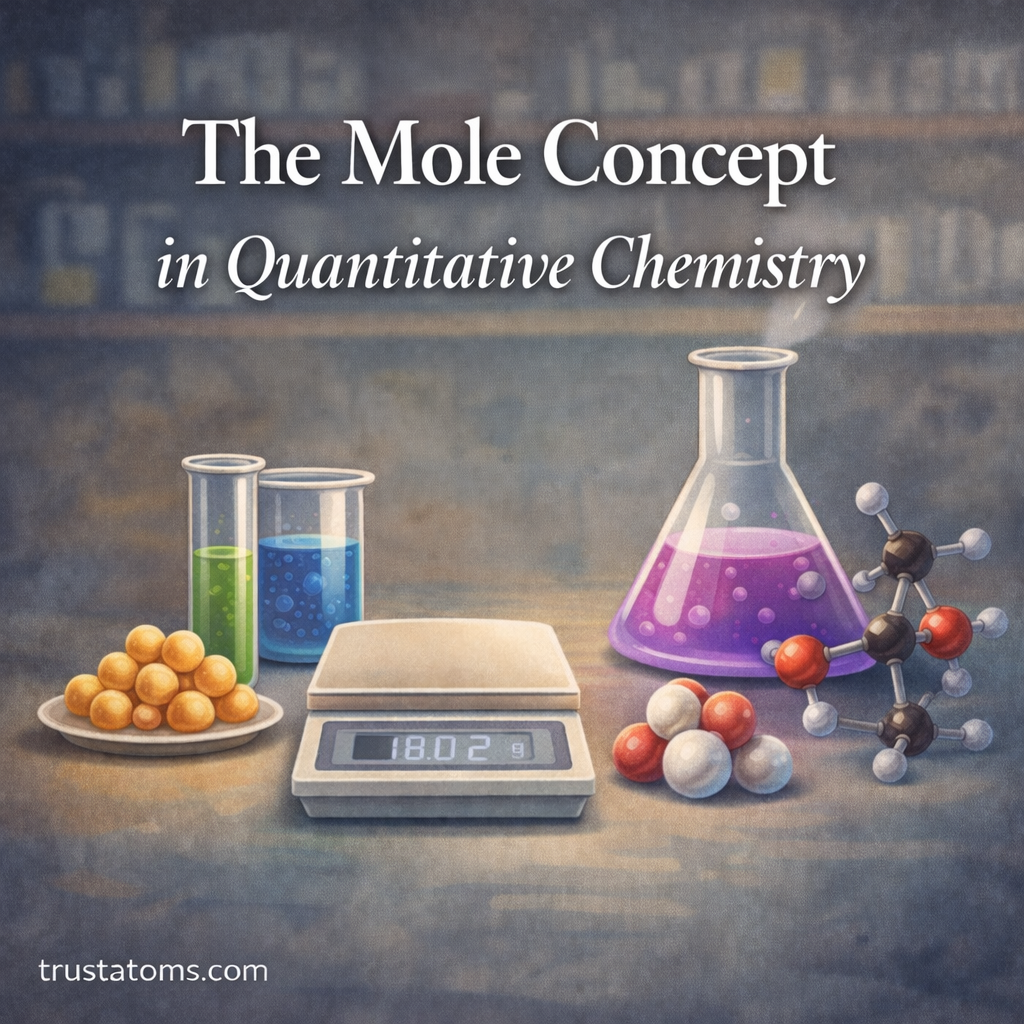
The mole concept is one of the most important ideas in chemistry. It provides a bridge between the microscopic world of atoms and molecules and the measurable quantities used in laboratory experiments.
Chemists rarely count individual atoms or molecules directly. Instead, they use the mole to represent large numbers of particles in a manageable way. This concept allows scientists to calculate how substances react, determine chemical compositions, and predict the outcomes of chemical reactions.
Understanding the mole concept is essential for studying stoichiometry, chemical reactions, and quantitative analysis in chemistry.
What Is the Mole in Chemistry?
In chemistry, a mole is a unit used to measure the amount of a substance. One mole contains a fixed number of particles such as atoms, molecules, ions, or formula units.
This number is called Avogadro’s number, which is approximately:
6.022 × 10²³ particles
This means that:
- 1 mole of carbon atoms contains 6.022 × 10²³ carbon atoms
- 1 mole of water molecules contains 6.022 × 10²³ water molecules
- 1 mole of sodium ions contains 6.022 × 10²³ sodium ions
The mole allows chemists to connect particle counts with measurable quantities like mass and volume.
Why the Mole Concept Is Important
Atoms and molecules are extremely small, making direct measurement impossible in most cases. The mole concept allows chemists to work with practical quantities of substances.
It helps scientists:
- Measure chemical substances accurately
- Relate particle numbers to mass
- Predict reaction quantities
- Perform stoichiometric calculations
- Design chemical experiments and processes
Without the mole concept, quantitative chemistry would not be possible.
Avogadro’s Number Explained
Avogadro’s number represents the number of particles in one mole of any substance.
It provides a standard for counting microscopic entities such as:
- Atoms
- Molecules
- Ions
- Electrons
- Formula units in ionic compounds
To understand how large this number is, consider a comparison:
If you counted one particle every second, it would take billions of years to reach Avogadro’s number.
Because chemical reactions involve enormous numbers of particles, the mole provides a convenient way to represent them.
Molar Mass and the Mole
One of the most useful aspects of the mole concept is its connection to molar mass.
Molar mass is the mass of one mole of a substance and is expressed in grams per mole (g/mol).
Determining Molar Mass
The molar mass of a compound can be calculated by adding the atomic masses of all atoms in its chemical formula.
For example:
Water (H₂O) contains:
- 2 hydrogen atoms
- 1 oxygen atom
Using atomic masses:
- Hydrogen ≈ 1 g/mol
- Oxygen ≈ 16 g/mol
Molar mass of water = 18 g/mol
This means one mole of water weighs approximately 18 grams.
Converting Between Moles and Mass
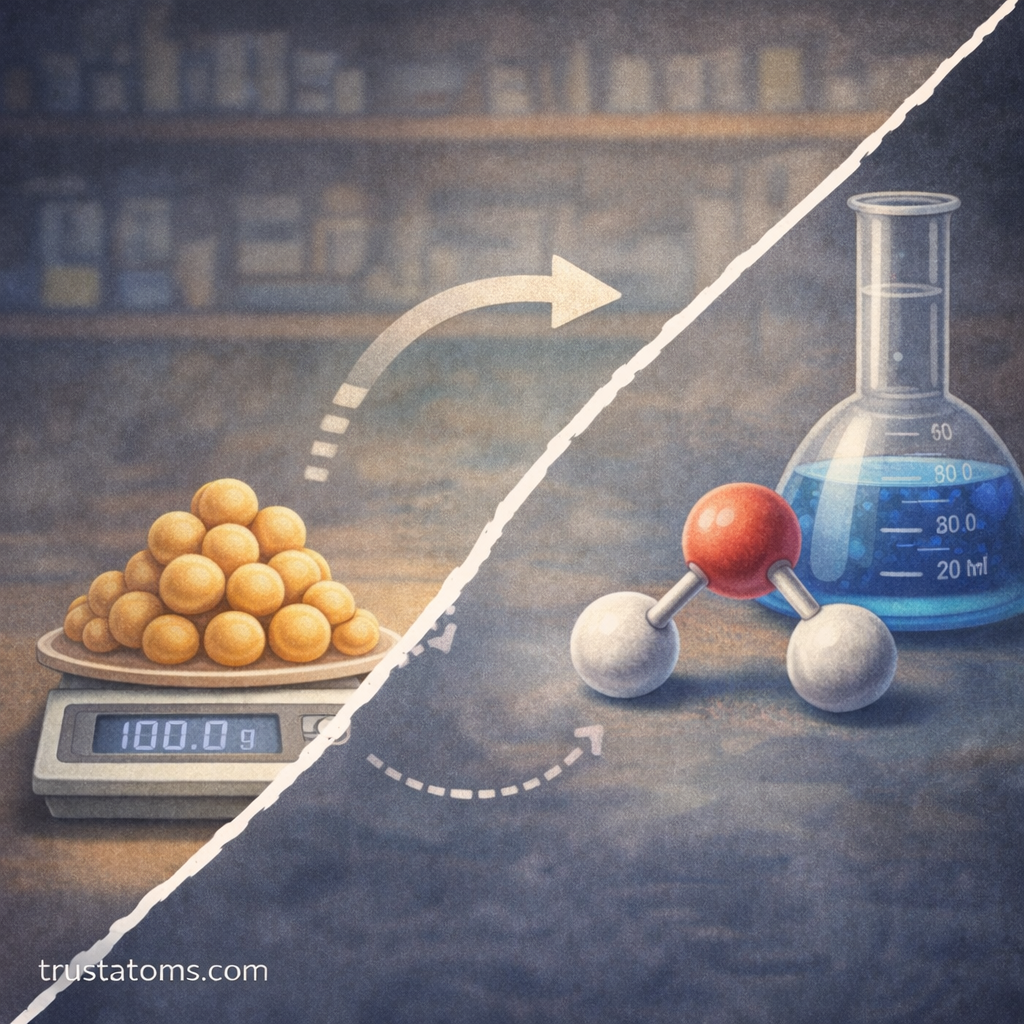
Chemists frequently convert between mass and moles using molar mass.
Conversion Formula
Moles = Mass ÷ Molar Mass
This relationship allows chemists to determine how many moles of a substance are present in a given mass.
Example Concept
If a compound has a molar mass of 50 g/mol and a sample weighs 100 grams:
100 ÷ 50 = 2 moles
This conversion is a fundamental step in quantitative chemical calculations.
The Mole and Chemical Reactions
The mole concept plays a central role in stoichiometry, which studies the quantitative relationships between reactants and products in chemical reactions.
Balanced chemical equations provide mole ratios that describe how substances react.
For example:
A balanced equation might show that:
- 2 moles of substance A react with
- 1 mole of substance B to produce
- 2 moles of substance C
These mole ratios allow chemists to calculate:
- Required reactant amounts
- Product formation
- Limiting reactants
- Reaction yields
Mole Relationships in Gases
The mole concept also applies to gases.
Under standard conditions of temperature and pressure, one mole of any gas occupies the same volume.
This relationship allows chemists to predict gas behavior in reactions involving gaseous substances.
Gas mole relationships are important in:
- Industrial gas production
- Combustion reactions
- Environmental chemistry
- Atmospheric science
The Mole in Solution Chemistry
The mole concept is also used when working with solutions.
Chemists often measure solution concentration using molarity.
What Is Molarity?
Molarity describes how many moles of a substance are dissolved in a liter of solution.
It is expressed as:
moles of solute per liter of solution
This measurement is widely used in:
- Laboratory experiments
- Pharmaceutical chemistry
- Environmental analysis
- Industrial chemical production
Everyday Analogies for the Mole Concept
Because Avogadro’s number is so large, the mole can be difficult to visualize. Analogies can help illustrate the scale.
For example, the mole can be compared to counting units like:
- A dozen, which represents 12 items
- A pair, which represents 2 items
- A gross, which represents 144 items
Similarly, a mole represents 6.022 × 10²³ particles.
The difference is simply the enormous size of the counting unit.
Common Mistakes When Using the Mole Concept
Students often encounter difficulties when first learning the mole concept. Some common mistakes include:
- Confusing moles with mass
- Forgetting to use molar mass during conversions
- Mixing particle counts with mole quantities
- Misinterpreting mole ratios in chemical equations
Carefully following unit conversions helps prevent these errors.
Why the Mole Concept Is Central to Chemistry
The mole concept connects atomic-scale chemistry with measurable laboratory quantities. It allows scientists to move from microscopic particles to macroscopic observations.
Because chemical reactions involve enormous numbers of particles, the mole provides a practical system for counting and calculating chemical quantities.
Nearly every field of chemistry relies on the mole concept, including:
- Analytical chemistry
- Biochemistry
- Environmental chemistry
- Industrial chemistry
- Materials science
For this reason, mastering the mole concept is a foundational step in understanding quantitative chemistry.
Final Thoughts
The mole concept is one of the most powerful tools in chemistry. By representing enormous numbers of atoms and molecules with a single unit, chemists can perform calculations that predict how substances react and interact.
From determining molar mass to calculating reaction quantities, the mole allows scientists to analyze chemical systems with precision and accuracy. As a result, it remains a cornerstone of quantitative chemistry and a fundamental concept for anyone studying chemical science.