Ultraviolet astronomy focuses on observing the universe in ultraviolet (UV) light—a region of the electromagnetic spectrum that sits just beyond visible violet light. While invisible to the human eye, ultraviolet radiation reveals critical details about hot stars, stellar formation, and the chemical composition of galaxies.
Because most ultraviolet radiation is absorbed by Earth’s atmosphere, astronomers rely on space-based observatories to capture this data. Thanks to missions led by NASA and ESA, ultraviolet astronomy has become essential for understanding how stars and galaxies evolve.
What Is Ultraviolet Light?
Ultraviolet light is a type of electromagnetic radiation with wavelengths shorter than visible light but longer than X-rays. It carries more energy than visible light, making it ideal for studying high-temperature objects in space.
Key characteristics of ultraviolet light:
- Wavelength range: about 10 to 400 nanometers
- Higher energy than visible light
- Emitted by hot, young stars and energetic processes
- Mostly blocked by Earth’s atmosphere
Ultraviolet light helps astronomers observe phenomena that are otherwise hidden in visible wavelengths.
Why Ultraviolet Astronomy Matters
Ultraviolet observations provide insight into some of the most important processes in the universe, especially those involving heat and energy.
What ultraviolet astronomy helps scientists study:
- Formation of new stars
- Behavior of hot, massive stars
- Interstellar gas and dust
- Chemical composition of galaxies
- Activity around black holes
By analyzing UV light, scientists can better understand how stars are born, evolve, and influence their surroundings.
How Ultraviolet Astronomy Works
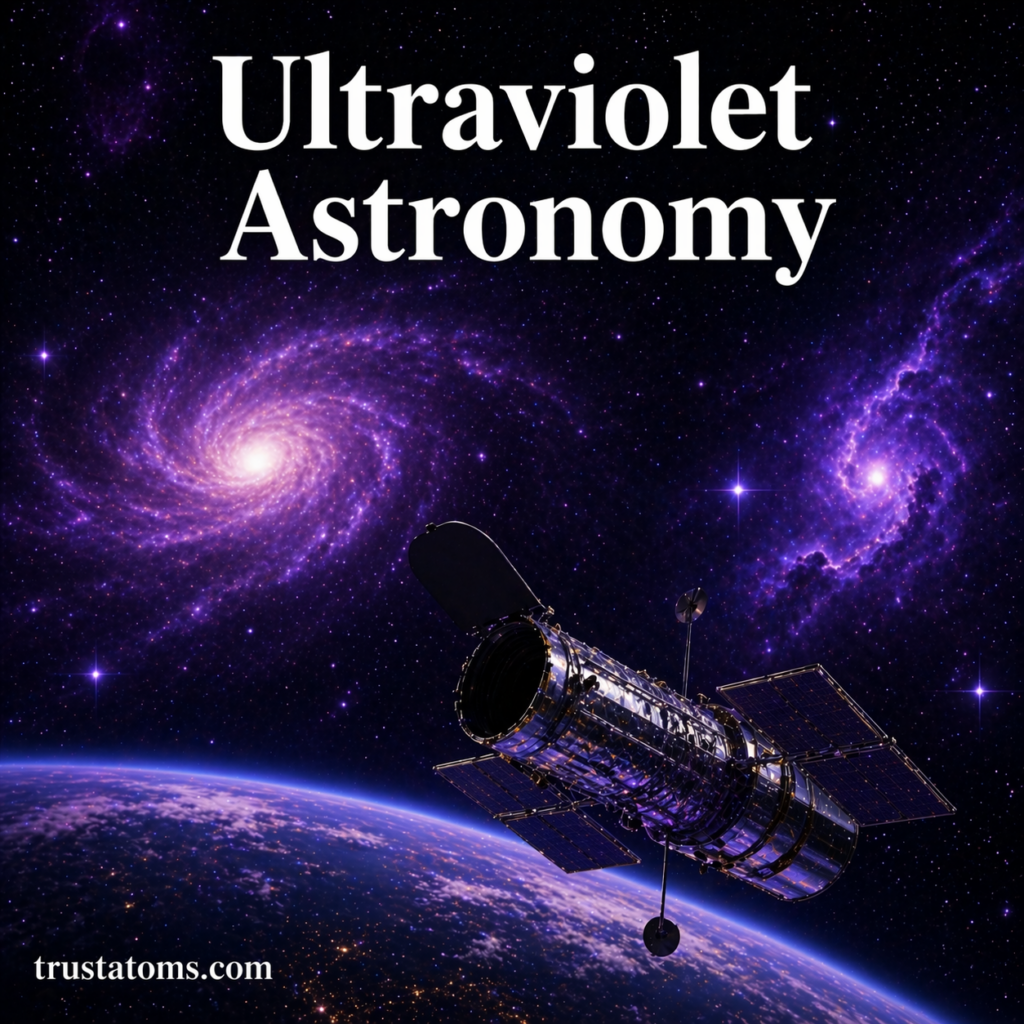
Since Earth’s atmosphere absorbs most ultraviolet radiation, observations must be made above it using satellites and space telescopes.
Major ultraviolet observatories:
- Hubble Space Telescope
- GALEX
These telescopes are equipped with specialized detectors that can capture ultraviolet wavelengths and convert them into detailed images and spectra.
Observation process:
- Ultraviolet light from space enters the telescope
- Mirrors focus the light onto UV-sensitive detectors
- Instruments measure intensity and wavelength
- Data is processed into images and scientific readings
What Objects Emit Ultraviolet Radiation?
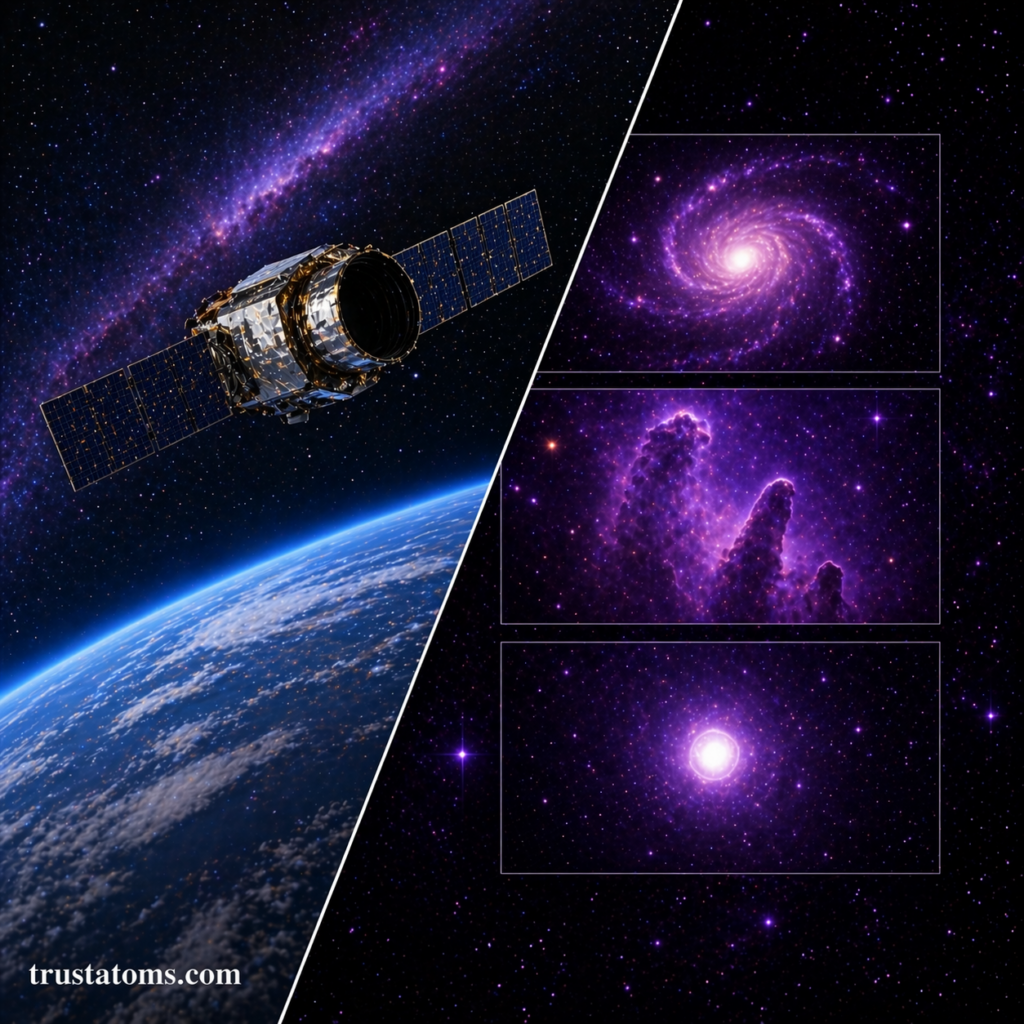
Ultraviolet radiation is typically produced by hot and energetic sources in space.
Common ultraviolet sources:
Hot Stars
- Young, massive stars emit strong UV radiation
- Provide clues about star formation regions
Star-Forming Regions
- Areas filled with gas and dust where new stars are born
- UV light reveals energetic activity
White Dwarfs
- Dense remnants of stars
- Extremely hot surfaces emit ultraviolet light
Active Galactic Nuclei
- Regions around supermassive black holes
- Emit intense UV radiation due to high-energy processes
Discoveries Made Through Ultraviolet Astronomy
Ultraviolet astronomy has played a major role in advancing our understanding of the cosmos.
Key discoveries:
- Mapping star formation in distant galaxies
- Identifying chemical elements in interstellar space
- Understanding stellar lifecycles
- Studying the structure of galaxy halos
- Observing interactions between stars and surrounding gas
These discoveries help scientists piece together the life cycle of stars and the evolution of galaxies.
Challenges of Ultraviolet Astronomy
Studying ultraviolet light presents several unique challenges.
Main challenges:
- Earth’s atmosphere blocks most UV radiation
- Requires costly space-based instruments
- UV detectors are sensitive and complex
- Data must be carefully calibrated
Despite these difficulties, ultraviolet astronomy continues to provide valuable insights.
How Ultraviolet Astronomy Compares to Other Types
Each region of the electromagnetic spectrum reveals different aspects of the universe.
Comparison with other wavelengths:
- Radio: detects cold gas and large-scale structures
- Infrared: reveals heat and dust-obscured objects
- Visible: shows stars and galaxies as seen by the eye
- Ultraviolet: highlights hot, energetic stars and regions
- X-ray and gamma-ray: reveal extreme high-energy events
Combining these observations gives a complete picture of cosmic phenomena.
The Future of Ultraviolet Astronomy
Advancements in technology are paving the way for more detailed ultraviolet observations.
Future developments:
- More sensitive UV detectors
- Improved space telescope designs
- Longer mission lifespans
- Better spectral analysis tools
Upcoming missions aim to explore star formation and galaxy evolution with greater precision than ever before.
Final Thoughts
Ultraviolet astronomy provides a unique window into the energetic and dynamic processes shaping the universe. By studying ultraviolet light, scientists uncover how stars form, how galaxies evolve, and how energy flows through space.
As new technologies emerge, ultraviolet astronomy will continue to deepen our understanding of the cosmos and reveal details that remain hidden in other wavelengths.