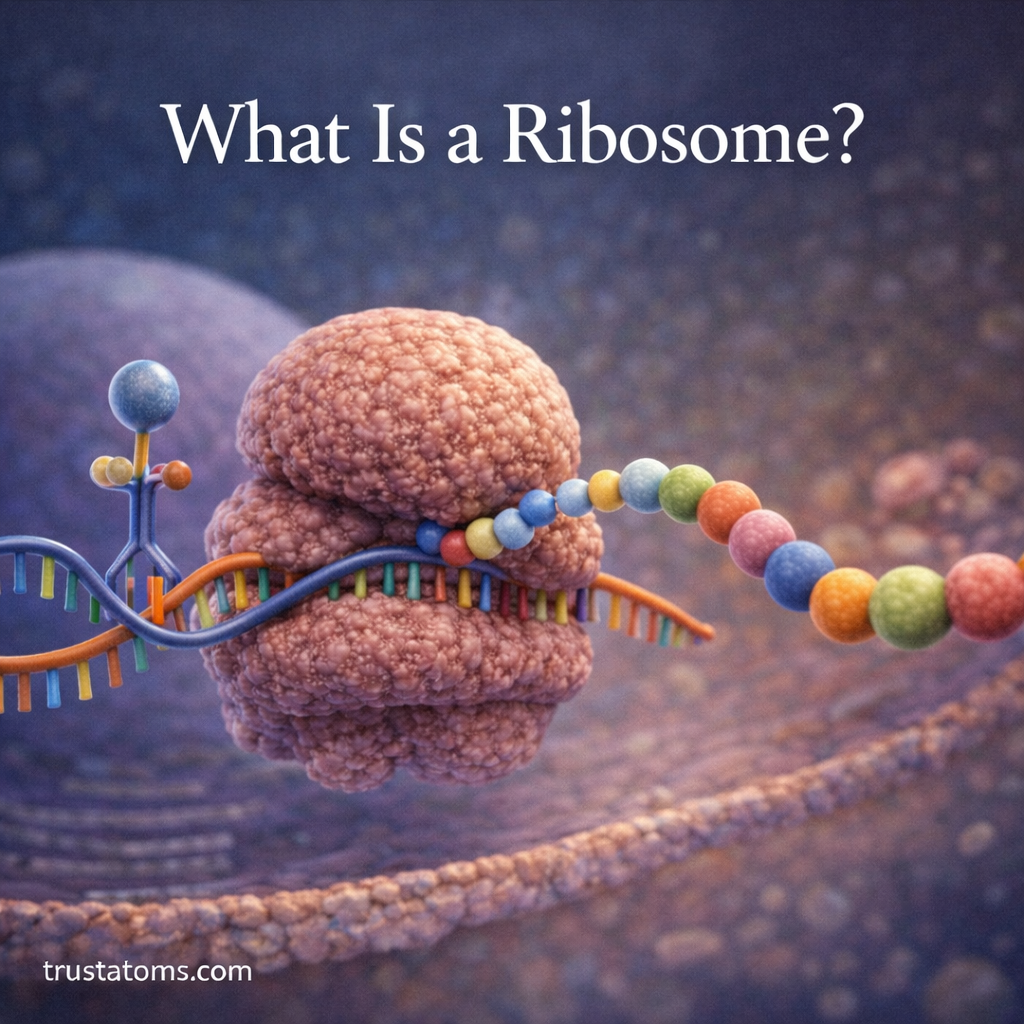
A ribosome is a small cellular structure responsible for building proteins. It acts as the cell’s protein-production machine by reading genetic instructions from messenger RNA (mRNA) and assembling amino acids into a chain that forms a protein.
Proteins are essential for nearly every biological process, including cell growth, metabolism, repair, and communication. Because ribosomes produce these proteins, they are among the most important structures inside living cells.
Ribosomes exist in all forms of life—from simple bacteria to complex human cells—making them one of the most universal components of biology.
The Role of Ribosomes in Cells
Ribosomes are central to the process known as protein synthesis. This process allows cells to convert genetic information into functional molecules.
Protein synthesis occurs in two major steps:
- Transcription – DNA is copied into messenger RNA (mRNA).
- Translation – Ribosomes read mRNA and assemble amino acids into proteins.
Ribosomes perform the second step. They interpret the instructions carried by mRNA and build the correct sequence of amino acids needed to create a specific protein.
Without ribosomes, cells would not be able to produce the proteins required for survival.
Where Ribosomes Are Found
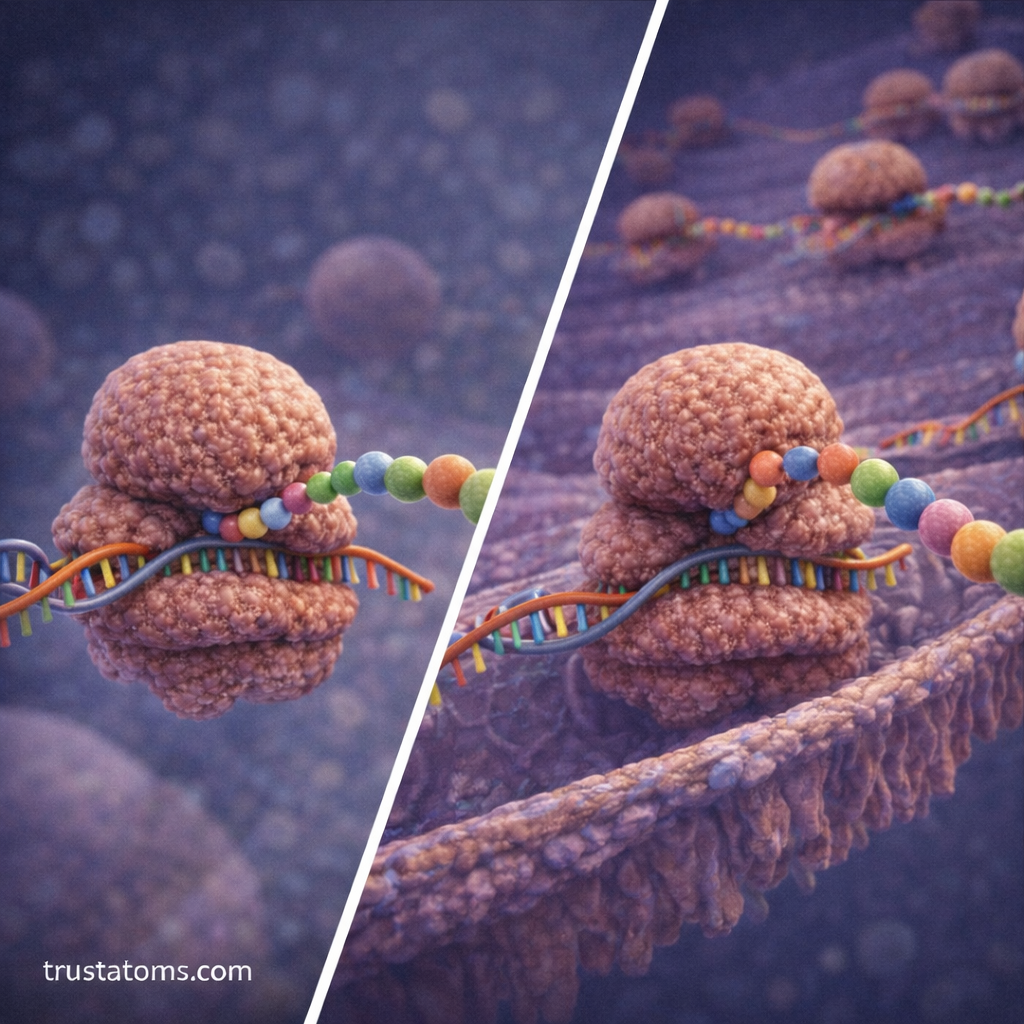
Ribosomes can be found in several locations inside cells.
Free Ribosomes
Free ribosomes float freely in the cytoplasm.
Proteins produced by free ribosomes usually function inside the cell itself. These proteins may be involved in:
- Metabolism
- Cell structure
- Internal chemical reactions
Bound Ribosomes
Bound ribosomes attach to the rough endoplasmic reticulum (rough ER), a network of membranes within the cell.
Proteins produced by bound ribosomes are typically:
- Exported from the cell
- Inserted into the cell membrane
- Sent to other organelles
The presence of ribosomes gives the rough endoplasmic reticulum its “rough” appearance under a microscope.
Ribosome Structure
Although ribosomes are very small, they have a complex structure made of both RNA and proteins.
A ribosome consists of two main parts:
- Large subunit
- Small subunit
These two subunits come together during protein synthesis and separate once the process is complete.
Ribosomal RNA (rRNA)
Much of a ribosome’s structure is made of ribosomal RNA (rRNA). This RNA not only provides structural support but also helps catalyze the chemical reactions needed to form peptide bonds between amino acids.
Ribosomal Proteins
Ribosomal proteins help stabilize the structure of the ribosome and assist in positioning the molecules involved in translation.
Together, rRNA and ribosomal proteins form a highly efficient molecular machine.
How Ribosomes Build Proteins
Ribosomes produce proteins by translating the instructions stored in mRNA.
This process follows several key steps:
- The ribosome attaches to a messenger RNA molecule.
- The ribosome reads the mRNA sequence in groups of three nucleotides called codons.
- Transfer RNA (tRNA) molecules bring the correct amino acids to the ribosome.
- The ribosome links amino acids together to form a growing chain.
- The completed protein is released once a stop codon is reached.
Each codon corresponds to a specific amino acid, ensuring that the protein is assembled in the correct order.
Ribosomes in Prokaryotic vs. Eukaryotic Cells
Ribosomes exist in both prokaryotic and eukaryotic cells, but there are some structural differences.
Prokaryotic Ribosomes
Prokaryotes include bacteria and archaea.
Their ribosomes are:
- Smaller
- Simpler in structure
- Located directly in the cytoplasm
Prokaryotic ribosomes are often referred to as 70S ribosomes.
Eukaryotic Ribosomes
Eukaryotes include animals, plants, fungi, and protists.
Their ribosomes are:
- Larger
- More complex
- Found both free in the cytoplasm and attached to the rough ER
Eukaryotic ribosomes are commonly called 80S ribosomes.
Despite these differences, both types perform the same essential function of building proteins.
Why Ribosomes Are Essential for Life
Ribosomes are critical for maintaining life because proteins control most cellular activities.
Through protein production, ribosomes support:
- Enzyme activity for chemical reactions
- Structural components of cells and tissues
- Transport of molecules
- Immune system functions
- Communication between cells
Every cell must continuously produce proteins to maintain normal function, making ribosomes indispensable.
Ribosomes and Scientific Discovery
Ribosomes have been the focus of extensive scientific research because of their importance in biology and medicine.
Studying ribosomes has helped scientists:
- Understand how genetic information becomes functional proteins
- Develop antibiotics that target bacterial ribosomes
- Explore the molecular basis of many diseases
In fact, research on ribosome structure has been recognized with major scientific awards, highlighting its significance in molecular biology.
Final Thoughts
A ribosome is a tiny but powerful structure responsible for building proteins within cells. By reading the genetic instructions carried by messenger RNA, ribosomes assemble amino acids into proteins that perform countless functions throughout living organisms.
Found in every form of life, ribosomes serve as the essential machinery that turns genetic information into the molecules needed for growth, repair, and survival.
Understanding ribosomes provides important insight into how cells function and how life operates at the molecular level.