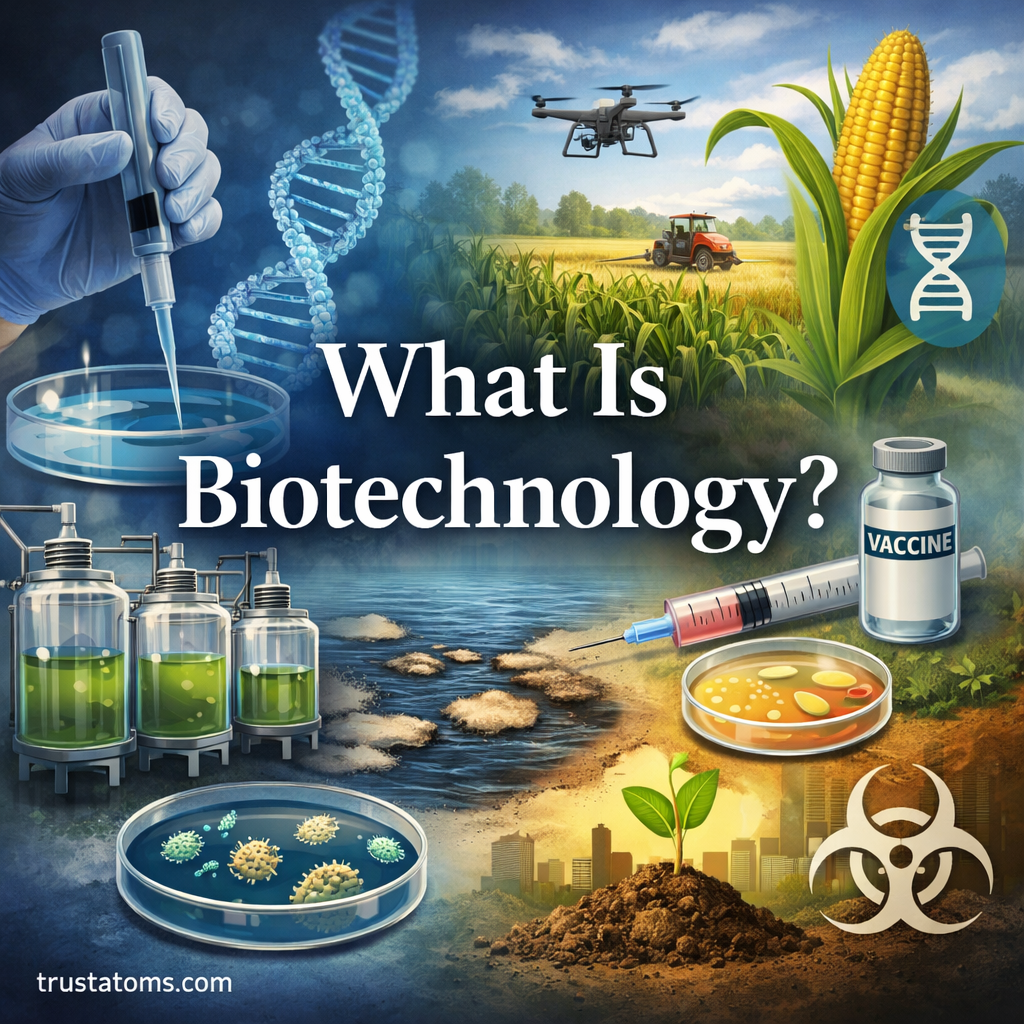
Biotechnology is the use of living organisms, cells, or biological processes to develop useful products and technologies. It combines scientific knowledge with practical techniques to produce medicines, improve crops, manufacture materials, and address environmental problems.
Biotechnology is an applied branch of the science of biology, but it is not limited to advanced laboratories. Making bread with yeast, producing antibiotics using microorganisms, and manufacturing insulin with genetically engineered cells are all examples of biotechnology.
Modern biotechnology allows researchers to work directly with DNA, proteins, and cells. These capabilities have expanded what biological systems can produce, although every application must be evaluated for effectiveness, safety, and practical limitations.
Biotechnology Definition: How Living Systems Become Useful Technologies
Biotechnology is a broad field of science that uses living organisms, biological systems, or biological processes to create products and improve existing technologies. Biotechnology applications in medicine, for example, include manufacturing therapeutic proteins, developing vaccines, and producing diagnostic tests.
Biotechnologists may work with entire organisms or individual biological components. Common materials include bacteria, yeast, plant cells, animal cells, DNA, and enzymes.
The underlying idea is straightforward: living systems perform chemical reactions and produce complex molecules. Scientists can study, select, or modify those systems to perform useful tasks under controlled conditions.
Not every biotechnology process involves changing DNA. Traditional fermentation, selective breeding, and the use of naturally occurring enzymes are also biotechnology.
How Biotechnology Developed From Fermentation to Genetic Engineering
Humans used biological processes long before scientists understood microorganisms or genetics. Fermentation allowed communities to produce foods such as bread, yogurt, and cheese. Selective breeding gradually changed the characteristics of cultivated plants and domesticated animals.
During the nineteenth century, research by Louis Pasteur helped establish the relationship between microorganisms and fermentation. Gregor Mendel’s experiments with pea plants provided foundational evidence for understanding inheritance.
Scientific advances during the twentieth century made it possible to study and manipulate genetic material more directly. Recombinant DNA techniques developed in the 1970s enabled researchers to combine DNA sequences from different sources.
Today, biotechnology has expanded into advanced fields such as genetic engineering, pharmaceutical development, and synthetic biology.
These approaches differ in their methods, but they share a common objective: using biological knowledge to develop systems or products with useful properties.
The Four Major Areas of Biotechnology
Biotechnology is commonly grouped according to where its products and techniques are applied. Medicine, agriculture, environmental management, and industrial manufacturing are four major areas.

Medical Biotechnology
Medical biotechnology uses biological systems to develop treatments, diagnostic tools, and preventive technologies. Examples include recombinant insulin, monoclonal antibodies, certain vaccines, and molecular tests that detect genetic material from pathogens.
Some treatments use proteins manufactured by cultured cells. Others involve modifying a patient’s cells or introducing genetic material to treat particular diseases.
Agricultural Biotechnology
Agricultural biotechnology aims to improve crops, livestock, and agricultural production. Techniques include tissue culture, marker-assisted breeding, genetic engineering, and gene editing.
Some genetically engineered crops resist particular insect pests or tolerate specific herbicides. Other research focuses on disease resistance, nutritional characteristics, and tolerance to environmental stress.
Environmental Biotechnology
Environmental biotechnology uses organisms and biological processes to manage pollution, treat waste, and recover useful resources.
Microorganisms in wastewater treatment systems break down organic matter and help remove certain pollutants. Bioremediation uses biological activity to reduce or transform contaminants, although effectiveness depends on the substance and environmental conditions.
Industrial Biotechnology
Industrial biotechnology uses enzymes, microorganisms, and cultured cells in manufacturing. Products include food ingredients, industrial enzymes, certain bio-based chemicals, and fermentation-derived fuels.
Enzymes used in laundry detergents, for example, help break down protein, starch, or fat stains. Biological manufacturing can sometimes reduce energy use or waste, but environmental benefits depend on the entire production process.
| Biotechnology Area | Common Application | Example Product or Process |
|---|---|---|
| Medical | Producing treatments and diagnostic tools | Recombinant human insulin |
| Agricultural | Improving crop characteristics | Insect-resistant crops |
| Environmental | Treating waste and contaminants | Microbial wastewater treatment |
| Industrial | Manufacturing chemicals and materials | Enzymes used in detergents |
The Main Techniques Used in Biotechnology
Biotechnology includes several techniques for growing cells, studying biological molecules, and changing how organisms function.
Genetic Engineering
Genetic engineering involves deliberately modifying genetic material. Scientists may introduce a gene into an organism, alter an existing sequence, or change how a gene is expressed.
For example, researchers can introduce DNA instructions for producing human insulin into suitable microorganisms. The resulting cells can manufacture insulin that is collected and purified for medical use.
Gene Editing and CRISPR
Gene editing technologies allow scientists to precisely change DNA sequences.
CRISPR is a widely used gene-editing tool that enables researchers to:
- Disrupt selected genes to investigate their functions.
- Make targeted genetic changes in research organisms.
- Develop potential treatments for certain genetic diseases.
CRISPR systems use a guide RNA to direct a protein, such as Cas9, toward a matching DNA sequence. Editing outcomes depend on the system used and how the cell repairs or processes the targeted DNA.
Gene editing is powerful but not automatically error-free. Unintended changes, delivery challenges, and differences among cell types must be considered.
Cell Culture and Fermentation
Cell culture allows scientists to grow cells under controlled laboratory conditions. It supports drug testing, biological manufacturing, and research into cellular behavior.
Fermentation uses microorganisms or cells to produce useful substances. Modern industrial fermentation often takes place in vessels called bioreactors, where temperature, acidity, oxygen availability, and nutrients can be monitored.
Worked Example: How Biotechnology Produces Human Insulin
Recombinant human insulin provides a concrete example of biotechnology connecting genetics, microbiology, and medicine. Before recombinant insulin became available, insulin used for treatment was commonly extracted from animal pancreases.
Modern manufacturing can use genetically engineered bacteria or yeast to produce insulin or an insulin precursor. The following simplified sequence explains the process.
- Identify the genetic instructions: Scientists use a DNA sequence encoding human insulin or a suitable precursor.
- Introduce the DNA: The sequence is incorporated into an appropriate genetic construct and introduced into production cells.
- Grow the cells: The engineered cells are cultivated under controlled conditions so they can produce the intended protein.
- Recover and process the protein: The product is collected and, when necessary, converted from a precursor into its functional form.
- Purify and test: Manufacturing processes remove impurities and verify that the medicine meets required quality standards.
Human insulin contains two polypeptide chains, called the A chain and B chain, with 21 and 30 amino acids respectively. These chains are connected by disulfide bonds that help maintain the protein’s functional structure.
The example shows why biotechnology involves more than inserting DNA. Producing a safe biological medicine also requires controlled growth, protein processing, purification, and extensive quality testing.
Biotechnology in Everyday Life
Many biotechnology products are familiar household items rather than experimental inventions.
- Bread: Yeast produces carbon dioxide during fermentation, causing dough to rise.
- Yogurt: Bacteria ferment lactose into lactic acid, changing milk’s acidity and texture.
- Detergents: Microbial enzymes help remove different types of stains.
- Medicines: Cultured cells and microorganisms manufacture certain therapeutic proteins.
- Textiles: Enzymes can assist fabric processing, including treatments used in denim finishing.
- Wastewater treatment: Microbial communities help remove organic pollutants from water.
These examples demonstrate the range of biological processes used in biotechnology, from traditional food preparation to tightly controlled industrial manufacturing.
Advantages and Limitations of Biotechnology
Biotechnology can provide practical benefits when biological methods offer capabilities that conventional techniques cannot easily achieve.
Potential advantages include producing complex medicines, improving disease detection, developing useful crop traits, and manufacturing certain materials with biological processes.
However, results vary. A genetically engineered crop may perform well against a particular pest but provide little benefit where that pest is absent. A bio-based material may still require substantial energy, land, or water during production.
Biotechnology should therefore be evaluated according to the specific product, its intended use, available alternatives, and evidence from testing.
Safety, Regulation, and Ethical Questions
Biotechnology raises questions about safety, environmental effects, fairness, and access. These concerns differ substantially between applications.
Medical biotechnology requires evidence that treatments are sufficiently safe and effective for their intended use. Agricultural biotechnology may require assessments of food safety, environmental effects, and interactions with other organisms.
Human gene editing raises additional ethical questions, particularly when proposed changes could be inherited by future generations. Access to expensive biological medicines and control over patented technologies also influence who benefits from scientific advances.
Regulatory requirements vary by country and product category. Responsible development involves scientific testing, appropriate oversight, and clear communication of both benefits and uncertainties.
Emerging Directions in Biotechnology
Researchers are developing new approaches to biological manufacturing, disease treatment, and sustainable production.
Gene therapies are being investigated for additional inherited disorders, while engineered immune cells are expanding treatment possibilities for certain cancers. Scientists are also studying tissue engineering and organoid systems, although laboratory-grown tissues are not equivalent to fully functional transplantable organs.
Other research areas include cultivated animal cells for food production, engineered microorganisms for chemical manufacturing, and biological methods for producing or recycling materials.
Whether these technologies become widely adopted depends on safety, cost, manufacturing scale, regulation, and demonstrated advantages over existing methods.
Common Misconceptions About Biotechnology
Misconception 1: Biotechnology Always Involves Genetic Modification
Biotechnology includes fermentation, cell culture, enzyme production, and selective breeding. Genetic modification is one important technique, but many biotechnology applications do not require direct DNA changes.
Misconception 2: Biotechnology Is a Completely Modern Invention
Humans have used fermentation and selective breeding for thousands of years. Modern biotechnology differs mainly in its scientific understanding, precision, and ability to manipulate biological systems directly.
Misconception 3: Gene Editing Always Produces the Intended Result
Gene-editing tools can target specific DNA sequences, but the resulting changes are not always perfectly predictable. Researchers must check for unintended edits, incomplete modifications, and unexpected biological effects.
Misconception 4: Bio-Based Products Are Automatically Environmentally Friendly
A product made using biological materials is not necessarily biodegradable or sustainable. Its environmental impact depends on raw materials, energy consumption, manufacturing, transportation, use, and disposal.
Frequently Asked Questions
What is biotechnology in simple terms?
Biotechnology means using living organisms, cells, or biological processes to make useful products or solve practical problems. Examples include making yogurt with bacteria and producing medicines with engineered cells.
What are five examples of biotechnology?
Five examples are recombinant insulin production, vaccine manufacturing, microbial wastewater treatment, insect-resistant crops, and enzyme-based laundry detergents. Each uses biological materials or processes for a practical purpose.
What is the difference between biotechnology and genetic engineering?
Biotechnology is the broader field of using biological systems for practical applications. Genetic engineering is a specific biotechnology technique that deliberately modifies genetic material.
How is biotechnology used in medicine?
Medical biotechnology supports the production of therapeutic proteins, certain vaccines, diagnostic tests, and some cell-based or gene-based treatments. Each medical application requires appropriate testing and regulatory evaluation.
Is biotechnology safe?
Safety depends on the specific technology, product, and intended use. Biotechnology includes both long-established practices and newer methods that require specialized assessment. Scientific testing and regulatory oversight help identify and manage potential risks.
Biotechnology applies biological processes to practical challenges, ranging from food fermentation to the production of complex medicines. Its methods continue to expand through advances in genetics, cell biology, and biological manufacturing. Understanding both its capabilities and limitations helps explain how biotechnology can contribute to medicine, agriculture, industry, and environmental management.
Sources: OpenStax, Biology 2e; Bruce Alberts et al., Molecular Biology of the Cell, Seventh Edition; U.S. Food and Drug Administration, Science and Research; National Human Genome Research Institute.