Genetics explains how traits are passed from parents to offspring. One of the most fundamental concepts in genetics is the difference between dominant and recessive alleles.
These terms describe how certain versions of genes influence visible traits, such as eye color, blood type, or inherited conditions. Understanding dominant and recessive inheritance helps explain why some traits appear frequently in families while others may skip generations.
Understanding Genes and Alleles
Before exploring dominant and recessive traits, it helps to understand two basic genetic concepts.
Genes
Genes are segments of DNA that contain instructions for building proteins. These proteins influence traits and biological functions such as:
- Eye color
- Hair type
- Blood type
- Height tendencies
- Certain inherited diseases
Humans carry two copies of most genes, one inherited from each parent.
Alleles
An allele is a different version of a gene. For example, the gene for eye color may have alleles for:
- Brown eyes
- Blue eyes
- Green eyes
Each parent contributes one allele for each gene.
What Is a Dominant Allele?
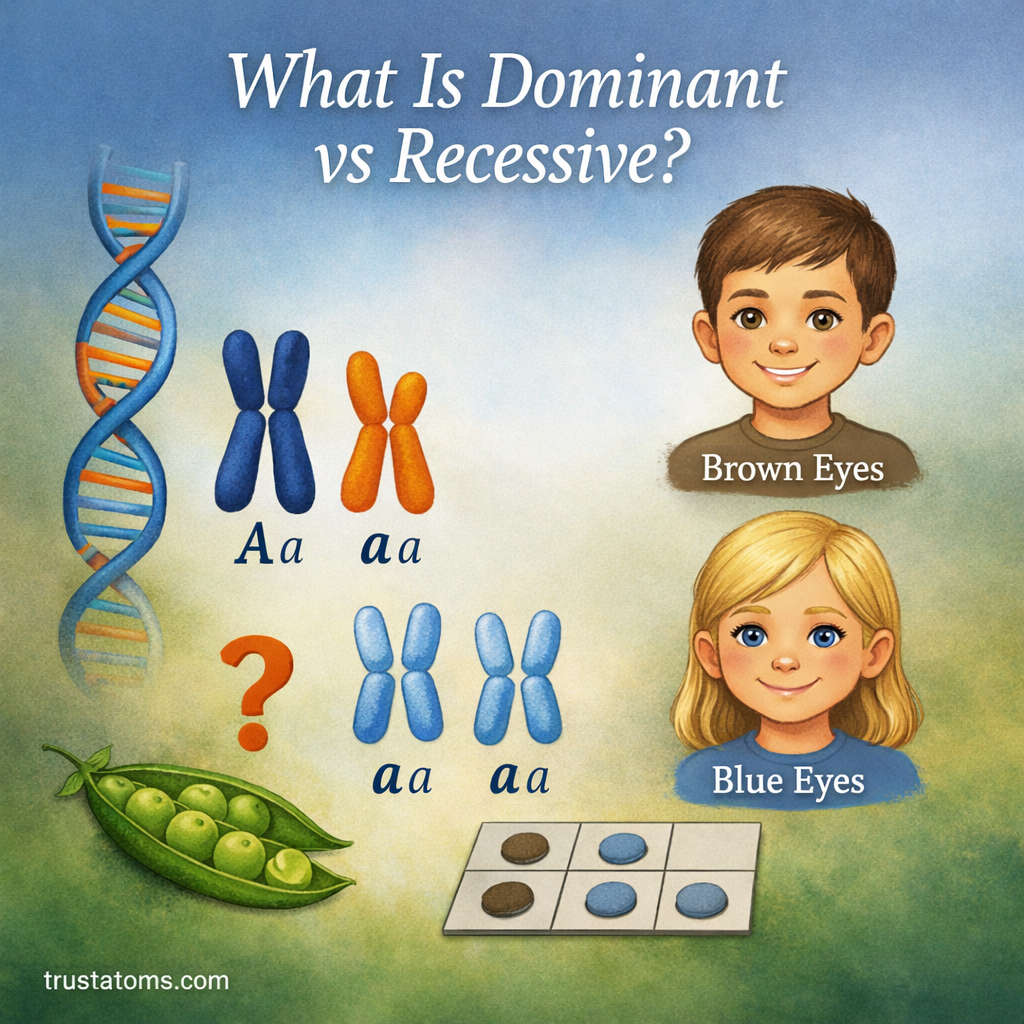
A dominant allele is a version of a gene that expresses its trait even when only one copy is present.
This means that if a person inherits one dominant allele and one recessive allele, the dominant trait will appear in the individual.
Key Characteristics of Dominant Alleles
- Only one copy is needed for the trait to show
- Masks the effect of a recessive allele
- Often represented with a capital letter in genetics
Example
Brown eye color is often taught as a dominant trait.
Possible allele combinations:
- BB – Brown eyes
- Bb – Brown eyes
- bb – Blue eyes
In this simplified model, both BB and Bb produce brown eyes because the dominant allele overrides the recessive one.
What Is a Recessive Allele?
A recessive allele only influences a trait when two copies are present.
If a recessive allele is paired with a dominant allele, the dominant trait will be expressed instead.
Key Characteristics of Recessive Alleles
- Requires two copies to appear
- Hidden when paired with a dominant allele
- Often represented with a lowercase letter
Example
Using the eye color example again:
- bb – Blue eyes appear because no dominant allele is present
- Bb – Blue allele is present but hidden by the dominant brown allele
A person with Bb is called a carrier because they carry the recessive gene but do not show the trait.
Genotype vs Phenotype
Dominant and recessive inheritance also relates to two important terms in genetics.
Genotype
A genotype refers to the genetic combination of alleles someone carries.
Examples:
- AA
- Aa
- aa
Phenotype
A phenotype is the observable trait produced by the genotype.
Examples:
- Brown eyes
- Blue eyes
- Curly hair
- Straight hair
Two individuals can have different genotypes but the same phenotype if a dominant allele is present.
Common Examples of Dominant and Recessive Traits
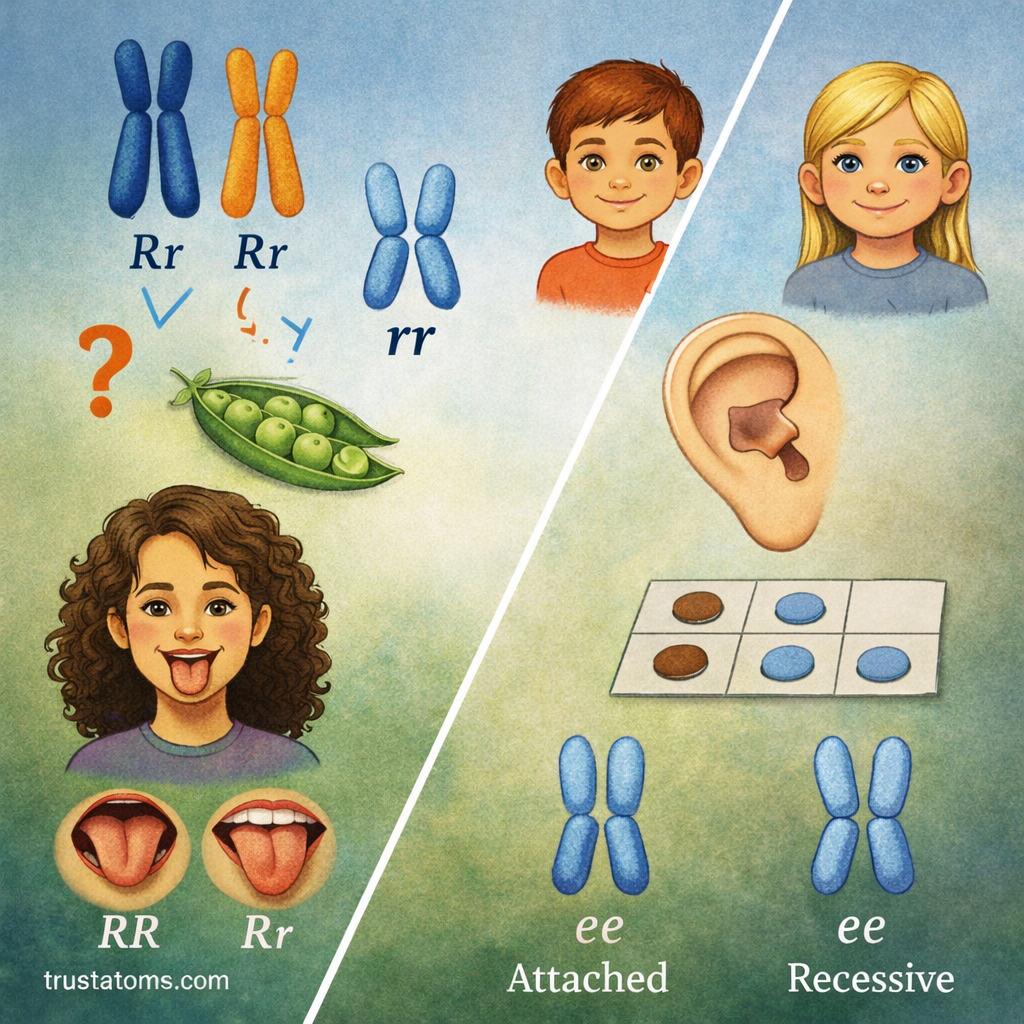
Many traits in biology follow dominant–recessive patterns, though real genetics can sometimes be more complex.
Dominant Traits (Common Classroom Examples)
- Widow’s peak hairline
- Freckles
- Dimples
- Ability to roll the tongue
Recessive Traits
- Attached earlobes
- No freckles
- Straight hairline
- Certain inherited genetic disorders
Genetic Disorders and Recessive Inheritance
Some inherited diseases occur when a person inherits two recessive alleles for a harmful gene.
Examples include:
- Cystic fibrosis
- Tay-Sachs disease
- Sickle cell disease
In these cases:
- Carriers (one dominant, one recessive allele) usually show no symptoms.
- The disorder appears only when two recessive copies are inherited.
How Traits Are Passed Down
Genetic inheritance often follows patterns discovered by Gregor Mendel, a scientist who studied pea plants in the 1800s.
His research showed that traits are passed through predictable allele combinations.
Simple Inheritance Example
If two parents both carry one dominant and one recessive allele (Aa):
Possible offspring combinations:
- AA
- Aa
- Aa
- aa
This produces the classic probability:
- 75% dominant trait
- 25% recessive trait
These patterns are often illustrated using Punnett squares, which help predict genetic outcomes.
When Genetics Is More Complex
While dominant and recessive inheritance explains many traits, biology often involves more complicated patterns.
Some traits follow different genetic rules, including:
- Incomplete dominance – traits blend together
- Codominance – both alleles show equally
- Polygenic inheritance – multiple genes influence one trait
Human characteristics such as height, skin tone, and intelligence involve many genes working together rather than simple dominant–recessive relationships.
Why Dominant and Recessive Traits Matter
Understanding dominant and recessive genes helps scientists and doctors:
- Predict inherited conditions
- Study family genetic patterns
- Improve plant and animal breeding
- Understand human genetic diversity
- Develop medical treatments and genetic screening
These concepts form the foundation of modern genetics, medicine, and evolutionary biology.
Final Thoughts
Dominant and recessive alleles describe how different versions of genes influence traits. A dominant allele can express its trait with only one copy, while a recessive allele requires two copies to appear.
Although genetics is often more complex than simple dominant–recessive inheritance, these principles remain essential for understanding how traits are passed from one generation to the next.
By studying these patterns, scientists continue to uncover how DNA shapes the biological diversity seen across humans and other living organisms.