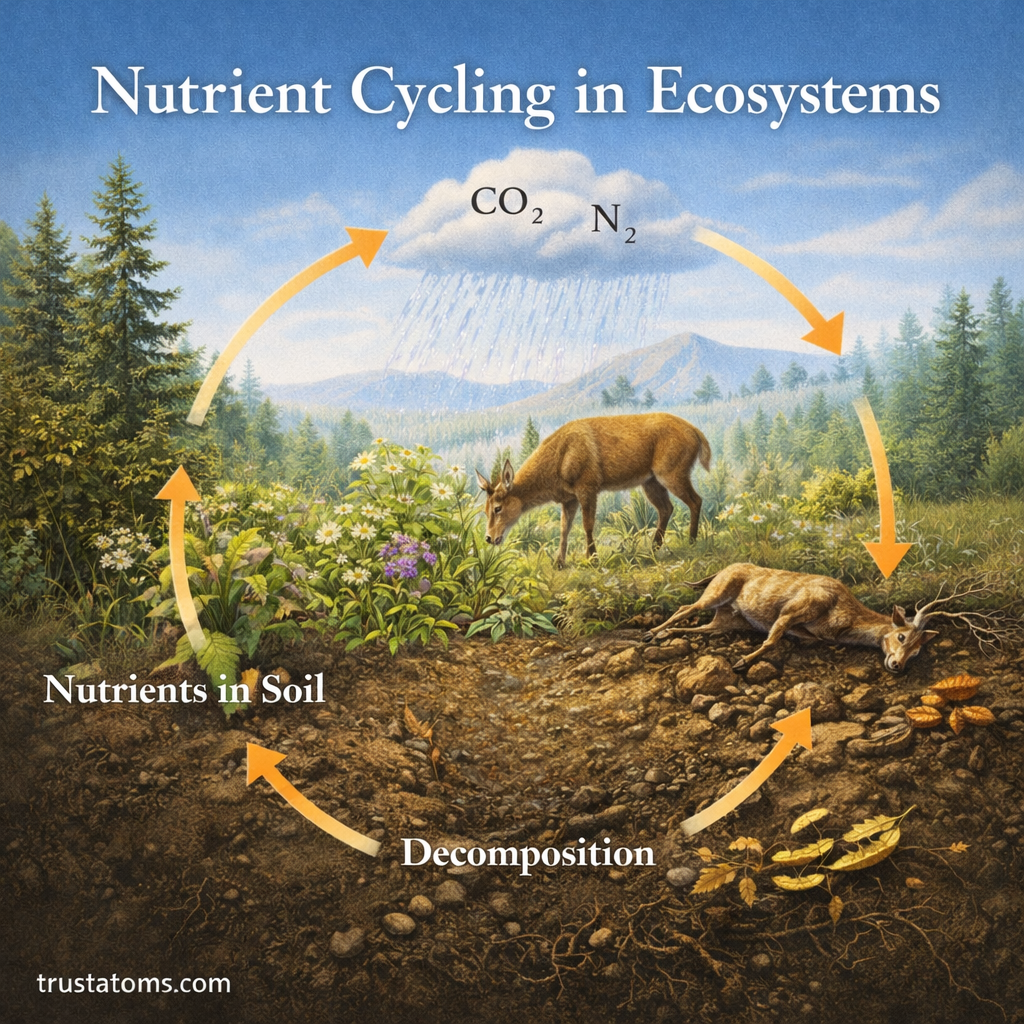
Nutrient cycling is one of the most essential processes that keeps ecosystems functioning. While energy moves through food chains and is eventually lost as heat, nutrients are continuously recycled through the environment. These nutrients support plant growth, sustain food webs, and help maintain ecological balance.
Every living organism depends on nutrients such as carbon, nitrogen, phosphorus, and water. Through natural biological and chemical processes, these elements move between organisms, soil, water, and the atmosphere. This ongoing movement is known as nutrient cycling.
Understanding nutrient cycling helps scientists explain how ecosystems remain productive and how environmental changes can disrupt ecological stability.
What Is Nutrient Cycling?
Nutrient cycling refers to the movement and reuse of chemical elements within an ecosystem. These elements circulate through living organisms and the physical environment in a continuous loop.
Nutrients move through several components of an ecosystem:
- Plants and other producers
- Animals and consumers
- Decomposers
- Soil and sediments
- Water bodies
- The atmosphere
Unlike energy, which flows in one direction, nutrients are reused repeatedly through natural cycles.
Why Nutrient Cycling Is Important
Nutrient cycling supports nearly every biological process within ecosystems. Without it, ecosystems would quickly run out of essential elements needed for life.
Key benefits of nutrient cycling include:
- Sustaining plant growth
- Supporting food chains and food webs
- Recycling organic matter
- Maintaining soil fertility
- Balancing ecosystems over time
These cycles ensure that nutrients remain available for new generations of organisms.
The Role of Producers in Nutrient Cycling
Primary producers such as plants, algae, and phytoplankton are the entry point for many nutrients in ecosystems.
Plants absorb nutrients from the environment through:
- Soil (minerals and nutrients)
- Water
- Atmospheric gases
For example:
- Plants absorb nitrogen from soil compounds.
- Plants take in carbon dioxide from the atmosphere.
- Plants use these elements to build organic molecules.
These nutrients become available to other organisms when herbivores consume plants.
The Role of Consumers
Consumers obtain nutrients by eating other organisms. Through feeding relationships, nutrients move through the food web.
Examples of nutrient transfer include:
- Herbivores consume plants and absorb plant nutrients.
- Carnivores consume herbivores and obtain those nutrients.
- Omnivores consume both plant and animal sources.
As animals grow, move, and reproduce, nutrients are redistributed throughout ecosystems.
Animals also release nutrients back into the environment through:
- Waste products
- Shedding biological material
- Death and decomposition
Decomposers and Nutrient Recycling
Decomposers play a critical role in nutrient cycling because they break down dead organic matter.
Common decomposers include:
- Bacteria
- Fungi
- Certain insects and invertebrates
When organisms die, decomposers break down tissues and release nutrients back into the soil and environment.
This process returns valuable elements such as:
- Nitrogen
- Phosphorus
- Carbon
- Sulfur
These nutrients can then be reused by plants, completing the cycle.
Major Nutrient Cycles in Ecosystems
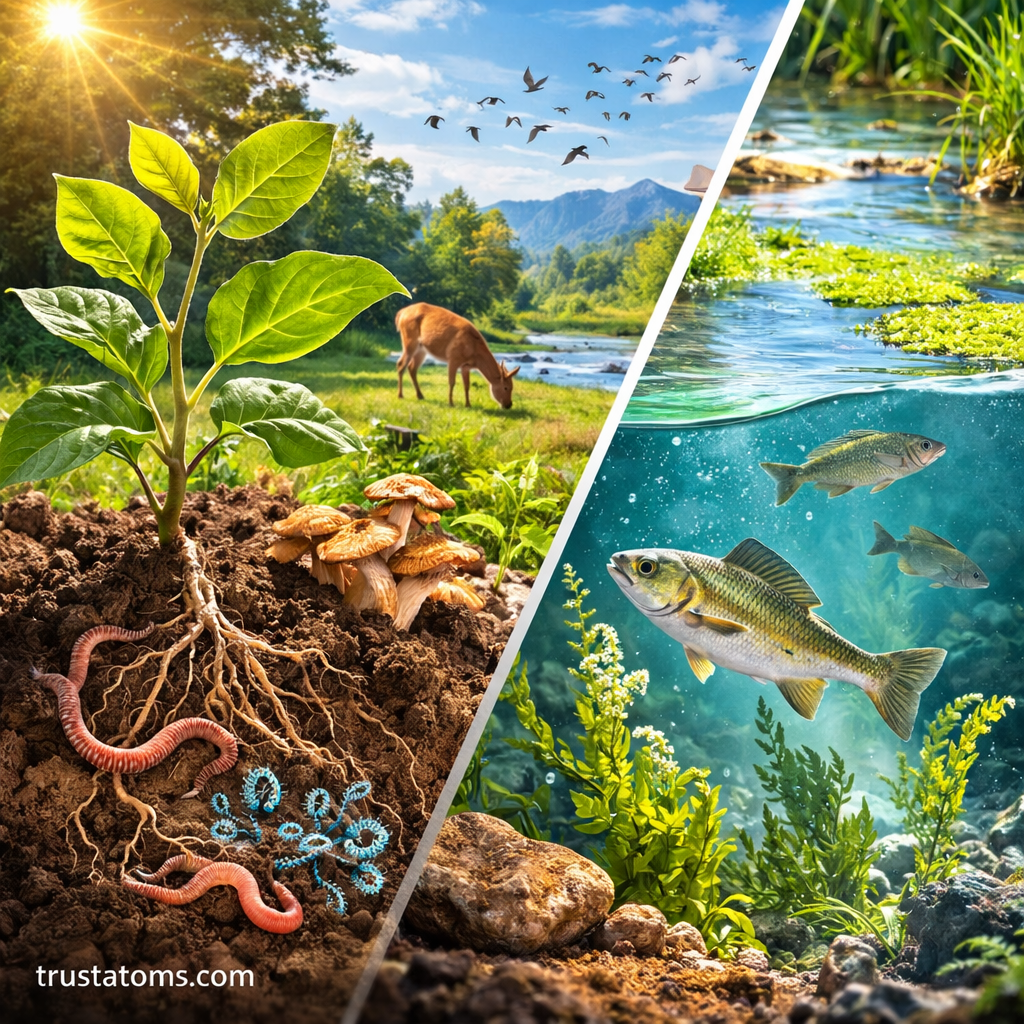
Several key nutrient cycles operate within ecosystems. Each cycle involves the movement of specific elements through living and non-living components of the environment.
The Carbon Cycle
The carbon cycle describes the movement of carbon between organisms, the atmosphere, and the Earth’s surface.
Carbon enters ecosystems when plants absorb carbon dioxide (CO₂) during photosynthesis.
Carbon moves through ecosystems in several steps:
- Plants convert carbon dioxide into organic compounds.
- Herbivores eat plants and incorporate carbon into their bodies.
- Carnivores consume herbivores.
- Decomposers break down dead organisms and release carbon.
Carbon can also return to the atmosphere through respiration and decomposition.
Large reservoirs of carbon exist in:
- Forests
- Oceans
- Fossil fuels
- Soil
The Nitrogen Cycle
Nitrogen is essential for building proteins and DNA, but most organisms cannot use nitrogen directly from the atmosphere.
The nitrogen cycle converts atmospheric nitrogen into usable forms.
Key steps include:
Nitrogen Fixation
Certain bacteria convert nitrogen gas into ammonia or related compounds.
Nitrification
Soil bacteria convert ammonia into nitrates that plants can absorb.
Assimilation
Plants absorb nitrates and incorporate them into tissues.
Denitrification
Other bacteria convert nitrogen compounds back into nitrogen gas, returning it to the atmosphere.
This cycle ensures that nitrogen remains available to living organisms.
The Phosphorus Cycle
The phosphorus cycle moves phosphorus through soil, water, and living organisms.
Unlike carbon and nitrogen, phosphorus does not typically move through the atmosphere.
Instead, it circulates through:
- Rocks
- Soil
- Water bodies
- Living organisms
The cycle begins when weathering breaks down rocks and releases phosphorus into soil.
Plants absorb phosphorus from soil, and animals obtain it by eating plants or other animals.
When organisms die or produce waste, phosphorus returns to soil and sediments through decomposition.
The Water Cycle and Nutrient Movement
Water plays an important role in transporting nutrients throughout ecosystems.
The water cycle, also known as the hydrologic cycle, moves water through:
- Evaporation
- Condensation
- Precipitation
- Runoff
- Groundwater movement
As water travels through ecosystems, it dissolves and carries nutrients into soils, rivers, lakes, and oceans.
This movement distributes nutrients across landscapes and supports biological productivity.
Human Impacts on Nutrient Cycling
Human activities can significantly alter natural nutrient cycles.
Common impacts include:
- Fertilizer use in agriculture
- Deforestation
- Fossil fuel combustion
- Urban development
- Industrial pollution
For example, excess fertilizer runoff can introduce large amounts of nitrogen and phosphorus into water systems.
This can cause eutrophication, a process where nutrient-rich water promotes excessive algae growth. These blooms can reduce oxygen levels and harm aquatic ecosystems.
Understanding nutrient cycling helps scientists manage these environmental challenges.
Nutrient Cycling and Ecosystem Stability
Healthy ecosystems rely on balanced nutrient cycles. When nutrients are properly recycled, ecosystems can support diverse plant and animal life.
Balanced nutrient cycling helps ecosystems:
- Maintain soil fertility
- Support plant productivity
- Sustain complex food webs
- Recover from disturbances
Disruptions to nutrient cycles can reduce biodiversity and weaken ecosystem resilience.
Key Takeaways About Nutrient Cycling
Nutrient cycling ensures that essential elements remain available to support life in ecosystems.
Important points include:
- Nutrients move continuously through ecosystems.
- Producers absorb nutrients from the environment.
- Consumers transfer nutrients through feeding relationships.
- Decomposers recycle nutrients from dead organisms.
- Major cycles include carbon, nitrogen, phosphorus, and water.
- Human activities can alter nutrient cycles and affect ecosystem health.
These processes help ecosystems remain productive and sustainable.
Final Thoughts
Nutrient cycling is a fundamental process that connects living organisms with the physical environment. By recycling essential elements such as carbon, nitrogen, and phosphorus, ecosystems maintain the resources needed to support life.
Through the combined actions of producers, consumers, decomposers, and environmental processes, nutrients continue moving through natural systems. Understanding these cycles helps scientists protect ecosystems, manage natural resources, and respond to environmental challenges.