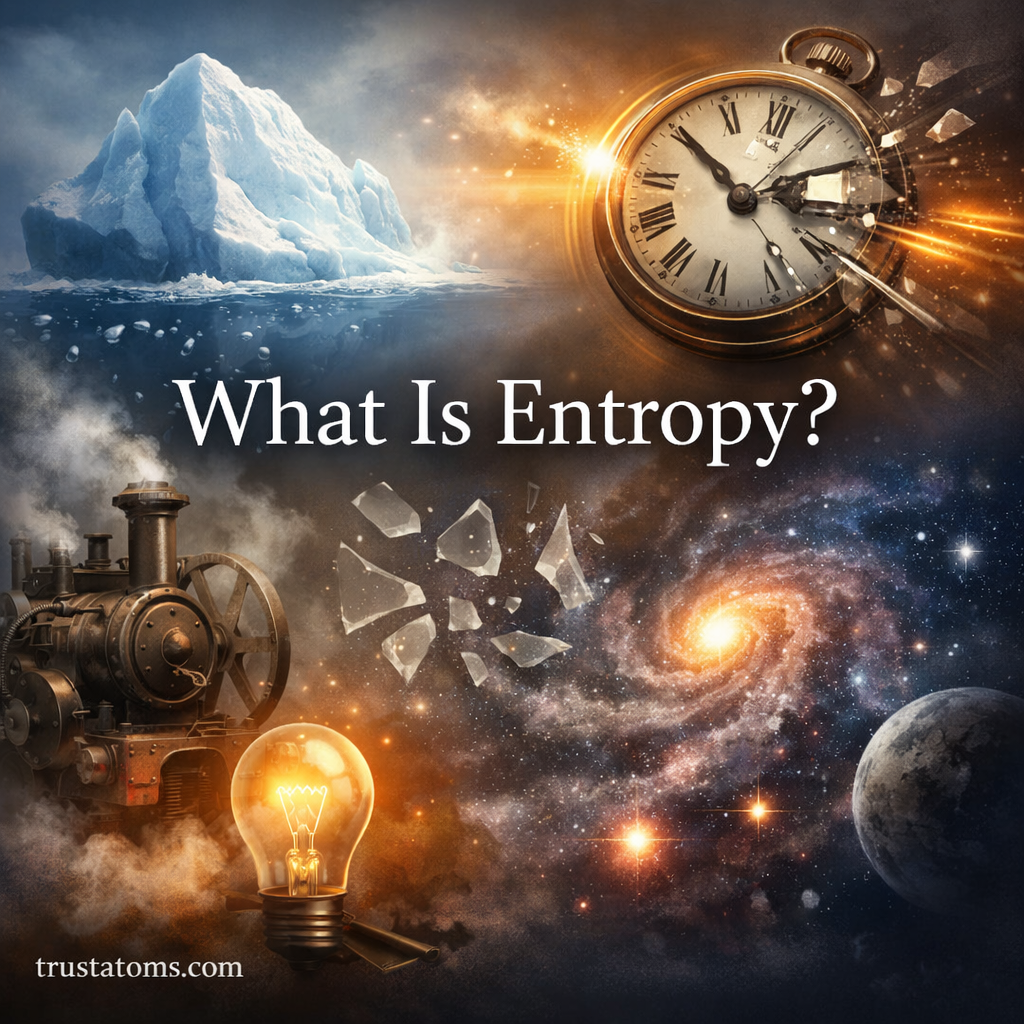
Entropy is one of the most important — and most misunderstood — concepts in physics. It explains why ice melts, why engines lose efficiency, why time seems to move in one direction, and even how the universe evolves.
In simple terms, entropy measures disorder — or more accurately, the number of possible ways a system can be arranged.
But that short definition only scratches the surface.
Let’s break it down clearly.
The Basic Definition of Entropy
In physics, entropy is a measure of how spread out energy is within a system.
More precisely:
Entropy measures the number of microscopic arrangements (microstates) that correspond to a system’s overall condition (macrostate).
If that sounds abstract, don’t worry. Here’s the intuitive version:
- Low entropy = ordered, predictable arrangement
- High entropy = disordered, more possible arrangements
- Natural processes tend to increase entropy
Entropy is central to the Second Law of Thermodynamics, which states:
In an isolated system, entropy tends to increase over time.
This law explains why certain processes are irreversible.
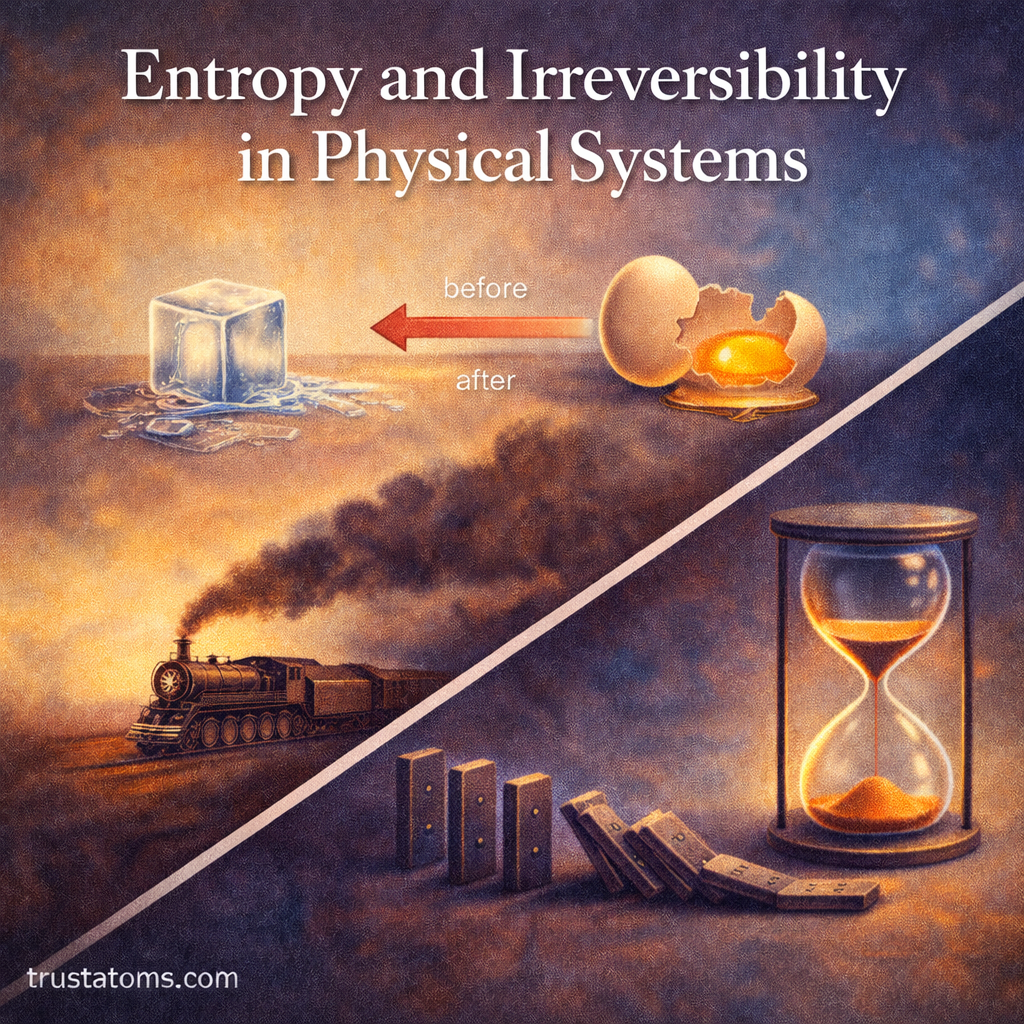
A Simple Example: Ice Melting
Imagine a solid ice cube.
In ice:
- Water molecules are arranged in a rigid crystal structure
- Movement is limited
- The arrangement is highly organized
This is a low-entropy state.
Now the ice melts.
In liquid water:
- Molecules move freely
- They can arrange themselves in many more ways
- The system becomes less ordered
This is a higher-entropy state.
Melting increases entropy — and that’s why ice naturally melts in a warm room.
Entropy and the Direction of Time
Entropy is deeply connected to what physicists call the “arrow of time.”
We observe that:
- Glass shatters, but shards don’t spontaneously reassemble
- Hot coffee cools down, but doesn’t heat itself up
- Cream mixes into coffee, but doesn’t unmix
Why?
Because all of those reversed processes would require entropy to decrease — which is extremely unlikely in natural systems.
In other words:
Time appears to move forward because entropy increases.
The Second Law of Thermodynamics
The Second Law is one of the most powerful principles in science.
It tells us:
- Energy can change form
- Energy spreads out over time
- No energy transformation is 100% efficient
Every engine, battery, and biological system loses usable energy as entropy increases.
For example:
- Car engines waste heat
- Light bulbs release heat
- Power plants cannot convert all fuel energy into electricity
Entropy sets the limit on efficiency.
Entropy in Statistical Physics
In the 19th century, physicist Ludwig Boltzmann made entropy more precise.
He showed that entropy relates to probability.
The famous Boltzmann equation:
S = k log W
Where:
- S = entropy
- k = Boltzmann constant
- W = number of microscopic configurations
The more possible arrangements (W), the higher the entropy.
This explains why disorder is more likely than order — there are simply more ways for something to be messy than perfectly arranged.
Entropy Is Not Just “Disorder”
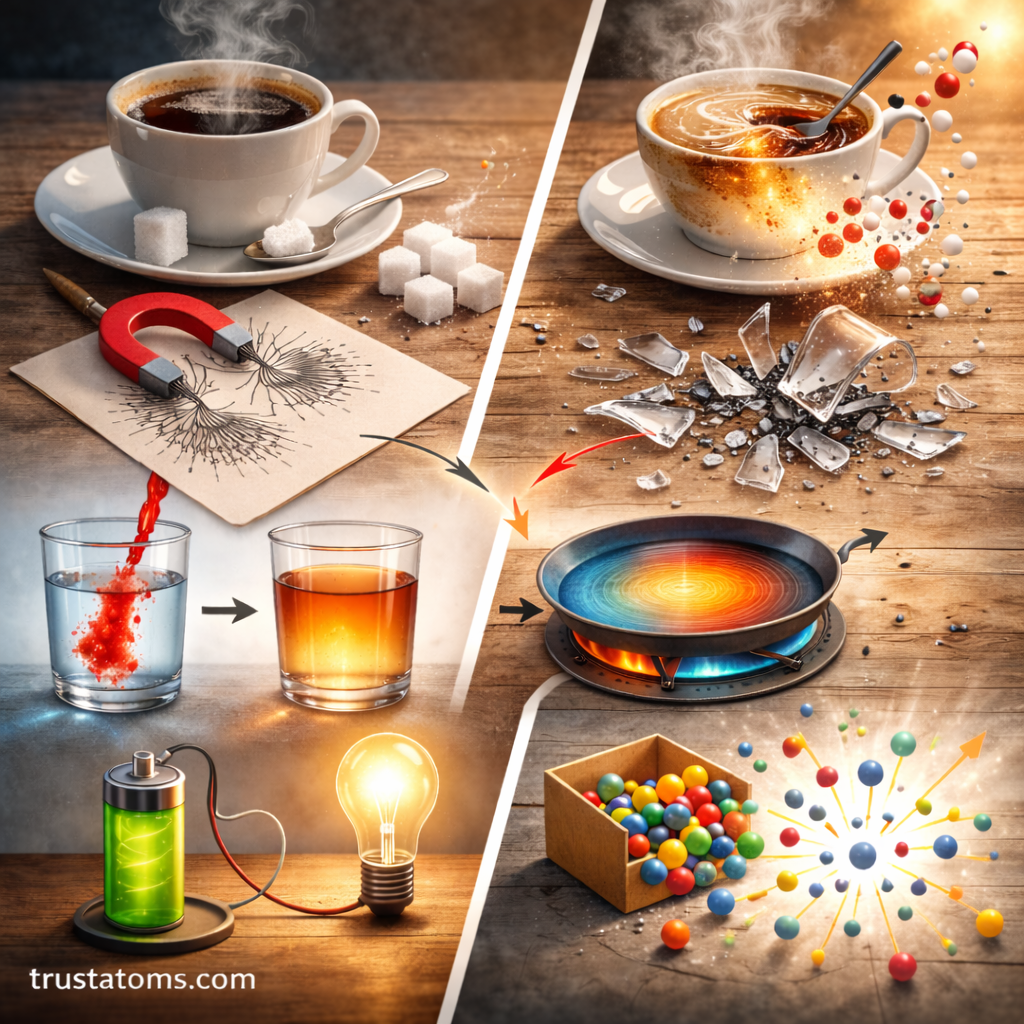
While entropy is often described as disorder, that definition is incomplete.
Entropy really measures:
- Energy dispersal
- Probability of arrangements
- Information about a system’s configuration
For example:
- A shuffled deck of cards has higher entropy than a perfectly ordered one
- A mixed gas has higher entropy than separated gases
- A uniform temperature distribution has higher entropy than hot-and-cold separation
Entropy is about how evenly energy and matter are spread.
Entropy and the Universe
Entropy doesn’t just apply to ice cubes and engines — it governs the cosmos.
According to current cosmology:
- The universe began in a low-entropy state
- Entropy has been increasing ever since
- Eventually, the universe may reach “heat death”
Heat death means:
- Energy becomes evenly distributed
- No temperature differences remain
- No usable energy exists to do work
This would be the maximum entropy state.
Entropy in Information Theory
Entropy also appears in information science.
In the 1940s, Claude Shannon defined informational entropy as a measure of uncertainty in data.
High entropy:
- More unpredictability
- More possible message variations
Low entropy:
- Predictable patterns
- Less information content
This connection shows how entropy bridges physics, mathematics, and computer science.
Why Entropy Matters
Entropy explains:
- Why perpetual motion machines are impossible
- Why energy systems lose efficiency
- Why time has direction
- Why systems naturally move toward equilibrium
- Why the universe evolves the way it does
It is one of the deepest organizing principles of nature.
Common Misconceptions About Entropy
Let’s clear up a few myths:
Entropy does NOT mean:
- Everything becomes chaotic instantly
- Order cannot locally increase
- Life violates physics
Local decreases in entropy are possible — but only if entropy increases elsewhere.
For example:
- Living organisms build order internally
- But they release heat and increase environmental entropy
The total entropy of the larger system still rises.
Final Summary
Entropy is a measure of how energy spreads out and how many ways a system can be arranged.
It tells us:
- Why processes are irreversible
- Why efficiency has limits
- Why time moves forward
- Why the universe changes
At its core, entropy is about probability — and probability favors disorder over perfect order.
Understanding entropy means understanding one of the most fundamental rules governing reality.