In biology, a population refers to a group of organisms of the same species that live in the same geographic area and interact with one another. Populations form the foundation of ecological and evolutionary studies because they represent the level at which biological processes such as reproduction, competition, and natural selection occur.
By studying populations, scientists can understand how species survive, grow, adapt, and respond to environmental changes.
The Basic Definition of a Population
A biological population is defined as:
A group of individuals belonging to the same species that live in a specific location at the same time and can potentially reproduce with each other.
This definition includes several important elements:
- Individuals belong to the same species
- They share a common geographic area
- They interact through ecological and reproductive processes
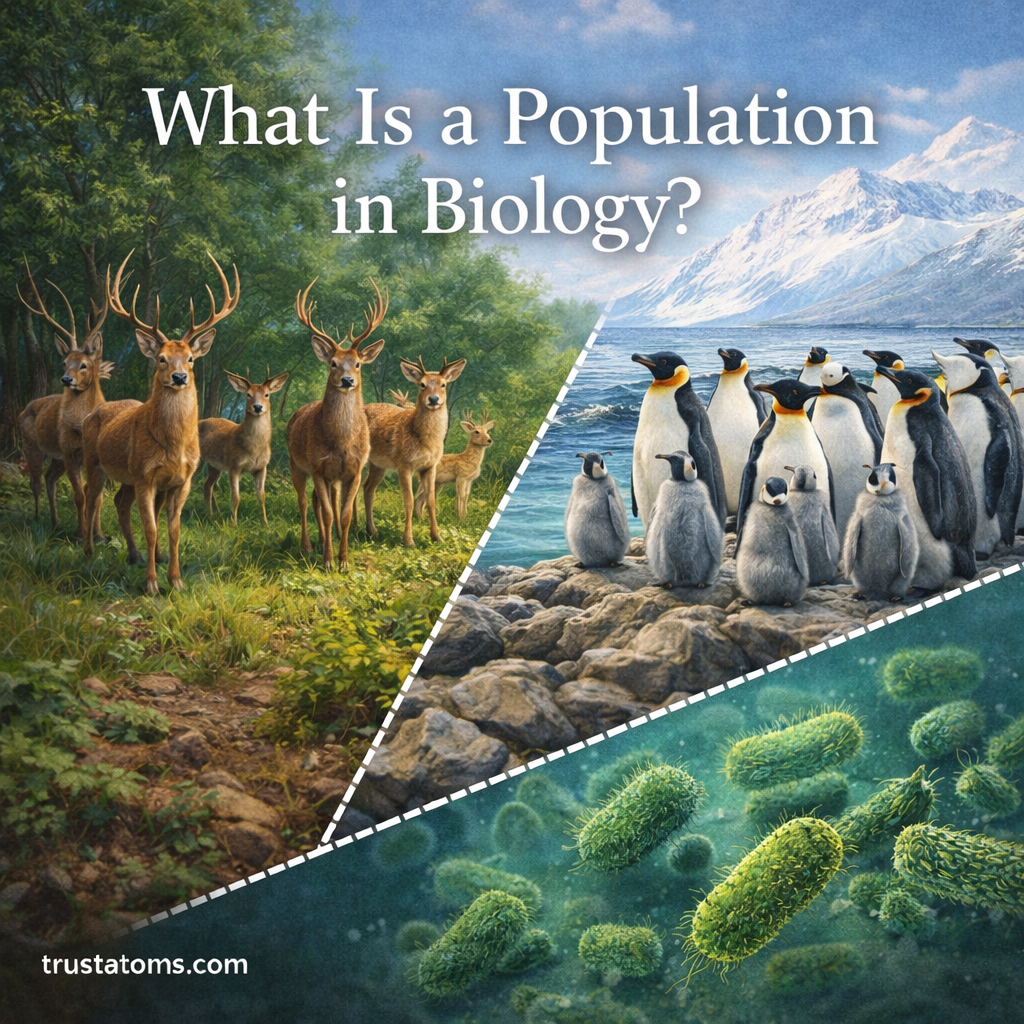
For example:
- A herd of deer living in a forest region
- A colony of penguins on a coastal island
- A group of bacteria in a freshwater lake
Each of these groups represents a population because the organisms live together and interact within a defined environment.
Key Characteristics of a Population
Biologists study several characteristics to understand how populations function and change over time.
Population Size
Population size refers to the total number of individuals in a population.
Population size can change due to:
- Births
- Deaths
- Immigration (individuals moving into the population)
- Emigration (individuals leaving the population)
Monitoring population size helps scientists track species health and identify environmental impacts.
Population Density
Population density measures how many individuals live within a specific area or volume.
It is usually expressed as:
- Individuals per square kilometer
- Individuals per square meter
- Individuals per cubic meter (for aquatic environments)
High population density can increase competition for resources such as food, water, and space.
Population Distribution
Population distribution describes how individuals are spaced within their habitat.
There are three common distribution patterns:
- Clumped distribution
Individuals group together in clusters.
Example: schools of fish or herds of animals. - Uniform distribution
Individuals are evenly spaced.
Example: plants competing for nutrients in agricultural fields. - Random distribution
Individuals appear scattered without a predictable pattern.
Example: certain plants that grow wherever seeds land.
These patterns often reflect environmental conditions and social behaviors.
Population Growth
Population growth describes how the number of individuals in a population changes over time.
Two main growth models are commonly studied.
Exponential Growth
Exponential growth occurs when a population increases rapidly under ideal conditions.
Characteristics include:
- Unlimited resources
- Minimal competition
- Low predation
In this model, population size increases at an accelerating rate.
However, exponential growth is rarely sustainable in natural environments.
Logistic Growth
Logistic growth occurs when population growth slows as resources become limited.
The environment can only support a certain number of individuals, known as the carrying capacity.
Key factors that limit growth include:
- Food availability
- Habitat space
- Predators
- Disease
When a population approaches its carrying capacity, growth stabilizes.
Factors That Influence Population Size

Several environmental and biological factors influence how populations change.
Birth Rate
Birth rate refers to the number of new individuals produced within a population over a specific time period.
High birth rates can lead to rapid population growth.
Death Rate
Death rate measures the number of individuals that die within a population during a given time period.
Higher death rates can reduce population size.
Immigration
Immigration occurs when individuals move into a population from another area.
This increases population size and may introduce new genetic variation.
Emigration
Emigration occurs when individuals leave a population.
This reduces population size and may affect genetic diversity.
Population Genetics
Population genetics examines how genes vary within populations.
Scientists study how genetic variation changes through processes such as:
- Natural selection
- Mutation
- Genetic drift
- Gene flow
These processes influence how populations evolve over time.
Genetic diversity within populations helps species adapt to environmental changes.
Populations with low genetic diversity may struggle to survive environmental challenges.
Population Interactions in Ecosystems
Populations rarely exist in isolation. They interact with populations of other species within ecosystems.
These interactions shape ecological communities.
Competition
Competition occurs when populations compete for limited resources such as:
- Food
- Water
- Territory
- Light
Competition can limit population growth.
Predation
Predation occurs when one species feeds on another.
Predators and prey often influence each other’s population sizes.
For example:
- If prey populations increase, predator populations may grow.
- If prey populations decline, predator numbers may decrease.
Symbiosis
Some populations interact in ways that benefit one or both species.
Types of symbiotic relationships include:
- Mutualism – both species benefit
- Commensalism – one species benefits while the other is unaffected
- Parasitism – one species benefits while the other is harmed
These relationships shape ecosystem dynamics.
Population Ecology
Population ecology is the scientific study of how populations interact with their environments.
Researchers examine:
- Population growth patterns
- Resource availability
- Environmental pressures
- Species interactions
Population ecology helps scientists understand how ecosystems function and how environmental changes affect species survival.
Human Impacts on Populations
Human activities can strongly influence biological populations.
Major impacts include:
- Habitat destruction
- Pollution
- Climate change
- Overhunting or overfishing
- Introduction of invasive species
These factors can cause population declines or, in some cases, rapid population growth.
Understanding population dynamics allows scientists and conservationists to develop strategies for protecting endangered species.
Why Population Studies Matter
Studying populations provides important insights into how life on Earth functions.
Population research helps scientists:
- Predict changes in wildlife populations
- Manage fisheries and natural resources
- Control disease outbreaks
- Protect endangered species
- Understand evolutionary processes
Population-level analysis is a critical tool in modern biology and environmental science.
Final Thoughts
A population in biology represents a group of individuals from the same species living together within a specific environment. By examining how populations grow, interact, and adapt, scientists gain valuable insights into the functioning of ecosystems and the evolution of life.
Population biology connects ecology, genetics, and environmental science, helping researchers understand how species survive and change in an ever-evolving natural world.