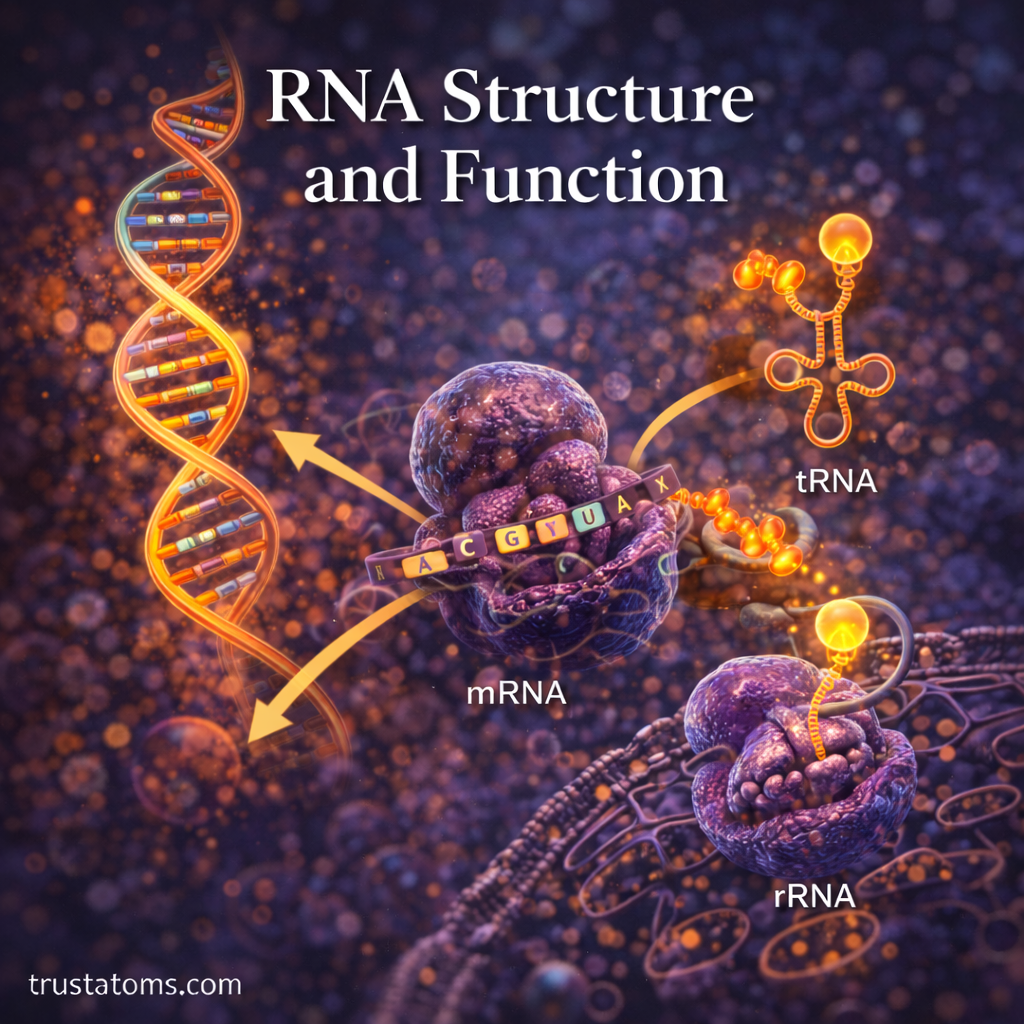
Ribonucleic acid, commonly known as RNA, is one of the most important molecules in biology. While DNA stores genetic information, RNA plays a crucial role in using that information to produce proteins and regulate cellular processes.
RNA molecules are involved in gene expression, protein synthesis, gene regulation, and many other cellular functions. Scientists once thought RNA served only as a simple messenger between DNA and proteins, but modern research shows that RNA molecules perform diverse and complex roles in living systems.
Understanding RNA structure and function is essential for studying genetics, molecular biology, and modern biomedical research.
What Is RNA?
RNA is a single-stranded nucleic acid that helps translate genetic information into functional molecules within cells.
Like DNA, RNA is made of repeating units called nucleotides. Each nucleotide contains three components:
- A ribose sugar molecule
- A phosphate group
- A nitrogenous base
The four nitrogenous bases found in RNA are:
- Adenine (A)
- Cytosine (C)
- Guanine (G)
- Uracil (U)
Uracil replaces thymine, which is present in DNA.
RNA molecules are typically shorter than DNA and can fold into complex shapes that allow them to perform specific functions.
Structural Differences Between RNA and DNA
Although RNA and DNA share similar building blocks, they differ in several important ways.
Single-Stranded Structure
DNA forms a double helix composed of two complementary strands.
RNA, in contrast, is usually single-stranded, although it can fold into loops and secondary structures.
Ribose Sugar
RNA contains ribose sugar, while DNA contains deoxyribose.
The ribose sugar includes an extra oxygen atom, which makes RNA less chemically stable than DNA.
Uracil Instead of Thymine
RNA uses uracil (U) instead of thymine (T).
Uracil pairs with adenine during RNA base pairing.
Cellular Location
DNA is primarily located in the cell nucleus.
RNA molecules can be found in multiple cellular locations, including:
- The nucleus
- The cytoplasm
- Ribosomes
- Mitochondria
These locations reflect RNA’s role in gene expression and protein production.
Types of RNA
Cells produce several different types of RNA, each with specialized roles.
Messenger RNA (mRNA)
Messenger RNA carries genetic information from DNA to ribosomes, where proteins are synthesized.
The process involves:
- DNA being transcribed into mRNA.
- mRNA leaving the nucleus.
- Ribosomes reading the mRNA sequence to build proteins.
Each sequence of three nucleotides on mRNA is called a codon, which specifies a particular amino acid.
mRNA serves as the blueprint for protein production.
Transfer RNA (tRNA)
Transfer RNA helps translate the genetic code during protein synthesis.
Each tRNA molecule carries a specific amino acid and contains an anticodon sequence that matches the mRNA codon.
The process works as follows:
- The ribosome reads an mRNA codon.
- A tRNA with the matching anticodon binds to the ribosome.
- The attached amino acid is added to the growing protein chain.
This process ensures accurate protein assembly.
Ribosomal RNA (rRNA)
Ribosomal RNA is a structural and functional component of ribosomes, the cellular machines that synthesize proteins.
rRNA molecules:
- Form the core structure of ribosomes
- Help position mRNA and tRNA molecules
- Catalyze the formation of peptide bonds between amino acids
Because of this catalytic activity, rRNA functions as a type of ribozymes, meaning RNA molecules that can act as enzymes.
Regulatory RNAs
In addition to the main RNA types involved in protein synthesis, cells produce several regulatory RNAs that control gene expression.
Examples include:
- MicroRNA (miRNA)
- Small interfering RNA (siRNA)
- Long noncoding RNA (lncRNA)
These molecules regulate gene activity by influencing RNA stability, translation efficiency, or transcription processes.
RNA Folding and Secondary Structure
Although RNA is typically single-stranded, it can fold into complex shapes through base pairing between different parts of the molecule.
Common RNA secondary structures include:
- Hairpin loops
- Stem loops
- Bulges
- Internal loops
These structural features allow RNA molecules to perform specialized biological functions.
For example, tRNA molecules fold into a distinctive cloverleaf structure that helps them interact with ribosomes and mRNA.
RNA in Gene Expression
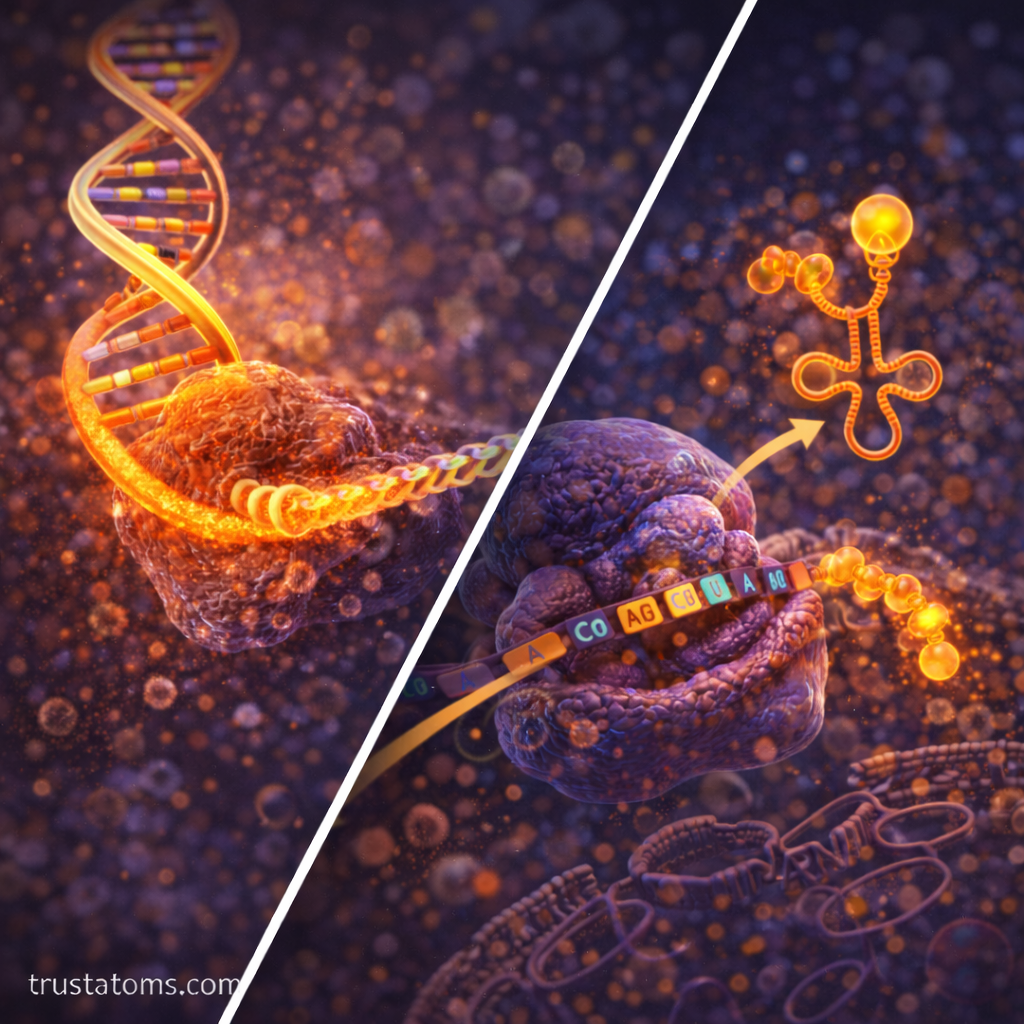
RNA plays a central role in the process of gene expression, which is how genetic information is converted into functional proteins.
Gene expression involves two major steps.
Transcription
During transcription:
- An enzyme called RNA polymerase reads a DNA template.
- RNA nucleotides are assembled to form a complementary RNA strand.
- The newly formed RNA molecule separates from DNA.
This process produces mRNA and other RNA molecules.
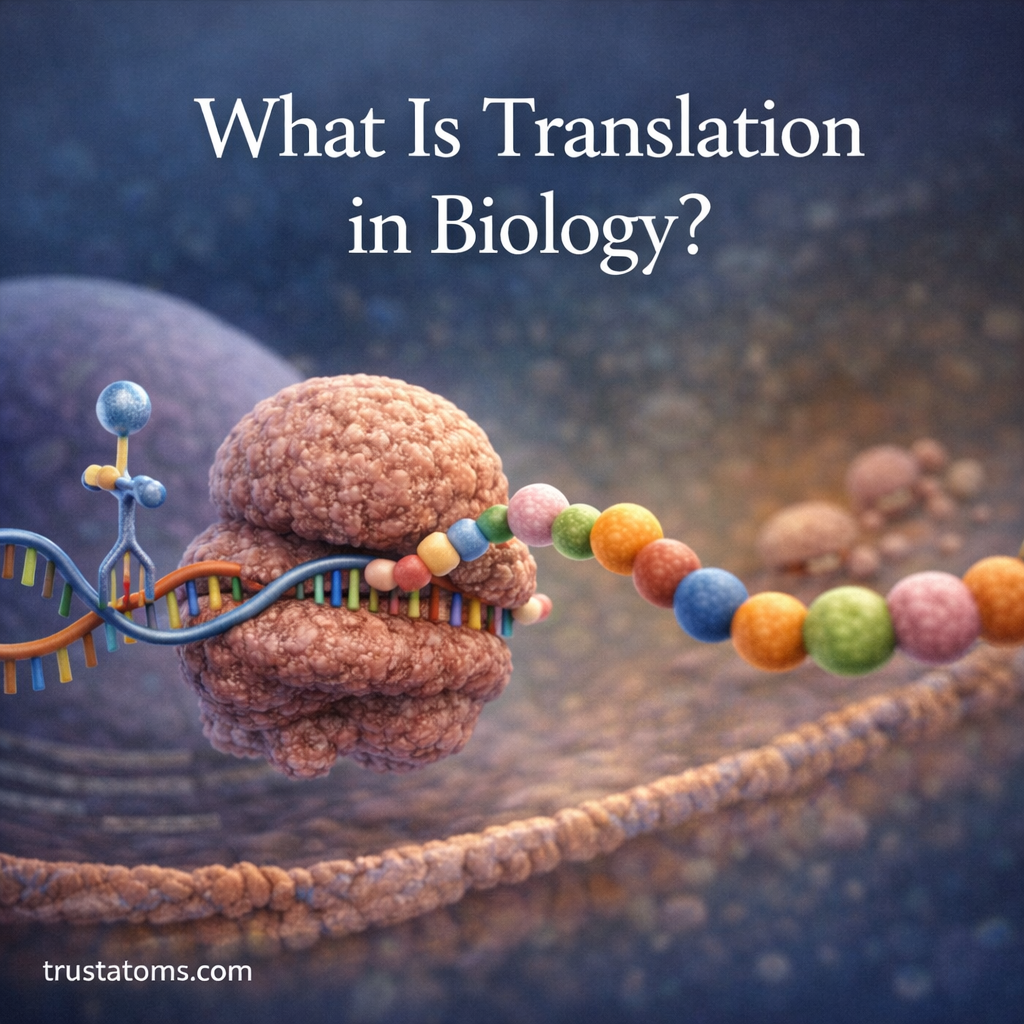
Translation
During translation:
- Ribosomes bind to mRNA.
- tRNA molecules bring amino acids corresponding to each codon.
- The ribosome links amino acids together to form a protein.
This process converts the genetic code into functional proteins.
RNA and Catalytic Activity
Some RNA molecules act as ribozymes, meaning they can catalyze chemical reactions.
Examples of RNA catalytic activity include:
- Peptide bond formation in ribosomes
- RNA splicing during gene processing
- Self-cleaving RNA molecules
These discoveries challenged the earlier belief that only proteins could act as enzymes.
RNA in Modern Biotechnology
RNA has become an important tool in biotechnology and medicine.
Applications include:
- RNA-based vaccines
- Gene silencing technologies
- CRISPR gene editing systems
- RNA therapeutics for genetic diseases
For example, mRNA vaccines deliver RNA instructions that allow cells to produce proteins that stimulate immune responses.
These technologies highlight the growing importance of RNA research.
RNA and the Origin of Life
Many scientists believe RNA may have played a key role in the early evolution of life.
The RNA world hypothesis proposes that early life forms relied primarily on RNA molecules for both genetic storage and catalytic activity.
Because RNA can both store information and catalyze reactions, it may have served as a precursor to modern DNA and protein-based life.
Although this hypothesis is still being studied, it provides insight into how biological systems may have evolved.
Final Thoughts
RNA is far more than a simple intermediary between DNA and proteins. Its versatile structure allows it to perform numerous roles in gene expression, regulation, catalysis, and cellular organization.
From messenger RNA guiding protein synthesis to regulatory RNAs controlling gene activity, RNA molecules are central to nearly every biological process. Advances in RNA research continue to transform our understanding of genetics, disease, and biotechnology.
As scientists explore new RNA-based technologies and therapies, this remarkable molecule remains at the forefront of modern biological research.