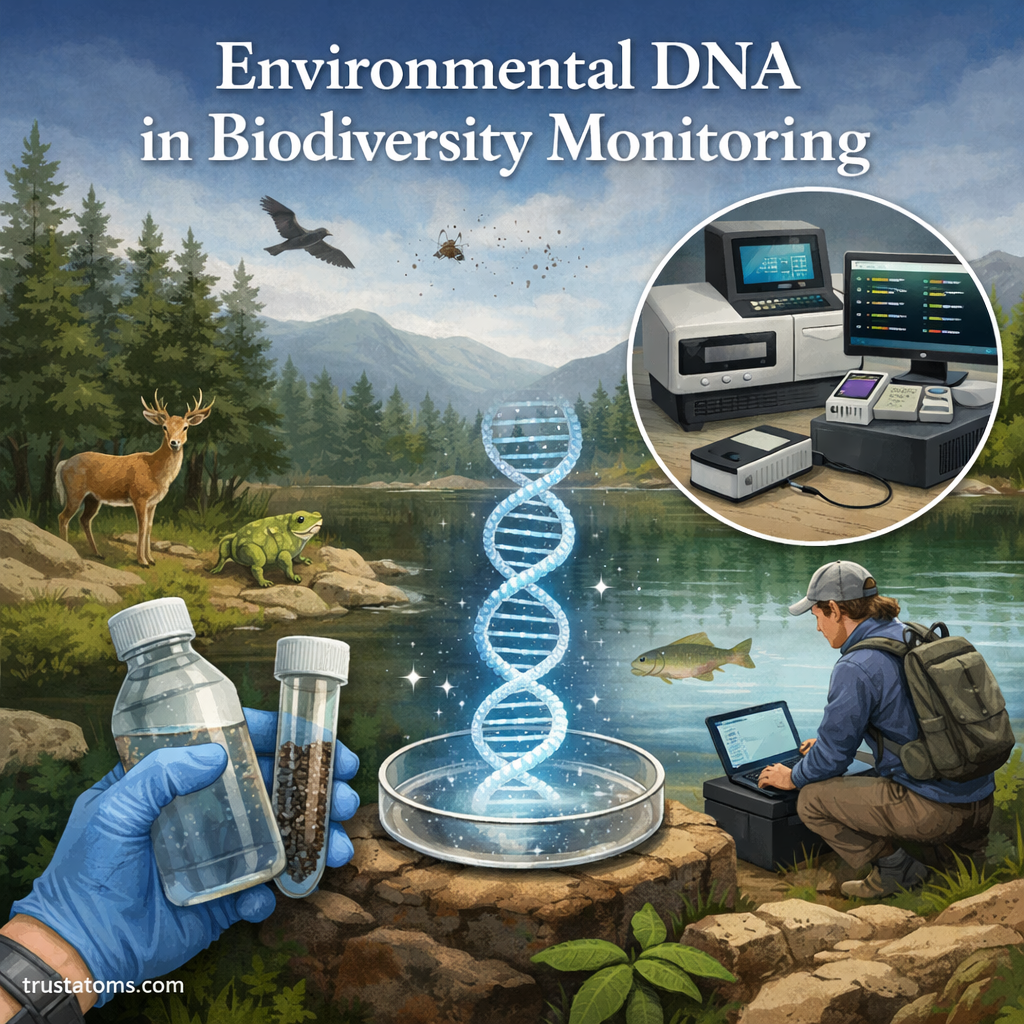
Environmental DNA (eDNA) has transformed how scientists study biodiversity. Instead of physically capturing or observing organisms, researchers can now detect species simply by analyzing genetic material found in water, soil, air, or sediment.
Every organism constantly sheds tiny traces of DNA through skin cells, mucus, waste, pollen, or decomposing tissue. These fragments accumulate in the environment and can be collected and analyzed to reveal which species are present in an ecosystem.
Because of its efficiency and sensitivity, eDNA is becoming one of the most powerful tools for monitoring biodiversity, tracking endangered species, and detecting invasive organisms.
What Is Environmental DNA?
Environmental DNA refers to genetic material that organisms leave behind in their surroundings. Unlike traditional genetic sampling that requires capturing an organism or collecting tissue directly, eDNA is gathered from environmental samples such as:
- Water from lakes, rivers, or oceans
- Soil or sediment from forests and wetlands
- Air samples in certain environments
- Ice cores or historical sediments
These samples contain microscopic fragments of DNA from organisms that have recently passed through or lived in the area.
Scientists extract the DNA from these samples and compare it with known genetic sequences in databases. If a match is found, it confirms that the species has been present in that environment.
How eDNA Monitoring Works
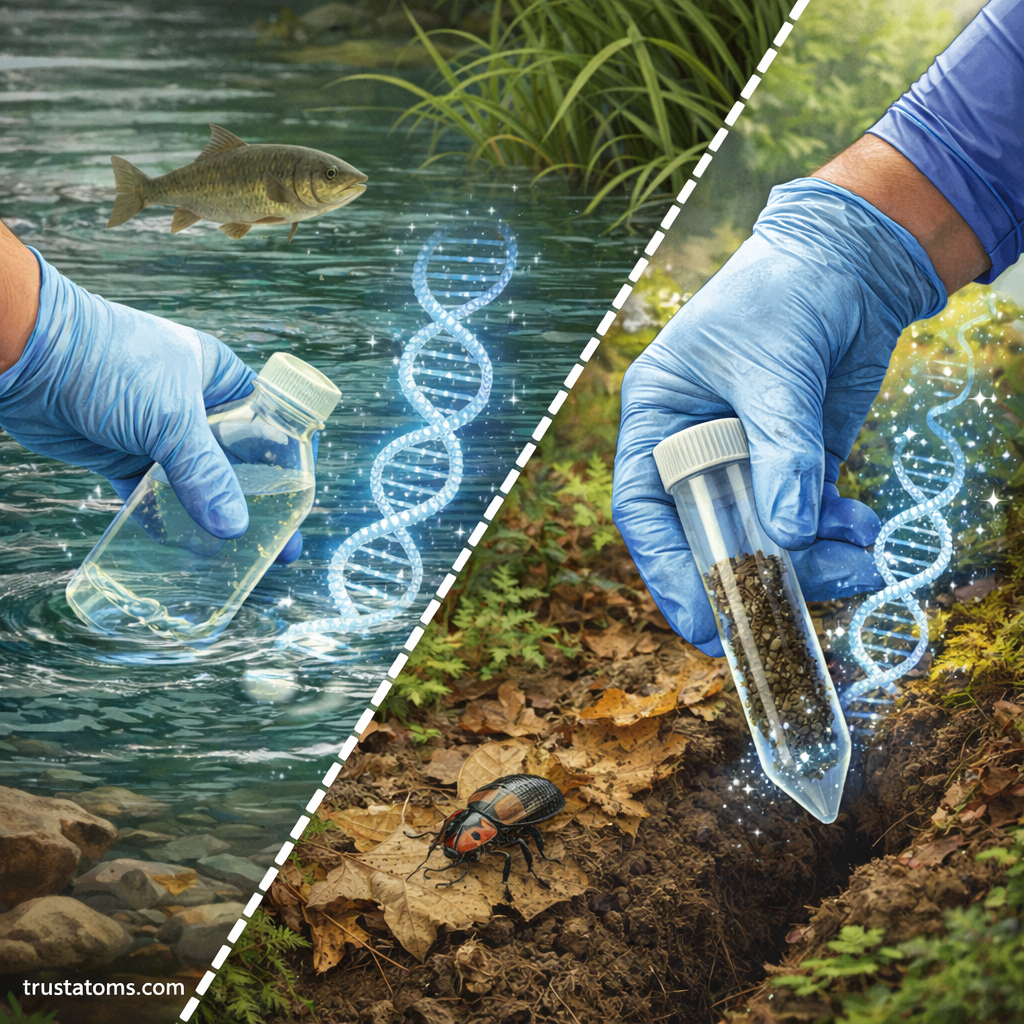
The process of environmental DNA monitoring follows several key steps.
1. Sample Collection
Researchers collect environmental samples from a location of interest.
Examples include:
- Water from a river to detect fish species
- Soil from a forest floor to identify mammals or insects
- Ocean water to monitor marine biodiversity
The samples must be handled carefully to avoid contamination.
2. DNA Extraction
Once collected, the samples are processed in a laboratory.
Scientists isolate DNA fragments using specialized chemical techniques that separate genetic material from other particles in the sample.
3. DNA Amplification
Because environmental DNA often exists in very small quantities, researchers use a method called Polymerase Chain Reaction (PCR) to amplify specific DNA sequences.
PCR allows scientists to make millions of copies of a DNA fragment, making it easier to detect and analyze.
4. DNA Sequencing
The amplified DNA is then sequenced to determine its genetic code.
Advanced sequencing technologies allow thousands of DNA fragments to be analyzed simultaneously.
5. Species Identification
Finally, the DNA sequences are compared to reference databases containing known species genomes.
If a match is found, scientists can identify which species contributed the DNA.
Why Environmental DNA Is So Powerful
Traditional biodiversity monitoring methods—such as trapping animals, conducting visual surveys, or using camera traps—can be time-consuming and expensive.
Environmental DNA offers several major advantages.
Non-Invasive Monitoring
eDNA sampling does not disturb wildlife.
Animals do not need to be captured, tagged, or handled, making it ideal for studying:
- Endangered species
- Elusive animals
- Sensitive ecosystems
High Sensitivity
Environmental DNA can detect species even when they are rare or difficult to observe.
For example, a single fish passing through a river may leave enough DNA traces to be detected in water samples.
Cost Efficiency
Collecting environmental samples is often cheaper and faster than conducting large field surveys.
A few water samples can reveal the presence of dozens or even hundreds of species.
Broad Biodiversity Detection
Modern sequencing techniques allow scientists to detect multiple species from a single sample.
This approach, known as metabarcoding, enables researchers to analyze entire communities of organisms at once.
Applications of eDNA in Biodiversity Monitoring
Environmental DNA is now used in many areas of ecological research and conservation.
Monitoring Endangered Species
Conservationists use eDNA to track rare species that are difficult to observe directly.
Examples include:
- Detecting endangered amphibians in wetlands
- Monitoring rare fish populations in rivers
- Tracking marine mammals in ocean habitats
This information helps guide conservation strategies and habitat protection.
Detecting Invasive Species
Invasive species can cause serious ecological damage if they spread unnoticed.
Environmental DNA allows scientists to detect these species early, before populations become established.
Examples include monitoring for:
- Zebra mussels in freshwater systems
- Asian carp in North American rivers
- Invasive amphibians or reptiles
Early detection gives conservation agencies time to respond.
Studying Ecosystem Health
Environmental DNA can reveal the diversity of organisms living in an ecosystem.
By analyzing species composition, researchers can assess:
- Ecosystem stability
- Effects of pollution
- Impacts of climate change
- Habitat degradation
Changes in biodiversity often signal environmental stress or ecological imbalance.
Marine Biodiversity Surveys
Ocean ecosystems are particularly difficult to study because many species live deep underwater or migrate widely.
Environmental DNA allows scientists to analyze marine biodiversity without large-scale fishing or observation efforts.
Researchers can detect:
- Fish communities
- Marine mammals
- Plankton species
- Coral reef biodiversity
This approach is transforming ocean monitoring.
Types of Environmental DNA Analysis
Several analytical approaches are used in eDNA studies.
Species-Specific Detection
This method targets DNA from a single species.
Scientists design genetic markers that match a particular organism, allowing them to confirm its presence in an environment.
This technique is often used for:
- Endangered species monitoring
- Invasive species detection
Metabarcoding
Metabarcoding analyzes DNA from many species simultaneously.
Short genetic markers—called DNA barcodes—are used to identify organisms across entire biological communities.
This approach can detect:
- Fish populations in rivers
- Insect diversity in forests
- Microbial communities in soil
Metagenomics
Metagenomics goes even further by sequencing all DNA present in an environmental sample.
This provides a comprehensive view of the genetic diversity within an ecosystem.
Metagenomics can reveal:
- Microbial ecosystems
- Unknown or poorly studied species
- Functional genes related to ecosystem processes
Limitations of Environmental DNA
Despite its advantages, environmental DNA monitoring has several limitations.
DNA Degradation
DNA breaks down over time due to:
- UV radiation
- Temperature changes
- Microbial activity
This means eDNA usually reflects recent presence, not long-term occupancy.
Uncertain Abundance Estimates
While eDNA can confirm that a species is present, it is often difficult to determine:
- Population size
- Exact location of individuals
DNA may drift in water or soil, making interpretation challenging.
Risk of Contamination
Because eDNA is highly sensitive, contamination from other samples or human handling can affect results.
Strict laboratory protocols are required to maintain accuracy.
Incomplete Reference Databases
Species identification relies on comparing DNA sequences with known references.
If a species is not represented in genetic databases, it may remain unidentified.
The Future of eDNA Technology
Environmental DNA research is advancing rapidly as sequencing technology improves.
Several developments are expected to expand its capabilities.
Portable DNA Sequencers
Portable sequencing devices allow scientists to analyze DNA directly in the field.
This could enable real-time biodiversity monitoring in remote locations.
Automated Sampling Systems
New technologies are being developed to collect environmental samples automatically.
For example:
- Ocean buoys that monitor marine DNA
- River sensors that track fish migration
These systems could provide continuous biodiversity data.
AI and Machine Learning Integration
Artificial intelligence is increasingly used to analyze large genetic datasets.
Machine learning algorithms can identify patterns in biodiversity data and improve species identification.
Why Environmental DNA Matters for Conservation
Global biodiversity is declining at an unprecedented rate due to:
- Habitat destruction
- Climate change
- Pollution
- Overexploitation
Effective conservation requires accurate and timely information about species distributions.
Environmental DNA provides a powerful solution by making biodiversity monitoring faster, more sensitive, and more accessible.
By revealing hidden species and detecting ecological changes early, eDNA helps scientists and conservationists protect ecosystems before irreversible damage occurs.
As the technology continues to evolve, environmental DNA will likely become one of the most important tools for understanding and preserving life on Earth.
Conclusion
Environmental DNA has revolutionized biodiversity monitoring by allowing scientists to detect species through traces of genetic material left behind in the environment. Through methods such as PCR amplification, DNA sequencing, and metabarcoding, researchers can identify organisms present in ecosystems without direct observation.
This approach offers major advantages in conservation biology, invasive species detection, and ecosystem health assessment. While challenges such as DNA degradation and database limitations remain, ongoing technological advances are rapidly improving the accuracy and scope of eDNA analysis.
As global ecosystems face increasing pressure, environmental DNA will play a critical role in helping scientists monitor biodiversity and protect the planet’s biological richness.