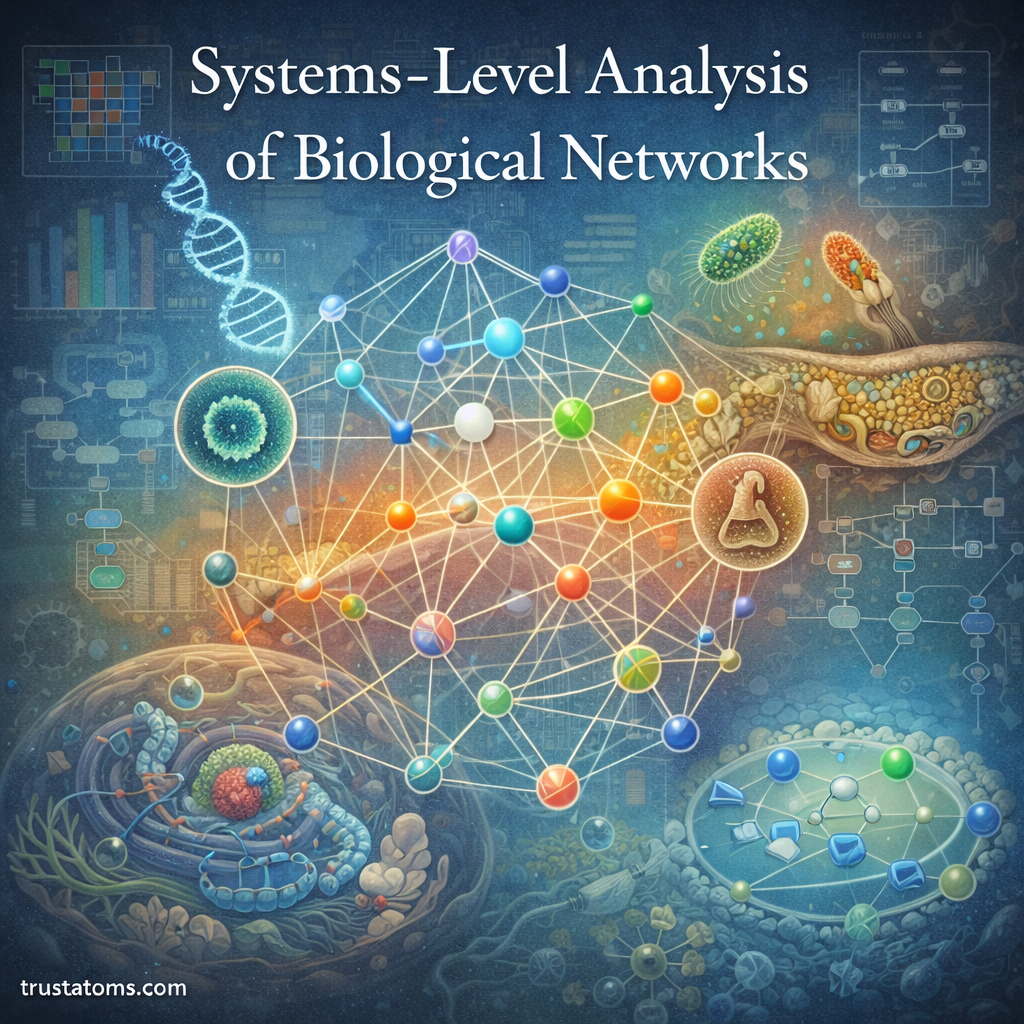
Biological systems are composed of vast networks of interacting molecules, cells, and signaling pathways. Instead of studying individual genes or proteins in isolation, scientists increasingly analyze entire biological networks to understand how living systems function as integrated wholes.
Systems-level analysis of biological networks is a core approach in modern systems biology. By examining the complex interactions among genes, proteins, metabolites, and regulatory pathways, researchers can identify patterns, predict system behavior, and understand how biological processes emerge from interconnected components.
This network-based perspective is essential for studying complex phenomena such as cellular regulation, disease development, and metabolic processes.
What Are Biological Networks?
Biological networks represent the interconnected relationships between components of living systems.
In network models, biological elements are typically represented as:
- Nodes – biological components such as genes, proteins, or metabolites
- Edges – interactions or relationships between these components
These interactions can represent many types of biological relationships, including:
- Gene regulation
- Protein–protein interactions
- Metabolic reactions
- Cellular signaling pathways
By mapping these relationships, scientists can visualize and analyze how biological systems operate at a global level.
Why Systems-Level Analysis Matters
Traditional biological research often focuses on individual molecules or genes. While this approach has produced important discoveries, many biological processes involve large networks of interacting components.
Systems-level analysis helps researchers:
- Understand how biological functions emerge from complex interactions
- Identify key regulatory hubs within networks
- Predict how systems respond to environmental changes
- Discover new targets for medical therapies
- Reveal mechanisms underlying complex diseases
By analyzing networks as integrated systems, scientists gain a deeper understanding of biological organization and function.
Types of Biological Networks
Several major types of biological networks are commonly studied in systems biology.
Gene Regulatory Networks
Gene regulatory networks describe how genes control each other’s expression through regulatory proteins and transcription factors.
In these networks:
- Genes may activate or suppress other genes
- Regulatory proteins bind to DNA to control gene transcription
- Feedback loops help maintain cellular stability
Gene regulatory networks play crucial roles in processes such as:
- Cell differentiation
- Development
- Immune responses
- Adaptation to environmental stress
Protein–Protein Interaction Networks
Proteins rarely act alone inside cells. Instead, they interact with other proteins to perform complex biological functions.
Protein–protein interaction networks map these physical interactions.
These networks help scientists understand:
- Cellular signaling pathways
- Molecular complexes
- Enzyme systems
- Disease mechanisms
Disruptions in protein interaction networks are often linked to genetic disorders and diseases.
Metabolic Networks
Metabolic networks describe the chemical reactions that convert nutrients into energy and cellular building blocks.
In metabolic networks:
- Enzymes catalyze biochemical reactions
- Metabolites serve as inputs and outputs of reactions
- Pathways connect multiple reactions into larger metabolic systems
Examples of metabolic pathways include:
- Glycolysis
- The citric acid cycle
- Fatty acid metabolism
Understanding metabolic networks is critical for studying metabolism, biotechnology, and drug development.
Cellular Signaling Networks
Cells communicate through signaling pathways that transmit information from the environment to the cell’s internal machinery.
Signaling networks involve:
- Receptors that detect external signals
- Signal transduction proteins
- Regulatory feedback loops
These networks regulate many cellular processes, including:
- Cell growth
- Immune responses
- Apoptosis (programmed cell death)
Complex signaling networks allow cells to respond dynamically to changing environments.
Network Properties in Systems Biology
Biological networks exhibit several structural features that influence their behavior.
Network Hubs
Some nodes in biological networks have many connections and serve as hubs.
Hub molecules often play critical roles in maintaining system stability.
For example:
- Key regulatory proteins may control multiple genes
- Metabolic enzymes may connect several pathways
Disruption of hub components can significantly affect the entire network.
Network Modules
Biological networks often contain modules—groups of components that work together to perform specific functions.
Examples of modules include:
- Protein complexes
- Metabolic pathways
- Regulatory circuits
Modular organization allows biological systems to maintain flexibility and robustness.
Feedback Loops
Feedback loops are regulatory mechanisms that control network activity.
Two main types exist:
- Positive feedback loops, which amplify biological responses
- Negative feedback loops, which stabilize systems and maintain balance
Feedback regulation is essential for maintaining homeostasis in living organisms.
Methods Used in Systems-Level Network Analysis
Studying complex biological networks requires advanced experimental and computational methods.
High-Throughput Experimental Techniques

Modern biological research uses high-throughput technologies to measure thousands of biological components simultaneously.
Common methods include:
- Genome sequencing
- RNA sequencing (transcriptomics)
- Proteomics
- Metabolomics
These technologies generate large datasets that describe biological activity across entire systems.
Computational Modeling
Computational models are used to simulate and analyze biological networks.
These models help scientists:
- Predict system behavior
- Identify key regulatory nodes
- Test hypothetical biological scenarios
Computational modeling is essential for interpreting large biological datasets.
Network Visualization Tools
Specialized software tools allow researchers to visualize biological networks and analyze their structure.
Examples of network analysis tasks include:
- Identifying highly connected nodes
- Detecting functional modules
- Measuring network connectivity
- Predicting regulatory pathways
Visualization tools make complex biological relationships easier to interpret.
Applications of Systems-Level Network Analysis
Systems-level analysis has transformed many areas of biological research.
Disease Research
Many diseases arise from disruptions in biological networks rather than single gene mutations.
Network analysis helps researchers identify:
- Disease-associated gene clusters
- Disrupted signaling pathways
- Potential drug targets
This approach is particularly important for studying complex diseases such as cancer, diabetes, and neurodegenerative disorders.
Drug Discovery
Understanding biological networks allows scientists to design drugs that target multiple components of a disease pathway.
This strategy can improve treatment effectiveness by addressing the complexity of disease mechanisms.
Network-based drug discovery also helps identify unintended side effects caused by interactions with other pathways.
Personalized Medicine
Systems biology can help tailor medical treatments based on an individual’s biological networks.
By analyzing gene expression, metabolic profiles, and signaling pathways, researchers can develop personalized therapies that match a patient’s biological characteristics.
Biotechnology and Synthetic Biology
Network analysis is also valuable in biotechnology and synthetic biology.
Engineers can design new biological systems by modifying network components to achieve desired outcomes, such as:
- Increased biofuel production
- Improved microbial fermentation
- Enhanced pharmaceutical synthesis
Systems-level understanding helps optimize these engineered biological processes.
Challenges in Analyzing Biological Networks
Despite its potential, systems-level analysis faces several challenges.
Data Complexity
Biological networks contain thousands of components and interactions.
Analyzing these complex datasets requires powerful computational tools and statistical methods.
Incomplete Network Information
Many biological interactions remain undiscovered.
Incomplete data can make it difficult to fully reconstruct biological networks.
Dynamic Biological Behavior
Biological systems constantly change in response to environmental conditions.
Network activity may vary depending on:
- cell type
- developmental stage
- environmental signals
Capturing these dynamic changes remains a major research challenge.
The Future of Systems-Level Biology
Advances in technology continue to improve systems-level analysis of biological networks.
Emerging developments include:
- Artificial intelligence for network prediction
- Improved multi-omics integration
- Real-time cellular monitoring technologies
- Advanced computational modeling tools
These innovations will allow scientists to build more accurate models of biological systems and uncover deeper insights into how life functions at the network level.
Conclusion
Systems-level analysis of biological networks provides a powerful framework for understanding the complexity of living organisms. By examining how genes, proteins, metabolites, and signaling pathways interact, scientists can reveal the mechanisms that drive biological processes.
This network-based perspective is transforming research in medicine, biotechnology, and ecology by allowing scientists to study biological systems as integrated wholes rather than isolated parts.
As computational tools and biological technologies continue to evolve, systems-level analysis will play an increasingly important role in uncovering the principles that govern life’s complex networks.