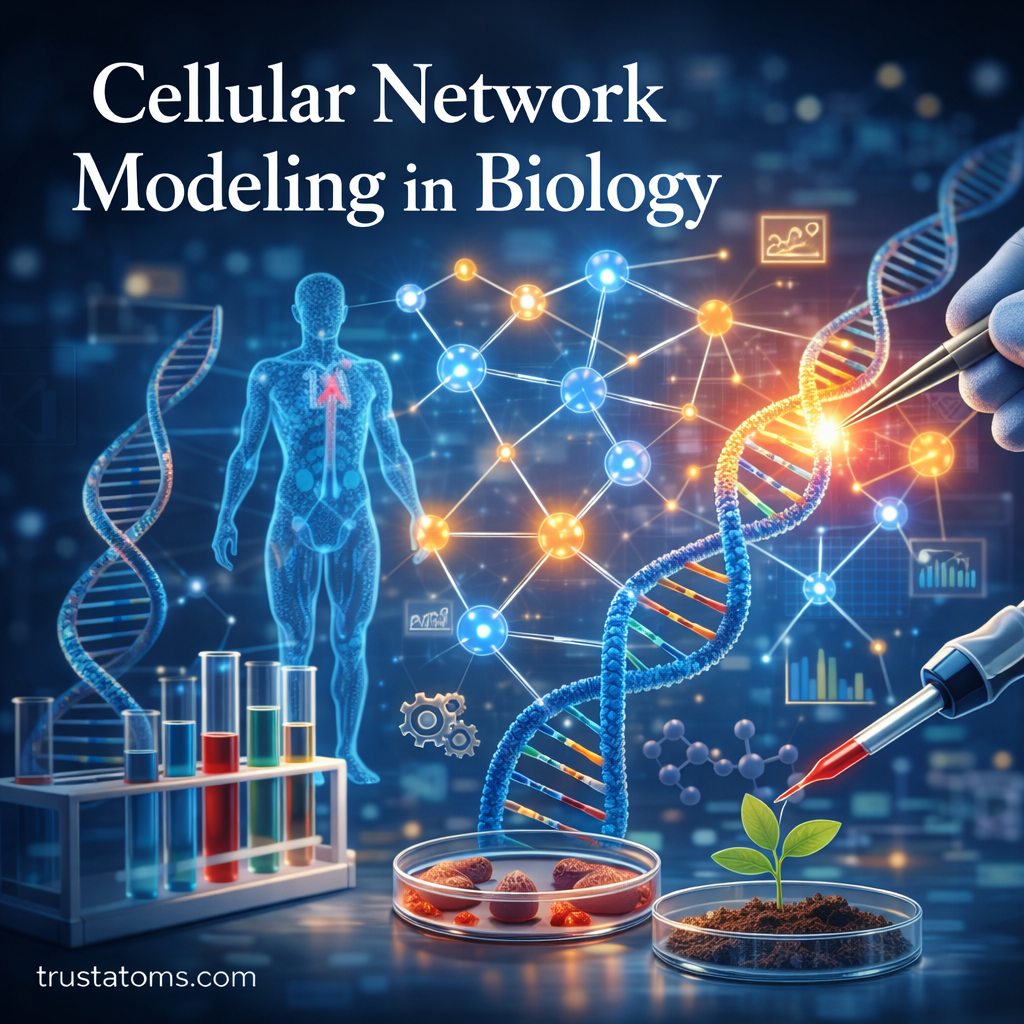
Cellular network modeling is a computational method that represents genes, proteins, and other cellular components as connected networks to understand how cells function. Scientists use these models to investigate biological processes, predict responses to changes, and identify interactions associated with disease.
Rather than examining molecules separately, network modeling explores how their relationships influence cellular behavior. This approach connects molecular research with the broader study of biology and living systems, revealing how coordinated interactions support growth, metabolism, and communication.
What Is Cellular Network Modeling?
Cellular network modeling is a computational and systems biology approach that represents biological processes as networks of interacting components. Each network provides a simplified picture of molecular relationships that researchers can analyze mathematically or computationally.
Most cellular networks contain two basic elements:
- Nodes: Biological components such as genes, proteins, metabolites, or molecular complexes.
- Edges: Connections representing physical interactions, chemical reactions, or regulatory relationships between components.
Connections may be directional, indicating that one component influences another, or weighted to represent interaction strength. Some models describe relatively fixed relationships, while dynamic models simulate changes over time.
Researchers studying integrated biological network systems combine different molecular networks to investigate how cellular processes influence one another. Similarly, systems-level regulation of metabolism examines how interconnected reactions coordinate cellular energy use and resource allocation.
How Cellular Networks Explain Cell Behavior
Cells depend on coordinated molecular interactions to regulate growth, respond to stress, process nutrients, and maintain internal conditions. A change affecting one molecule can influence several connected pathways, sometimes producing effects far beyond the original disturbance.
Network modeling helps researchers identify highly connected molecules, regulatory feedback loops, and alternative pathways that may compensate when one process is disrupted.
For a broader examination of these relationships, systems-level analysis of biological networks explores how network structure helps explain biological organization. Research into protein–protein interactions in cells provides additional insight into how molecular partnerships support signaling and cellular functions.
Four Major Types of Cellular Networks
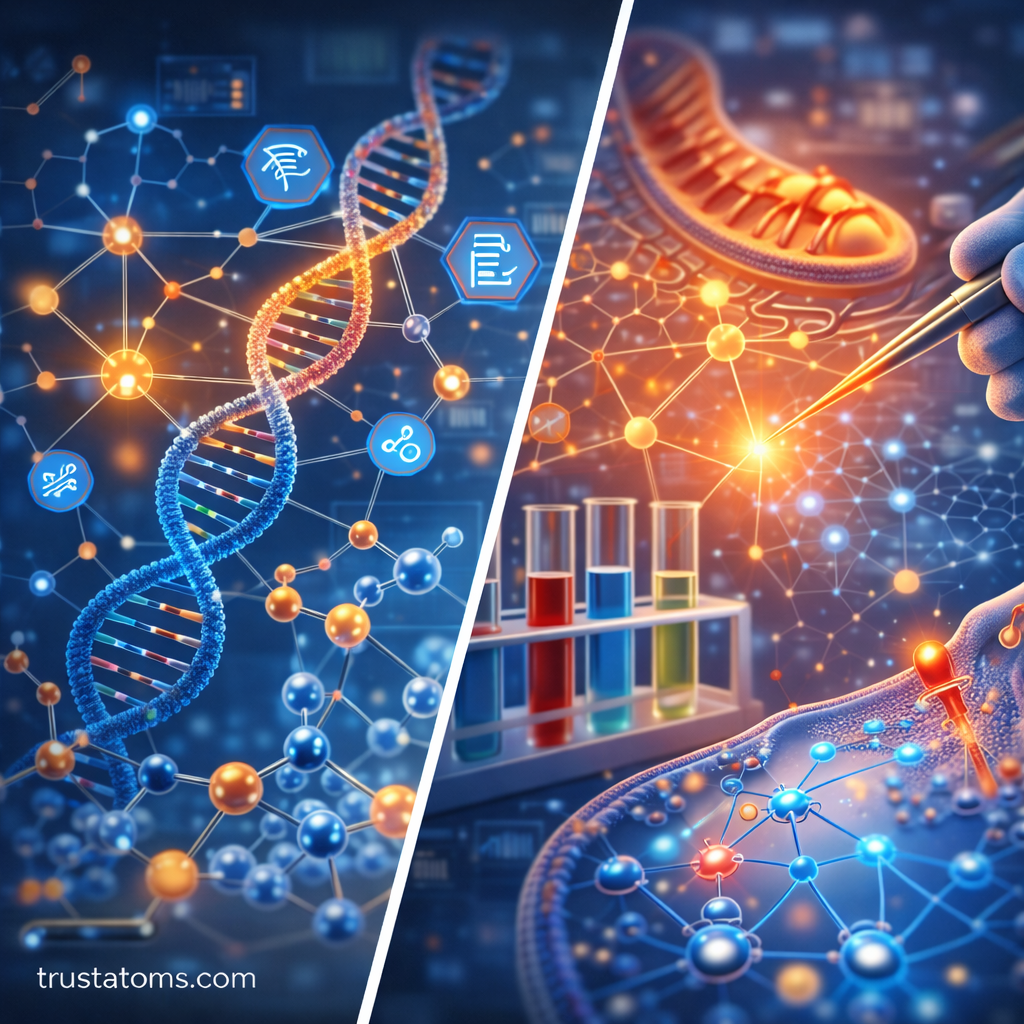
Different network types represent different biological relationships. Although researchers often study them separately, these systems interact continuously inside living cells.
Gene Regulatory Networks
Gene regulatory networks describe relationships controlling when and how strongly genes are expressed. Transcription factors bind regulatory DNA sequences and influence the production of RNA, while feedback mechanisms help stabilize or change gene activity.
Scientists investigate these networks to understand cell specialization, development, immune responses, and abnormal gene regulation associated with disease.
Protein Interaction Networks
Protein interaction networks map physical associations between proteins. Some proteins form stable molecular complexes, while others interact temporarily to transmit signals or coordinate cellular activities.
Mapping these relationships helps researchers identify protein complexes, investigate the consequences of mutations, and discover possible therapeutic targets. However, an observed interaction does not necessarily mean two proteins interact under every cellular condition.
Metabolic Networks
Metabolic networks represent enzyme-catalyzed chemical reactions that transform nutrients into energy, cellular building materials, and other compounds. Metabolites are connected through reactions that consume or produce them.
These models help scientists investigate energy production, nutrient limitations, and metabolic disorders. Some approaches calculate possible reaction rates while accounting for conservation of matter and other biochemical constraints.
Cell Signaling Networks
Signaling networks describe how cells detect and respond to information. Signals received by receptors can activate chains of molecular interactions that influence gene expression, metabolism, cell division, or programmed cell death.
Researchers use signaling models to examine how cells respond to hormones, immune signals, environmental stress, and certain medications.
A Simple Example of Network Modeling
Imagine a simplified cellular signaling network containing five proteins: A, B, C, D, and E. Protein A activates B, B activates C, and C activates D. Protein E inhibits C, reducing the signal reaching D.
A basic Boolean model assigns each protein one of two states: active (1) or inactive (0). If A and B are active but E inhibits C, the model might predict that C and D remain inactive. Removing E’s inhibitory effect could allow the signal to reach D.
This hypothetical example illustrates how researchers test the consequences of changing one network component. Actual signaling networks are considerably more complicated, and Boolean models simplify the continuous changes in protein activity observed in cells.
How Scientists Build Cellular Network Models
Constructing a useful network model involves gathering evidence, defining molecular relationships, selecting mathematical methods, and comparing predictions with experiments.
- Collect biological data. Researchers use gene expression measurements, protein interaction experiments, sequencing, and metabolite measurements to identify relevant components.
- Construct the network. Molecules become nodes, while experimentally supported or inferred relationships become edges. Researchers distinguish confirmed interactions from uncertain predictions.
- Select a mathematical model. Differential equations describe continuous changes, Boolean models represent simplified activity states, and probabilistic models account for uncertainty.
- Run simulations. Researchers examine how changes such as mutations, altered nutrient availability, or drug exposure affect predicted network behavior.
- Validate predictions. Laboratory experiments test whether simulated responses resemble actual cellular behavior. Disagreements help researchers refine the model.
The modeling method depends on the research question. A structural interaction map may be sufficient to identify molecular connections, while predicting changes over time requires additional information about regulatory mechanisms and reaction behavior.
Applications in Medicine and Biotechnology
Understanding Disease Mechanisms
Diseases such as cancer can involve disturbances across several interacting molecular pathways. Network analysis helps researchers investigate how altered genes and proteins influence cellular behavior and identify relationships worth examining experimentally.
Investigating Drug Effects
Drug researchers use network models to explore how targeting one protein might affect connected pathways. These predictions can suggest additional drug targets, possible resistance mechanisms, or unintended effects, but they require experimental confirmation.
Supporting Precision Medicine
Combining molecular measurements from individual patients with network models may help researchers investigate differences in disease mechanisms and treatment responses. Many such applications remain research tools rather than established methods for routine clinical decisions.
Designing Biological Systems
In synthetic biology, researchers model engineered gene circuits and metabolic pathways before testing them in organisms. This can support projects involving pharmaceutical production, biosensors, and microorganisms designed to manufacture useful compounds.
Limitations of Cellular Network Models
Network models simplify biological systems, which creates several practical limitations:
- Incomplete information: Many molecular interactions remain unknown, and experimental datasets may contain measurement errors.
- Changing conditions: Interactions can differ between cell types, environments, and stages of cellular activity.
- Computational complexity: Detailed simulations involving many interacting components can require substantial computing resources.
- Uncertain predictions: A connection in a network does not automatically establish causation or reveal the strength of its biological effect.
Newer approaches combine genomic, protein, and metabolic measurements with single-cell analysis and machine learning. These methods can improve network reconstruction, although better datasets do not eliminate the need for careful experimental validation.
Frequently Asked Questions
What is the difference between a cellular network and a pathway?
A biological pathway usually describes a defined sequence or group of molecular events. A cellular network can connect multiple pathways and include feedback loops, alternative routes, and interactions between different biological processes.
Can cellular network models predict disease?
Network models can identify molecular patterns associated with disease and generate predictions about biological responses. However, these findings do not independently establish a diagnosis or reliably predict an individual’s health outcome without appropriate clinical validation.
Do scientists need artificial intelligence to model cellular networks?
No. Researchers also use graph analysis, differential equations, Boolean logic, and statistical methods. Artificial intelligence can assist with identifying patterns and predicting interactions, but it is only one part of the available modeling toolkit.
Cellular network modeling helps scientists move beyond isolated molecular observations to examine how connected biological processes influence one another. Its greatest value comes from combining computational predictions with experimental evidence, allowing researchers to refine explanations of cellular behavior and investigate mechanisms that would otherwise be difficult to study.
Sources: Alberts et al., Molecular Biology of the Cell; Alon, An Introduction to Systems Biology: Design Principles of Biological Circuits; National Center for Biotechnology Information (NCBI).