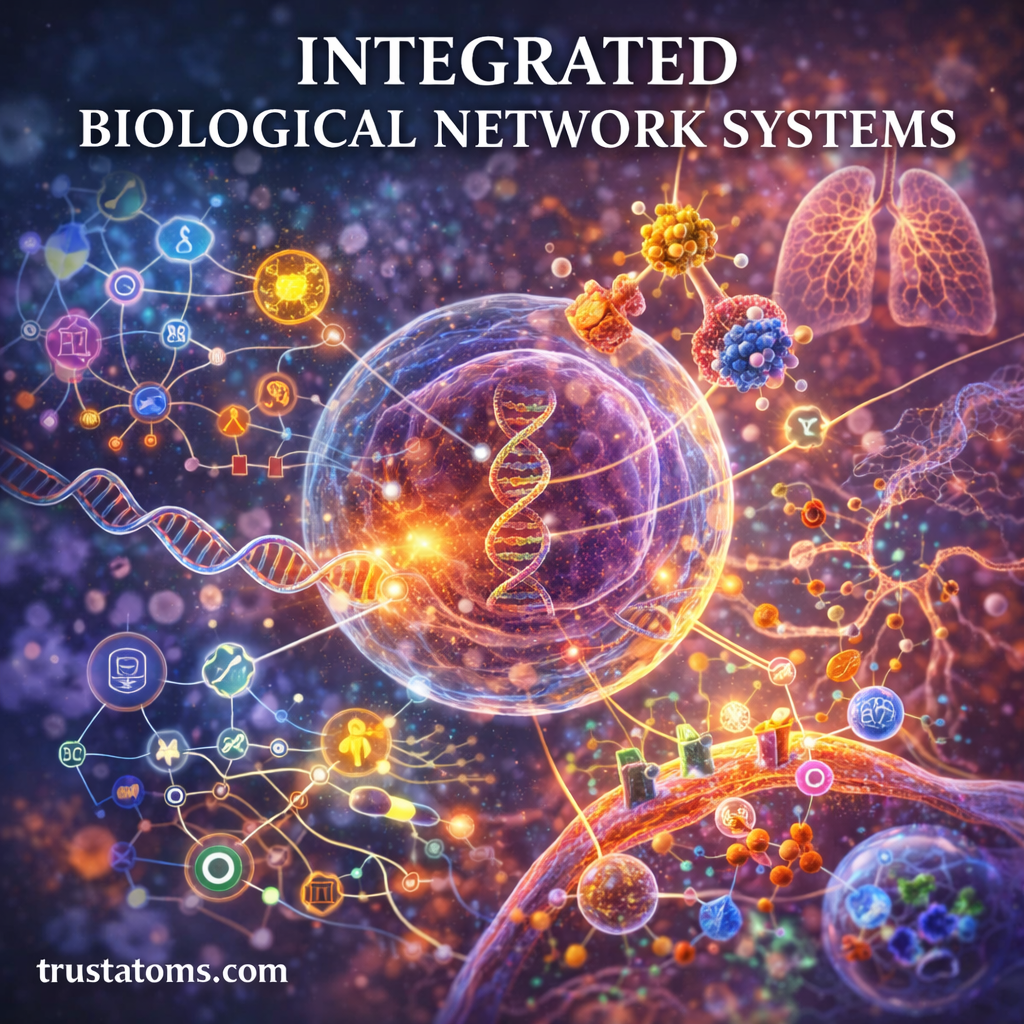
Living organisms function through vast interconnected systems rather than isolated biological processes. Cells, tissues, organs, and entire organisms rely on integrated biological network systems to coordinate complex activities such as metabolism, growth, communication, and adaptation.
These networks link genes, proteins, signaling molecules, and cellular pathways into dynamic systems that exchange information and regulate biological functions. Instead of operating independently, biological components interact continuously, forming networks that maintain stability and allow organisms to respond to internal and external changes.
Understanding integrated biological networks has become a central focus of modern biology, especially in fields like systems biology, bioinformatics, and biomedical research.
What Are Integrated Biological Network Systems?
Integrated biological network systems are interconnected sets of biological components that work together to regulate cellular and organism-level processes.
These networks involve interactions between:
- Genes
- Proteins
- Metabolic pathways
- Signaling molecules
- Cellular structures
- Environmental inputs
Each component influences others within the network, creating complex feedback and regulatory loops.
Instead of a simple linear chain of events, biological systems resemble interconnected webs of interactions, where multiple signals and pathways converge to determine cellular behavior.
Why Biological Systems Operate as Networks
Biological networks provide several advantages for living organisms.
Efficiency
Networks allow biological processes to operate efficiently by coordinating multiple pathways simultaneously.
For example:
- Metabolic pathways share intermediate molecules
- Cells regulate many genes at once
- Signaling networks process multiple signals simultaneously
Robustness
Integrated systems are often robust, meaning they can maintain function even when some components fail.
If one pathway is disrupted, alternative pathways can sometimes compensate.
Adaptability
Network structures enable organisms to respond quickly to environmental changes.
Cells can integrate information from multiple sources before deciding how to respond.
Major Types of Biological Networks
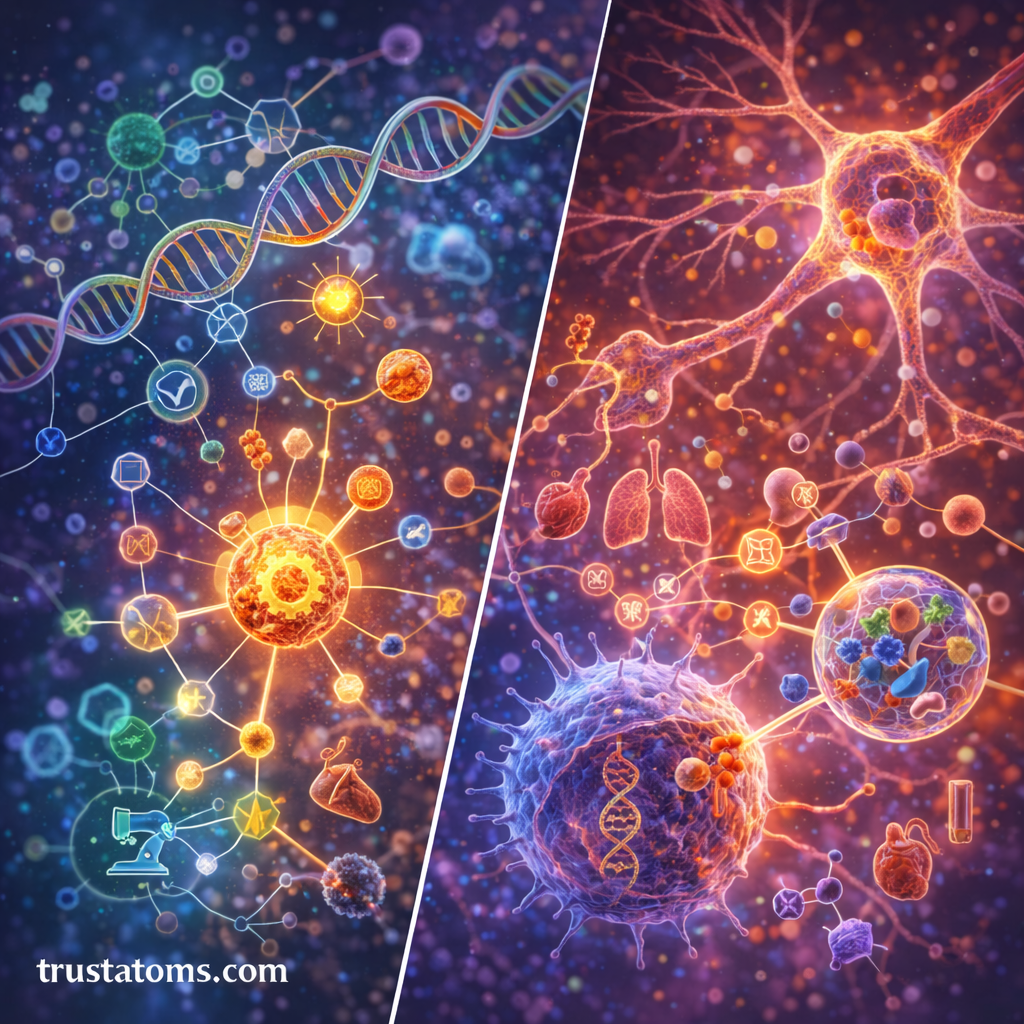
Biologists classify integrated biological networks into several major categories based on the types of interactions involved.
Gene Regulatory Networks
Gene regulatory networks control how genes are turned on or off.
In these networks:
- Transcription factors regulate gene activity
- Genes influence the expression of other genes
- Feedback loops stabilize gene expression patterns
Gene regulatory networks guide processes such as:
- Embryonic development
- Cell differentiation
- Environmental responses
Protein Interaction Networks
Proteins rarely act alone inside cells. Instead, they interact with other proteins to form functional complexes.
Protein interaction networks involve:
- Enzyme complexes
- Signaling pathways
- Structural protein assemblies
Mapping these interactions helps scientists understand how cellular processes are organized.
Metabolic Networks
Metabolic networks consist of chemical reactions that transform molecules to generate energy and build cellular components.
These networks connect numerous biochemical pathways such as:
- Glycolysis
- The citric acid cycle
- Amino acid synthesis
- Lipid metabolism
Metabolic networks are tightly regulated to maintain energy balance and cellular stability.
Signaling Networks
Cell signaling networks transmit information between cells and within cells.
These networks rely on:
- Receptors
- Signaling proteins
- Second messenger molecules
- Regulatory enzymes
Signaling networks control processes including:
- Immune responses
- Hormone regulation
- Tissue repair
- Growth and development
Systems Biology and Network Analysis
The study of integrated biological networks is a major focus of systems biology, an interdisciplinary field that combines biology, mathematics, and computer science.
Instead of studying individual molecules in isolation, systems biology analyzes how entire networks behave as a system.
Researchers use computational tools to:
- Map biological networks
- Model interactions between molecules
- Predict system behavior
- Identify critical regulatory points
Network analysis helps scientists understand how complex biological systems operate as a whole.
Network Nodes and Connections
In biological network models, components are represented using a structure similar to other complex networks.
Nodes
Nodes represent biological components such as:
- Genes
- Proteins
- Metabolites
- Cells
Each node performs specific biological functions.
Edges
Edges represent interactions between nodes.
These interactions may include:
- Protein binding
- Gene regulation
- Chemical reactions
- Signal transmission
By analyzing how nodes connect, researchers can identify important control points in biological systems.
Feedback Loops in Biological Networks
Feedback loops are critical features of integrated biological networks.
Negative Feedback
Negative feedback reduces activity when a system becomes too active.
Examples include:
- Hormone regulation controlling metabolism
- Enzyme pathways regulating product levels
- Temperature regulation in mammals
Negative feedback helps maintain homeostasis, the stable internal conditions necessary for life.
Positive Feedback
Positive feedback amplifies biological responses.
Examples include:
- Blood clot formation
- Rapid immune responses
- Certain developmental processes
Positive feedback allows biological systems to respond quickly when needed.
Cross-Talk Between Biological Pathways
In integrated networks, pathways often interact with one another in a process known as cross-talk.
Cross-talk allows cells to combine information from multiple signaling systems before making decisions.
For example:
- Immune signaling pathways interact with metabolic pathways
- Hormonal signals influence gene regulation
- Stress responses affect cellular metabolism
This integration allows cells to produce coordinated responses to complex conditions.
Biological Networks in Human Health
Integrated biological networks play a major role in health and disease.
Many disorders arise when network regulation fails.
Examples include:
Cancer
Cancer often results from disruptions in gene regulatory and signaling networks that control cell division.
Mutations can cause certain signaling pathways to remain permanently active, leading to uncontrolled growth.
Metabolic Disorders
Diseases such as diabetes involve disruptions in metabolic and hormonal networks that regulate energy balance.
Neurological Diseases
Neural networks in the brain rely on precise signaling and communication between neurons.
Disruptions in these networks can contribute to conditions such as:
- Alzheimer’s disease
- Parkinson’s disease
- Epilepsy
Understanding these network disruptions helps researchers develop targeted treatments.
Biological Network Mapping Technologies
Modern biological research uses advanced technologies to map and analyze networks.
Important techniques include:
Genomics
Genomics studies the complete set of genes in an organism.
It helps scientists identify regulatory relationships between genes.
Proteomics
Proteomics focuses on studying proteins and their interactions within cells.
This helps map protein interaction networks.
Metabolomics
Metabolomics analyzes the chemical products of metabolic reactions.
These measurements help reveal how metabolic networks function.
Computational Modeling
Computational models simulate biological networks and predict how systems respond to changes.
These models are increasingly used in:
- Drug discovery
- Disease prediction
- Synthetic biology
Applications in Biotechnology and Medicine
Research on integrated biological networks has numerous practical applications.
Precision Medicine
Network analysis allows doctors to identify disease mechanisms specific to individual patients.
This approach supports personalized treatments tailored to unique genetic and molecular profiles.
Drug Development
Many drugs target specific nodes within biological networks.
By identifying key control points in networks, scientists can design therapies that restore normal function.
Synthetic Biology
Synthetic biology uses network principles to design new biological systems.
Examples include engineered cells that can:
- Detect environmental toxins
- Produce pharmaceuticals
- Deliver targeted therapies
Key Takeaways
Integrated biological network systems explain how complex biological processes are coordinated across multiple levels of organization.
Important concepts include:
- Biological processes operate through interconnected networks rather than isolated pathways
- Major networks include gene regulatory, protein interaction, metabolic, and signaling networks
- Feedback loops and cross-talk allow systems to maintain stability and respond to changing conditions
- Network analysis plays a critical role in modern biology, medicine, and biotechnology
By studying biological networks, scientists gain deeper insights into how life functions as a coordinated system of interacting components.