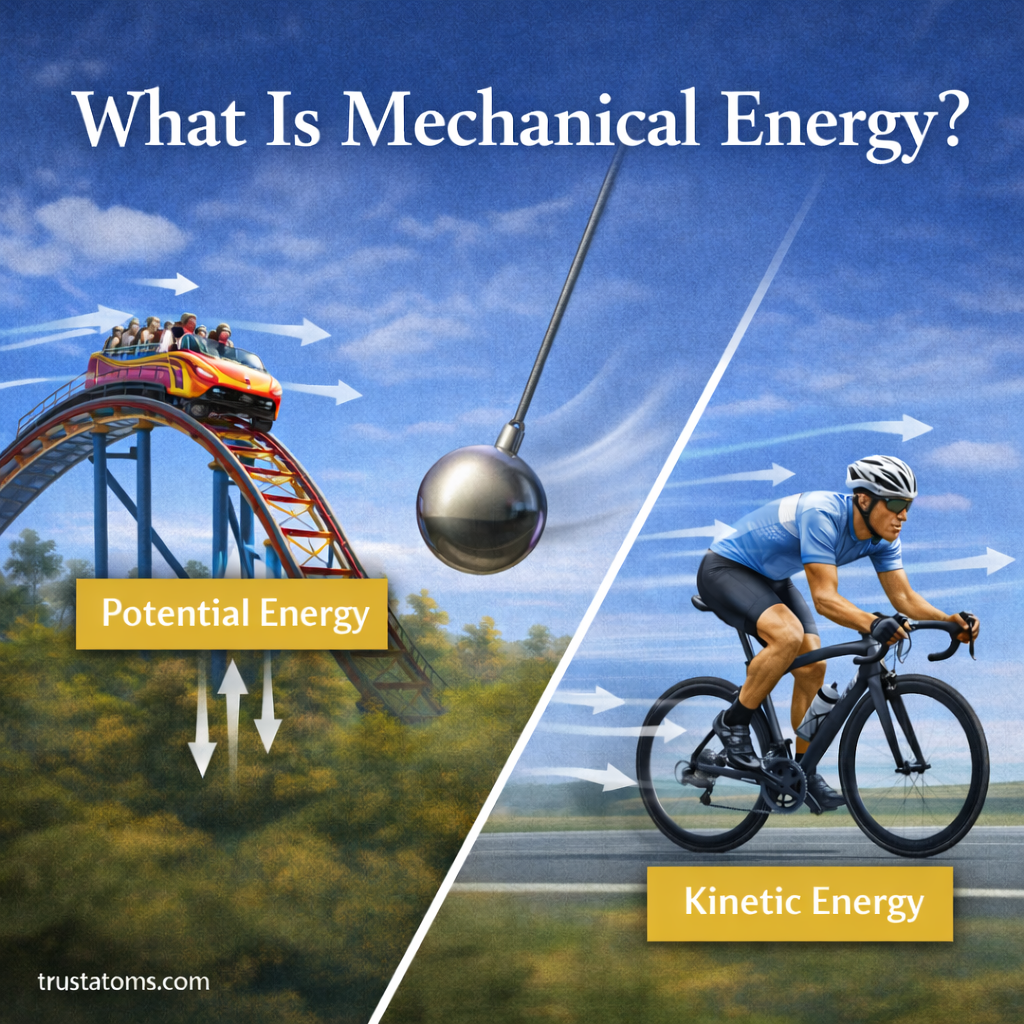
Mechanical energy is the energy associated with the motion and position of objects. It is one of the most fundamental concepts in physics and plays a major role in how objects move, interact, and perform work.
In simple terms, mechanical energy is the sum of two main types of energy:
- Kinetic energy (energy of motion)
- Potential energy (stored energy due to position or configuration)
Whenever an object moves, falls, stretches, or compresses, mechanical energy is involved.
Understanding mechanical energy helps explain many everyday phenomena—from a swinging pendulum and a rolling ball to roller coasters and moving vehicles.
The Two Main Types of Mechanical Energy
Mechanical energy consists of kinetic energy and potential energy working together within a system.
Kinetic Energy
Kinetic energy is the energy an object has because it is moving.
The faster an object moves or the more massive it is, the greater its kinetic energy.
Examples of kinetic energy include:
- A car driving down a highway
- A soccer ball flying through the air
- Water flowing in a river
- A spinning wind turbine
In all these cases, the motion of the object represents stored mechanical energy in the form of movement.
Potential Energy
Potential energy is stored energy due to an object’s position or condition.
This energy has the potential to be converted into motion.
Common forms of potential energy include:
- Gravitational potential energy
- Elastic potential energy
Examples include:
- A book resting on a shelf
- A stretched rubber band
- A compressed spring
- A roller coaster at the top of a hill
When the object moves or changes position, the stored energy is released and often turns into kinetic energy.
Mechanical Energy in Motion
One of the most important ideas in physics is that kinetic and potential energy can transform into each other.
As an object moves, these two types of energy constantly shift back and forth.
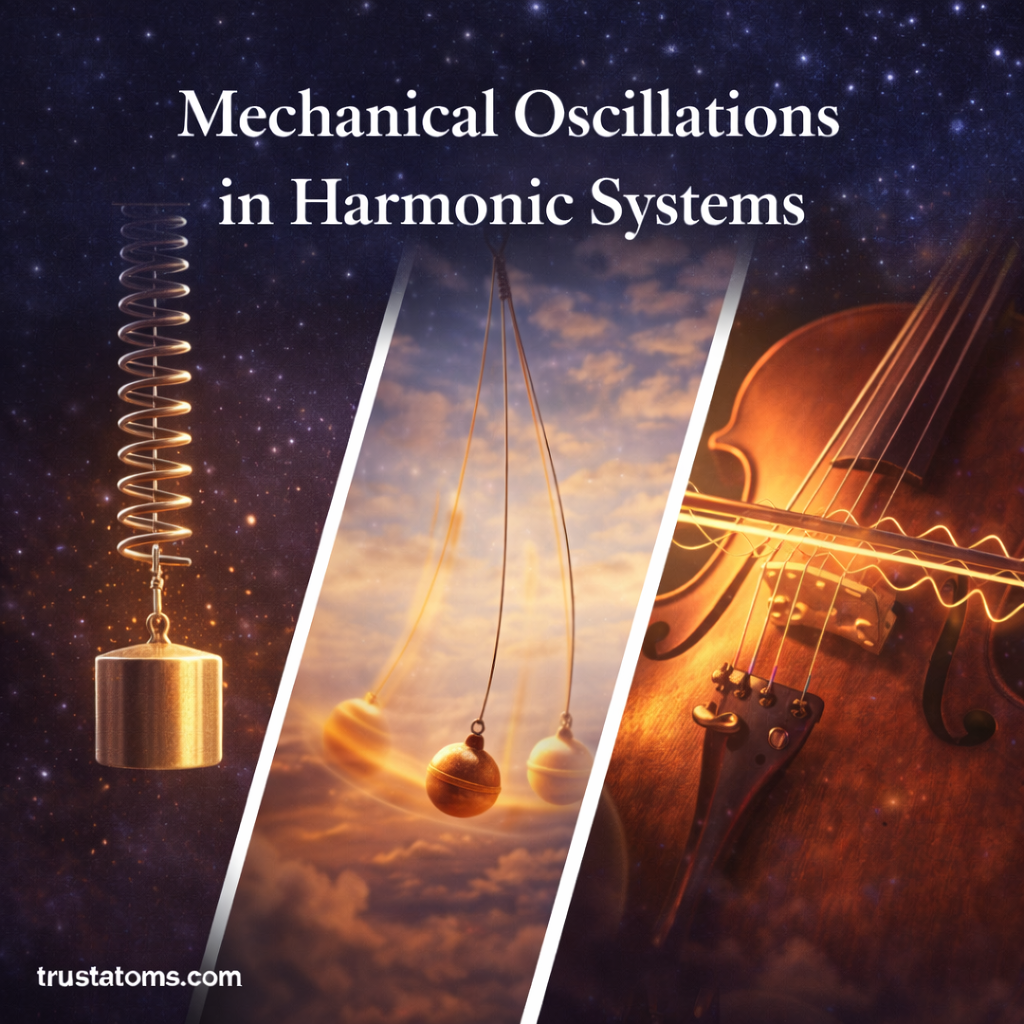
A simple example is a pendulum.
When the pendulum is at the highest point:
- Potential energy is greatest
- Kinetic energy is minimal
As the pendulum swings downward:
- Potential energy decreases
- Kinetic energy increases
At the lowest point of the swing:
- Kinetic energy is greatest
- Potential energy is lowest
This continuous exchange demonstrates how mechanical energy operates within a system.
Conservation of Mechanical Energy
In an ideal system with no energy loss, mechanical energy remains constant.
This concept is called the conservation of mechanical energy.
It means that the total amount of mechanical energy in a system stays the same, even though it may change form.
For example:
- Potential energy can become kinetic energy
- Kinetic energy can convert back into potential energy
But the total mechanical energy remains unchanged.
However, in real-world systems, other forces like friction and air resistance often convert some mechanical energy into heat or sound.
Everyday Examples of Mechanical Energy
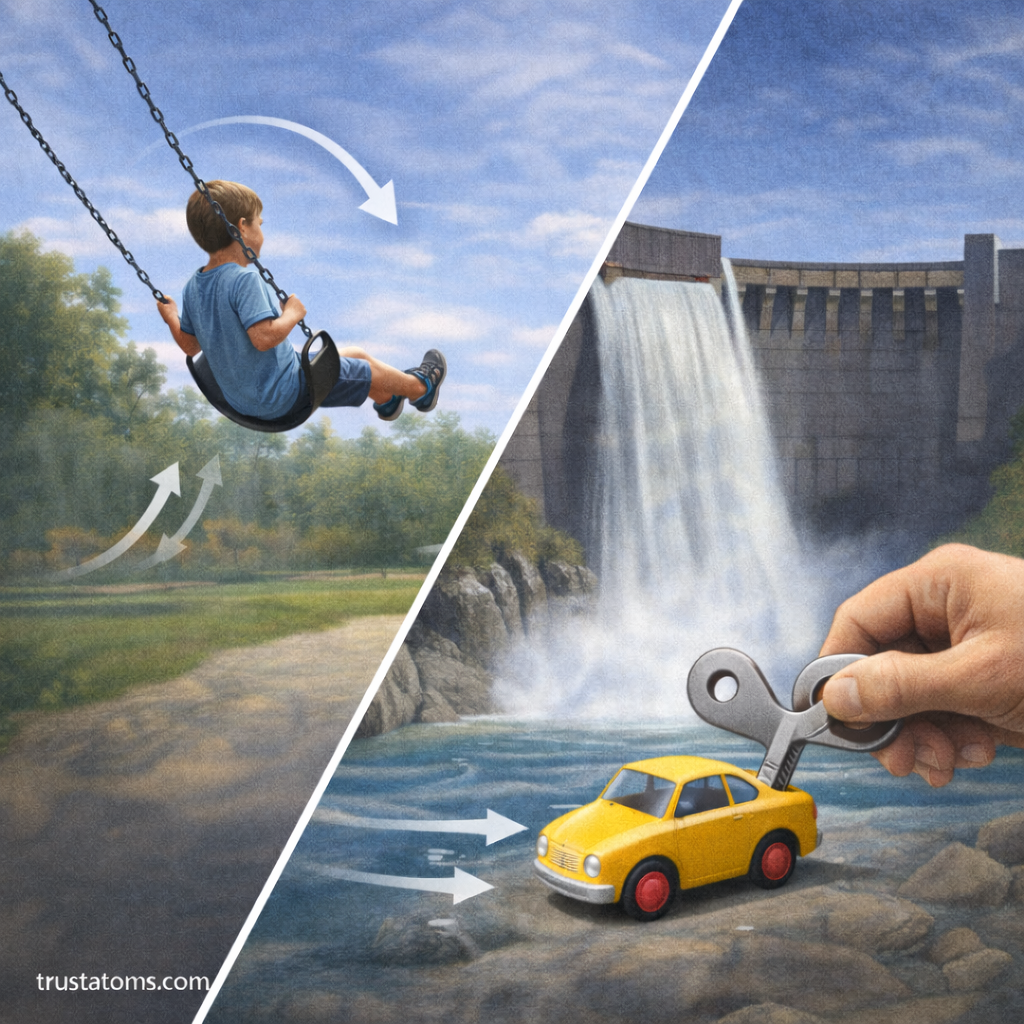
Mechanical energy is involved in many common activities and technologies.
Roller Coasters
A roller coaster is one of the best examples of mechanical energy at work.
- At the top of a hill, the coaster has high potential energy.
- As it descends, that energy converts into kinetic energy.
- When climbing the next hill, kinetic energy transforms back into potential energy.
Falling Objects
When an object falls, gravitational potential energy converts into kinetic energy.
For example:
- A dropped ball speeds up as it falls
- Its potential energy decreases
- Its kinetic energy increases
Wind Turbines
Wind turbines use the mechanical energy of moving air.
The wind’s motion spins turbine blades, which convert mechanical energy into electrical energy used to power homes and businesses.
Stretching Springs
A stretched or compressed spring stores elastic potential energy.
When released, the spring moves rapidly, converting stored energy into motion.
Examples include:
- Toy spring launchers
- Mechanical watches
- Suspension systems in vehicles
Mechanical Energy vs Other Types of Energy
Mechanical energy is only one form of energy in physics. Other types include:
- Thermal energy (heat)
- Chemical energy
- Electrical energy
- Nuclear energy
- Radiant energy (light)
Mechanical energy often transforms into other energy types during real-world processes.
For example:
- Friction converts mechanical energy into heat
- Generators convert mechanical energy into electricity
- Engines convert chemical energy into mechanical motion
These transformations allow energy to move through different systems and perform useful work.
Why Mechanical Energy Matters
Mechanical energy is central to understanding motion, engineering, and many natural processes.
It helps scientists and engineers:
- Design machines and engines
- Build efficient transportation systems
- Understand planetary motion
- Develop renewable energy technologies
Mechanical energy also forms the foundation of many important physics principles studied in schools and universities.
Key Takeaways
Mechanical energy describes the energy associated with motion and position.
Important points include:
- Mechanical energy consists of kinetic and potential energy.
- Kinetic energy relates to motion, while potential energy is stored energy.
- These two forms of energy can transform into each other.
- In ideal systems, mechanical energy follows the law of conservation.
- Mechanical energy plays a role in machines, transportation, sports, and natural processes.
By understanding mechanical energy, we gain insight into how objects move, interact, and transfer energy throughout the physical world.