Electric charge is one of the most fundamental properties in physics. It explains how particles interact through electric forces and forms the foundation of electricity, magnetism, and many modern technologies.
Everything from lightning storms to electronic devices relies on the behavior of electric charges. At the microscopic level, electric charge governs how particles attract, repel, and exchange energy.
Understanding electric charge helps explain how atoms work, how electric currents flow, and how electrical systems power the modern world.
What Is Electric Charge?
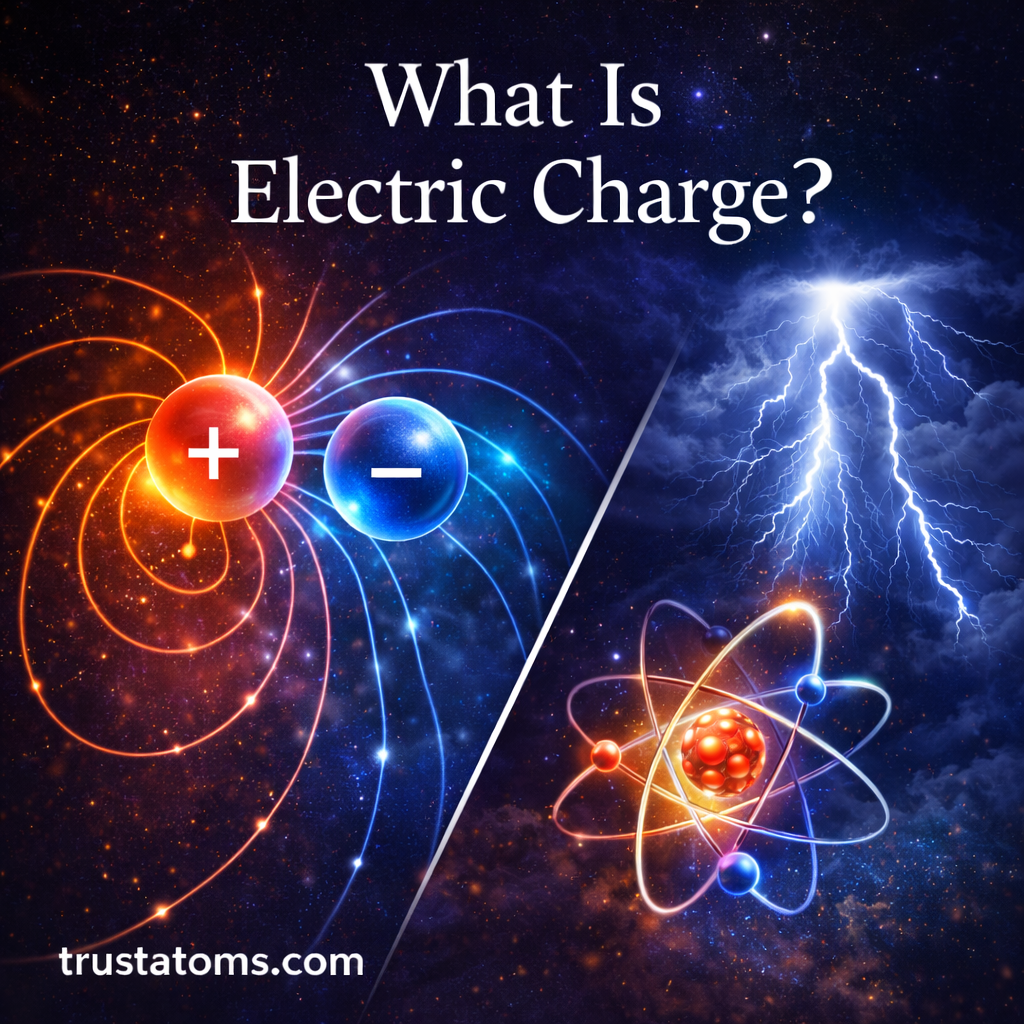
Electric charge is a physical property of matter that causes particles to experience electric forces.
Objects with electric charge can:
- Attract other charged objects
- Repel other charged objects
- Create electric fields around them
There are two types of electric charge:
- Positive charge
- Negative charge
These two types interact in predictable ways:
- Opposite charges attract
- Like charges repel
This simple rule explains many electrical phenomena observed in nature and technology.
Positive and Negative Charges
Electric charge exists in two forms.
Positive Charge
Positive charge is associated with certain particles inside atoms called protons.
Protons:
- Carry a positive electric charge
- Are found in the nucleus of atoms
- Help determine the identity of elements
When an object has more positive charges than negative ones, it becomes positively charged.
Negative Charge
Negative charge is carried by particles called electrons.
Electrons:
- Carry negative electric charge
- Move around the nucleus of atoms
- Can transfer between objects
If an object gains extra electrons, it becomes negatively charged.
How Electric Charge Works
Electric charge causes forces between particles through electric fields.
When a charged particle exists in space:
- It creates an electric field around itself.
- Other charged particles entering this field experience forces.
These forces can either pull particles together or push them apart depending on the charges involved.
For example:
- A positively charged object attracts a negatively charged object.
- Two negatively charged objects repel each other.
These interactions form the basis of many electrical systems.
Electric Charge in Atoms
Atoms normally contain equal numbers of protons and electrons.
Because protons carry positive charge and electrons carry negative charge, their charges cancel each other out.
This means most atoms are electrically neutral.
However, atoms can gain or lose electrons through processes such as:
- Friction
- Chemical reactions
- Electrical interactions
When this happens, atoms become ions, which are atoms with a net electric charge.
Static Electricity

Static electricity is one of the most familiar examples of electric charge in everyday life.
It occurs when electric charges build up on the surface of objects.
Common examples include:
- A balloon sticking to a wall after being rubbed on hair
- A small shock after touching a metal doorknob
- Clothes clinging together after drying
Static electricity occurs because electrons transfer from one material to another, leaving objects with an imbalance of charge.
Electric Charge and Electric Current
Electric current is the movement of electric charge through a material.
In most electrical systems, this movement occurs through electrons traveling in conductive materials such as metal wires.
Examples of electric current include:
- Electricity flowing through power lines
- Current inside electronic devices
- Charging a smartphone battery
When electric charges move in a controlled way through circuits, they deliver energy that powers electrical devices.
Conservation of Electric Charge
One of the fundamental laws of physics is the conservation of electric charge.
This principle states that:
- Electric charge cannot be created or destroyed.
- It can only be transferred from one object to another.
For example:
- When a balloon becomes negatively charged, another object must lose electrons.
- During electrical interactions, total charge in the system remains constant.
This law ensures that electric interactions follow predictable rules.
Measuring Electric Charge
Electric charge is measured using a unit called the coulomb (C).
A single electron carries a very small amount of charge, so the coulomb represents a large number of charged particles.
Scientists measure electric charge in many contexts, including:
- Electrical circuits
- Particle physics experiments
- Electrostatic interactions
Although individual particles carry tiny charges, large numbers of moving charges create the electrical effects used in technology.
Real-World Applications of Electric Charge
Electric charge plays a role in countless technologies and natural processes.
Electricity Generation
Power plants generate electricity by moving electric charges through generators.
These moving charges travel through power grids to supply homes and businesses.
Electronics
Electronic devices depend on the controlled movement of electric charges.
Examples include:
- Smartphones
- Computers
- Televisions
- Radios
Tiny electrical circuits manage the flow of charges to perform complex functions.
Lightning
Lightning occurs when large amounts of electric charge build up in storm clouds.
When the difference in charge becomes strong enough, the charges suddenly move between clouds or toward the ground, producing a powerful electric discharge.
Photocopiers and Laser Printers
Some office equipment uses static electric charges to control how ink or toner sticks to paper during printing.
This process relies on precise manipulation of electric charge.
Why Electric Charge Matters in Physics
Electric charge is one of the most important properties in physics because it explains how many forces and interactions occur at the atomic level.
It helps scientists understand:
- Electricity
- Magnetism
- Chemical bonding
- Particle interactions
- Electromagnetic radiation
Together with electric and magnetic fields, electric charge forms the foundation of electromagnetism, one of the four fundamental forces of nature.
Final Thoughts
Electric charge is a basic property of matter that allows particles to interact through electric forces. With two types—positive and negative—electric charge governs how objects attract, repel, and exchange energy.
From static electricity to large electrical power systems, the behavior of electric charge is essential to both natural phenomena and modern technology. By understanding electric charge, scientists and engineers can better explain how electricity flows, how atoms behave, and how many of the devices we use every day function.