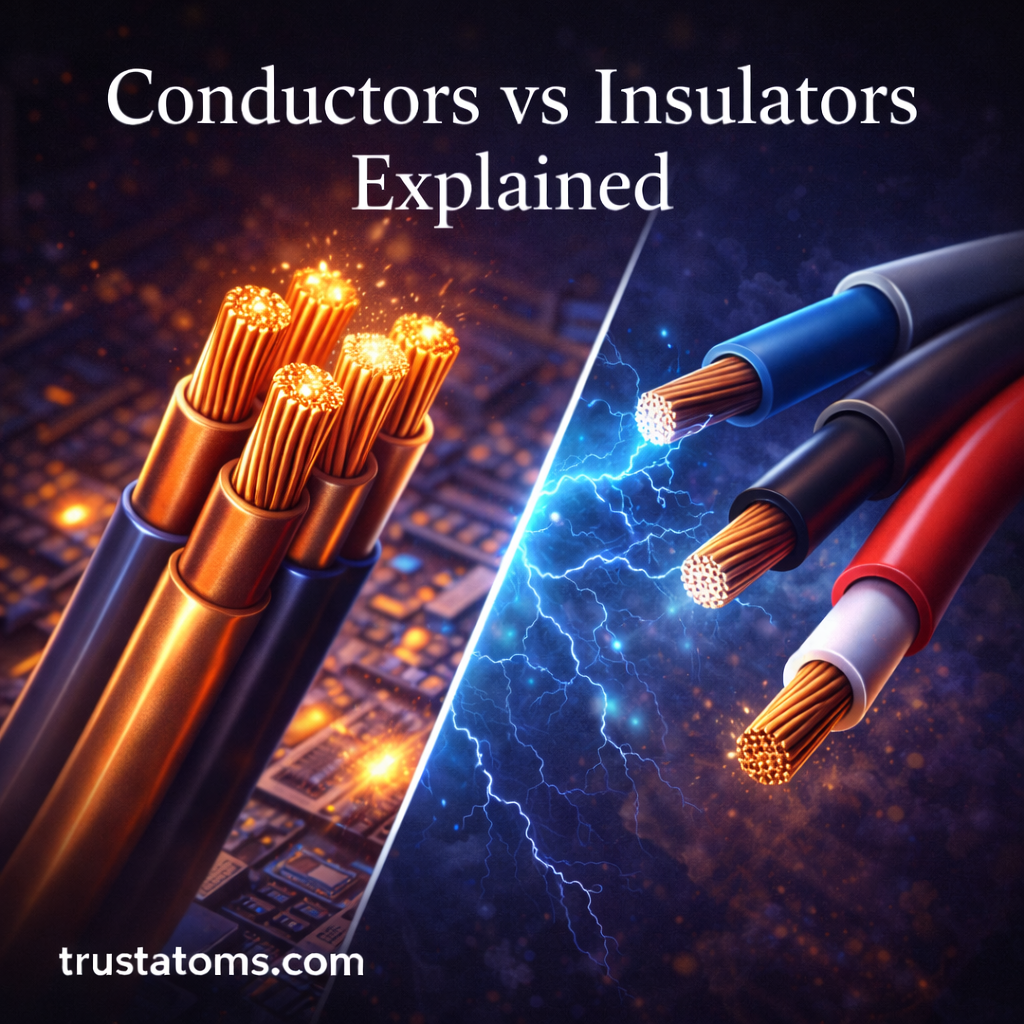
Electricity powers modern technology, from household appliances to global communication networks. But electricity does not move through all materials in the same way. Some materials allow electric current to flow easily, while others resist the movement of electric charge.
These two categories are known as conductors and insulators. Understanding the difference between them is essential in physics, electrical engineering, and everyday electrical safety.
In simple terms, conductors allow electricity to flow, while insulators prevent or restrict that flow.
What Is a Conductor?
A conductor is a material that allows electric charges to move freely through it.
In conductive materials, electrons can move easily between atoms. When an electric field is applied—such as when a battery is connected—these electrons begin to move, creating an electric current.
Because electrons move easily in conductors, they are widely used in electrical systems.
Common Examples of Conductors
Many metals are excellent conductors of electricity. Examples include:
- Copper
- Aluminum
- Silver
- Gold
- Iron
Copper is one of the most commonly used conductors in electrical wiring because it combines high conductivity with durability and affordability.
Other conductive materials include:
- Saltwater
- Graphite
- Human body tissues (which contain water and electrolytes)
How Conductors Work
Conductors work because their outer electrons are loosely bound to atoms. These electrons are often called free electrons.
When voltage is applied to a conductor:
- An electric field forms in the material.
- Free electrons begin moving in response to the field.
- The movement of electrons creates an electric current.
This flow of charge is what powers electrical devices.
The easier it is for electrons to move, the better the material functions as a conductor.
What Is an Insulator?
An insulator is a material that resists the flow of electric charge.
In insulating materials, electrons are tightly bound to their atoms. Because these electrons cannot move freely, electric current cannot easily pass through the material.
Insulators are extremely important in electrical systems because they help prevent unwanted current flow and protect people from electric shock.
Common Examples of Insulators
Many non-metal materials act as good electrical insulators.
Examples include:
- Rubber
- Plastic
- Glass
- Dry wood
- Ceramic
- Air
Electrical wires often contain a conductive metal core surrounded by a plastic or rubber insulating layer.
This insulation prevents electricity from escaping the wire and protects users from contact with the current.
How Insulators Work
Insulators work because their electrons are strongly attached to atoms and cannot move freely.
When an electric field is applied:
- Electrons may shift slightly within atoms
- But they do not move from atom to atom
- This prevents the flow of electric current
Because of this property, insulators are used to separate conductive materials and control the direction of electricity.
Without insulation, electrical systems would be dangerous and unreliable.
Key Differences Between Conductors and Insulators
The main difference between conductors and insulators is how easily electric charges move through the material.
Conductors
- Allow electric current to flow easily
- Contain free-moving electrons
- Usually metals
- Used for wiring and electrical components
Insulators
- Resist the flow of electric current
- Electrons are tightly bound to atoms
- Usually non-metals
- Used for electrical safety and protection
Quick Comparison
Conductors and insulators differ in several important ways:
| Property | Conductors | Insulators |
|---|---|---|
| Electron movement | Free electrons move easily | Electrons tightly bound |
| Electrical resistance | Low resistance | High resistance |
| Typical materials | Metals | Rubber, plastic, glass |
| Common use | Electrical wiring | Protective insulation |
Materials That Fall Between: Semiconductors
Some materials fall between conductors and insulators. These materials are called semiconductors.
Semiconductors conduct electricity under certain conditions, such as when temperature or voltage changes.
Common semiconductor materials include:
- Silicon
- Germanium
Semiconductors are the foundation of modern electronics and are used to build:
- Computer processors
- Transistors
- Solar panels
- Microchips
By controlling how electricity moves through semiconductors, engineers can design complex electronic systems.
Real-World Applications
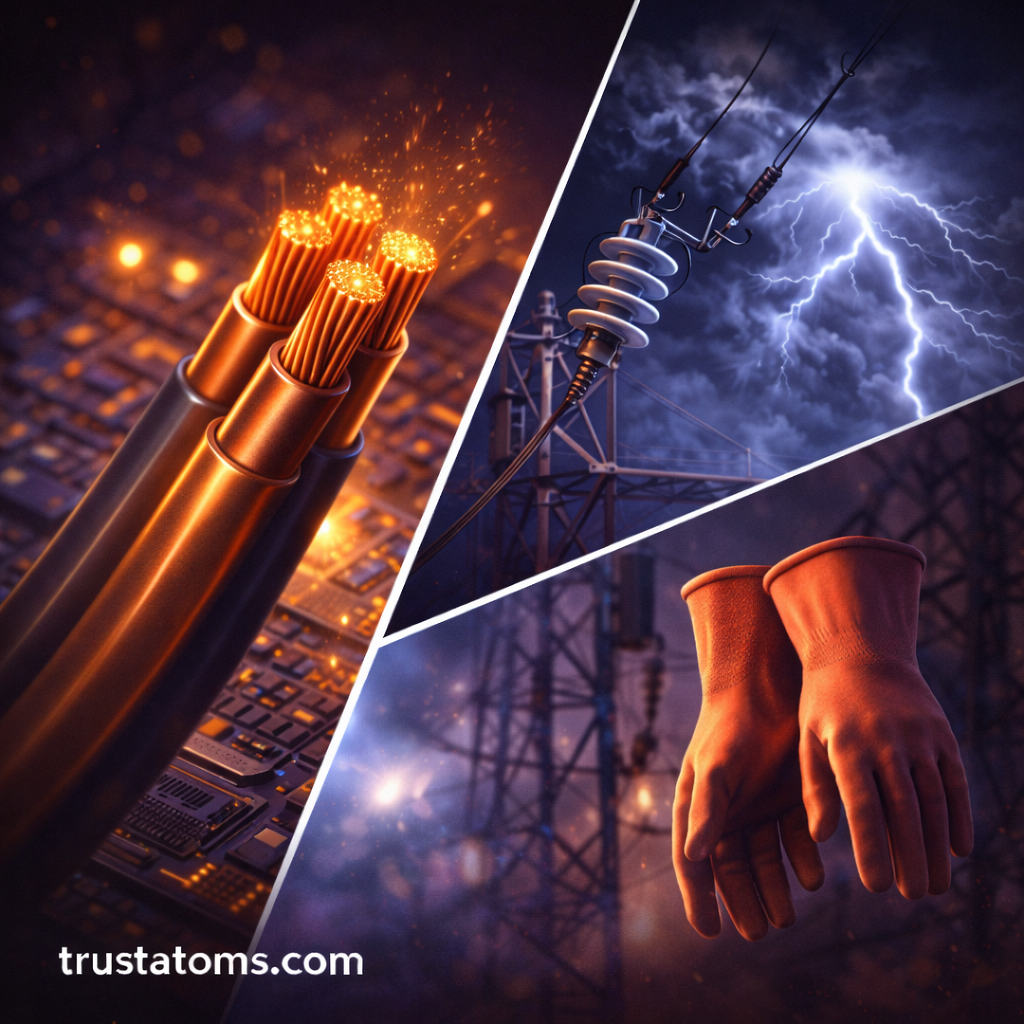
Conductors and insulators are used together in nearly every electrical device.
Electrical Wiring
Household wiring typically uses:
- Copper or aluminum conductors to carry electricity
- Plastic or rubber insulation to protect users
This combination allows electricity to reach appliances safely.
Power Transmission
Power lines carry electricity across long distances using conductive materials such as aluminum.
Insulators made from glass or ceramic hold the wires away from towers and prevent electricity from leaking into the structure.
Electronic Devices
Inside electronics, conductive materials form circuits that guide electrical signals.
Insulating materials separate circuit components so electricity flows along specific paths.
Without this separation, electronic devices would malfunction.
Electrical Safety Equipment
Insulating materials are used in protective equipment such as:
- Rubber gloves used by electricians
- Insulated tools
- Protective coverings for electrical cables
These materials reduce the risk of electric shock.
Why Understanding Conductors and Insulators Matters
The difference between conductors and insulators is essential for designing safe and effective electrical systems.
These concepts help engineers:
- Build reliable electrical circuits
- Prevent short circuits
- Protect people from electrical hazards
- Improve energy efficiency
They also help explain how electricity behaves in both natural environments and human-made technologies.
Final Thoughts
Conductors and insulators are two fundamental categories of materials that determine how electricity flows. Conductors allow electric charges to move easily, making them essential for wiring and electrical systems. Insulators resist this movement, helping protect people and control the direction of electric current.
Together, conductors and insulators form the backbone of modern electrical infrastructure. From household appliances to global power grids, these materials make it possible to use electricity safely and efficiently.